




By Jennifer Gomez
On the last day of its 2026 session, the U.S. Supreme Court did something rare – it told the president no.

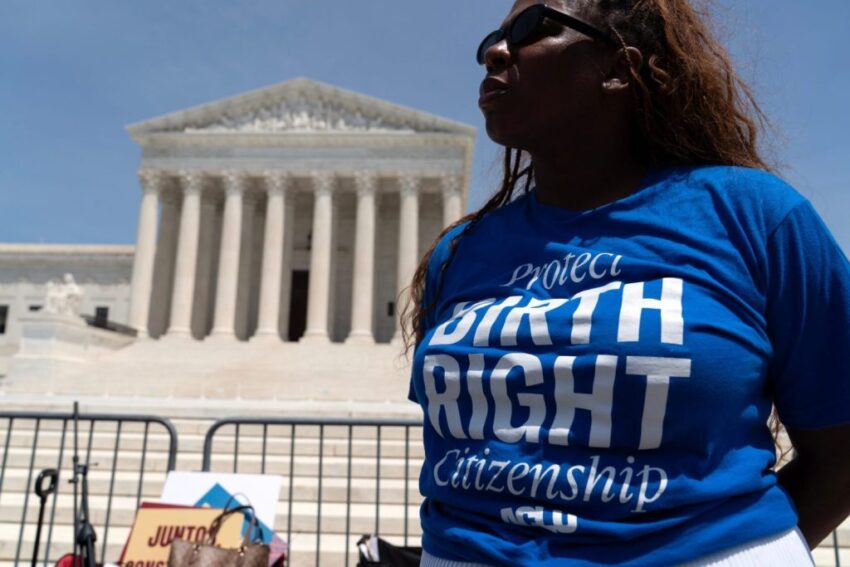
In a 6-3 ruling Tuesday, June 30, the Supreme Court upheld birthright citizenship, the understanding that a child born in the United States is automatically a citizen regardless of their parents’ immigration status, blocking an executive order President Trump signed on his first day back in office.
Chief Justice John Roberts wrote the majority opinion, citing the 14th Amendment and stating citizenship is “the right to have rights – to freely participate in our political community,” to “every free-born person in this land.”
I am a political science student and a legal intern in El Paso. More crucially, I am the daughter of a border city that has lived at the epicenter of debate my entire life. I want to tell you what the ruling really means when you strip away the cable news noise and examine what was truly at stake on the ground, and in my hometown.
El Paso sits directly across from Ciudad Juárez, Mexico. Families do not merely live near the border; they live across it, every day. Children are born in El Paso hospitals to parents who cross legally for work, family visits, and medical care.
An average of 255,000 children are born every year in the United States to noncitizen parents. In a city like mine, this number is not simply an abstract statistic. Those are our friends, our neighbors, our classmates, our communities.
Had Trump’s executive order been allowed to stand, like something out of a dystopian novel, those children – born on American soil, in American hospitals, raised in American cities – would have been rendered stateless. Not American citizens. Not Mexican citizens. Nothing.
This would imply that a child, born in El Paso hospitals to a mother who crossed legally on a tourist visa, would grow up in legal limbo in the only country they have ever known.
While the ruling upheld birthright citizenship, it does not resolve the political discourse surrounding it, and it will not be going away. Within hours of the ruling, Trump took to Truth Social to state that Congress could end birthright citizenship, writing “Congress should start TODAY.”
It is worth noting that, in actuality, changing birthright citizenship would require a constitutional amendment – a two-thirds majority vote in both chambers, then ratification by three-fourths of states – and not a singular act of Congress. This has not stopped the framing from taking root. It rarely does.
The anti-birthright citizenship movement relies on a particular rhetoric: treating children of immigrants as threats rather than as Americans.
The term “anchor baby” – dehumanizing and politically deliberate – has floated through this debate for decades. What it truly means, stripped of its euphemisms, is that we should punish children for the circumstances of their birth. It means that we should look at a child born in an El Paso hospital and, before she takes her first breath of Texas air, decide that she does not belong here.
The ACLU’s Cecillia Wang, a birthright citizen herself, argued the case before the court in April, saying “in America, we do not punish children for the sins of their fathers, but instead we wipe the slate clean. When you’re born in this country, we’re all American, all the same.”
Border towns understand this viscerally in a way that Washington rarely does. In El Paso, the line between documented and undocumented often runs through the middle of a single family. Grandparents hold permanent residency, parents hold work visas, and children are citizens.
That is not an anomaly; that is the life in a binational community that existed long before the current political movement and will continue to exist long after it.
The high court ruling is a victory, but it is an incomplete one. There is the argument that the ruling could strengthen arguments for increasing deportation, removing undocumented parents before they can have children on U.S. soil. The conversation is already shifting, and the fight is moving right along with it.
For my neighbors, my community – the ones who grew up at this border, who see the costs of these policies not in think tank reports, but in the faces of the people we grew up with – the lesson is the same one that it always is: a court ruling is not the end of a fight. It is one moment in a longer struggle. A struggle to protect the only community and home we have ever known.
The Constitution held Tuesday. Tomorrow, the work continues.
Jennifer Gomez is a resident of El Paso’s Lower Valley and a political science and legal reasoning student at the University of Texas at El Paso. She is currently an intern at the El Paso County Public Defender’s Office.
The post Opinion: What the Supreme Court’s birthright citizenship decision means for El Paso’s border community appeared first on El Paso Matters.
Read: Read More