




The decision by the Texas Higher Education Coordinating Board to not pay El Paso Community College – and its statewide peers – all the money the colleges earned through student performance outcomes could affect EPCC employees and El Paso homeowners.
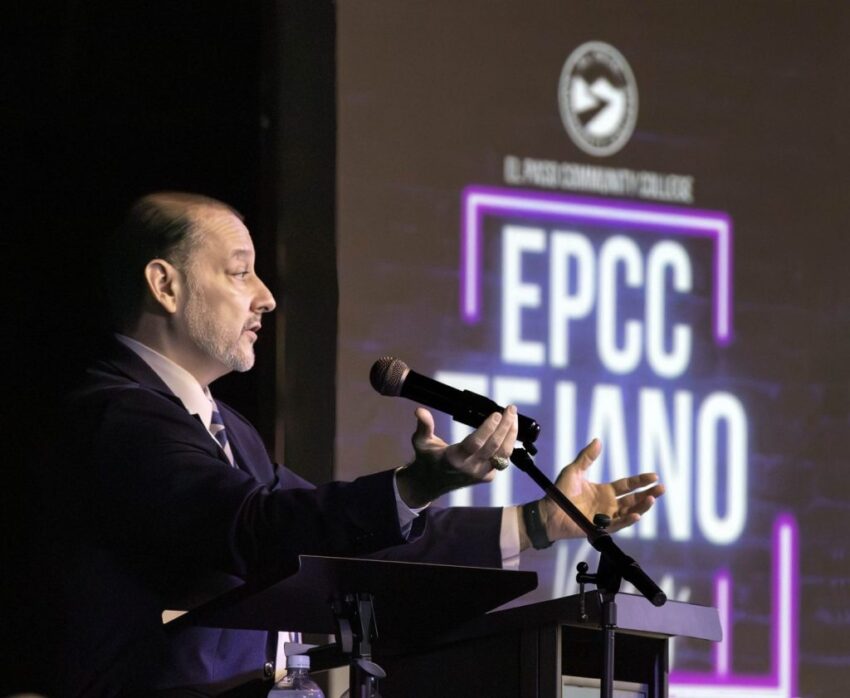
The situation was discussed at a special Board of Trustees meeting June 25 in the college’s Administrative Services Center.
Fernando Flores, EPCC’s vice president of finance and administration, called the THECB’s June 10 announcement “an appropriation funding surprise.”
Under the approved financing formula from 2023, the coordinating board was supposed to award EPCC about $43.9 million in 2025, but it only approved $40.9 million. This year, the THECB was supposed to send the college $40.9 million for fiscal year 2027, but instead will direct a prorated $35.9 million. Altogether, that is a loss of $8 million.
“That’s a really hard hit coming out of nowhere,” Flores told trustees during a preliminary presentation of the 2026-27 budget.
The coordinating board said those institutions had outperformed projections and earned more than the $1.2 billion the state had allocated for this fiscal year.
In a statement to El Paso Matters, the coordinating board said it will be up to the state Legislature during its 2027 session to consider a supplemental appropriation. Additionally, the THECB stressed that colleges, on a statewide basis, are receiving more funds than under the previous system.

Flores told the trustees that the college has few revenue streams to make up for the loss. The vast majority of its income – 94% – comes from property taxes, state appropriations, and tuition and fees. With the appropriation determined and the state’s directive to freeze tuition and fees for the 2026-27 academic year, the only option to raise additional funds is the property tax rate.
After the special meeting, EPCC President William Serrata explained the possibility of a tax increase, adding that the college is the lowest taxing entity in a property owners’ tax bill.
A 5% increase would raise the average homeowner’s property taxes by $11.73 annually, while a 6% increase would mean about $14 more per year. Those increases would generate $3.9 million to $4.7 million, respectively. The college based its numbers on an average value home of $240,564.
While some employee representatives from the classified and professional staff associations and the faculty association have requested up to a 6% raise, Serrata said a 2% raise might be more realistic at this time.
Albert Burnham, leader of EPCC’s Faculty Association, said he was saddened by Flores’ pessimistic preliminary budget report, and that he understood the college had limited options. He called the possible property tax rate hike a “radical” solution, but added the college does not have many options.
“As a property owner, I think it’s funny that I may have to pay more (in property taxes) to get a raise,” he said. “I’m disappointed.”
When asked about a possible supplemental appropriation, Serrata estimated that it would need to be about $400 million for the state’s 50 college districts.
When reminded that the state has a “rainy day fund” of more than $70 billion, Serrata joked that it would take a lot of rain to get the colleges the money they are owed.
“It would have to be pouring,” Serrata said. “It would have to be hurricane-like conditions.”
Regardless, he said the community colleges will advocate for it.

Members of El Paso’s state delegation, Rep. Mary González, vice chair of the House Appropriations Committee, and Rep. Vince Perez, a member of the House Higher Education Committee, said that the Legislature will need to consider a supplemental appropriation to close the gap of what is owed the community colleges.
“I’m deeply concerned (about) the loss of funding for El Paso Community College and the impact this will have on students and families across our region,” González said in a statement to El Paso Matters. “Our community colleges should not be punished for overperforming, overachieving, and producing quality educational opportunities.”
The lawmaker went on to say that the governor’s office, Legislature and coordinating board should take steps to minimize the effect of these prorations and commit to fully funding community colleges at the levels they earned. She committed her office to fight for additional funding for community colleges during the next session and to find ways to restore any money that they lost.
Perez added that the finance model worked better than projected, and he believed that it just needed to be tweaked to address the positive outcomes by the colleges.
“This is a successful structure, and our job now is to make it sustainable,” Perez said in a text to El Paso Matters.

The Texas Legislature voted unanimously for House Bill 8 in 2023, which revolutionized community college funding. The previous method was interested in the number of enrolled students, the number of courses they took and amount of time they spent in class. The new model focused on outcomes such as completions of degrees and credentials of value, transfers to four-year universities, and securing jobs in high-demand fields. If the colleges outperformed their expectations, the understanding was that they would get additional state funds.
Brian Haggerty, chairman of the EPCC Board of Trustees, blamed the coordinating board for the mix up, and thought it was wrong that state leaders were telling their community college districts to “suck it up,” or, in other words, continue without complaint.
“We went along with (the coordinating board’s plan) and it didn’t work,” he said. “It’s not our fault.”
As for EPCC’s current budget situation, Haggerty said that the college’s leaders have acted cautiously and should be able to get the institution out of the deficit quickly, but he was still miffed with the coordinating board.
“We did what we said we were going to do,” Haggerty said in terms of meeting agreed upon metrics. “Give us our money.”
The post EPCC’s $8 million state funding loss could affect raises, property taxes appeared first on El Paso Matters.
Read: Read More