



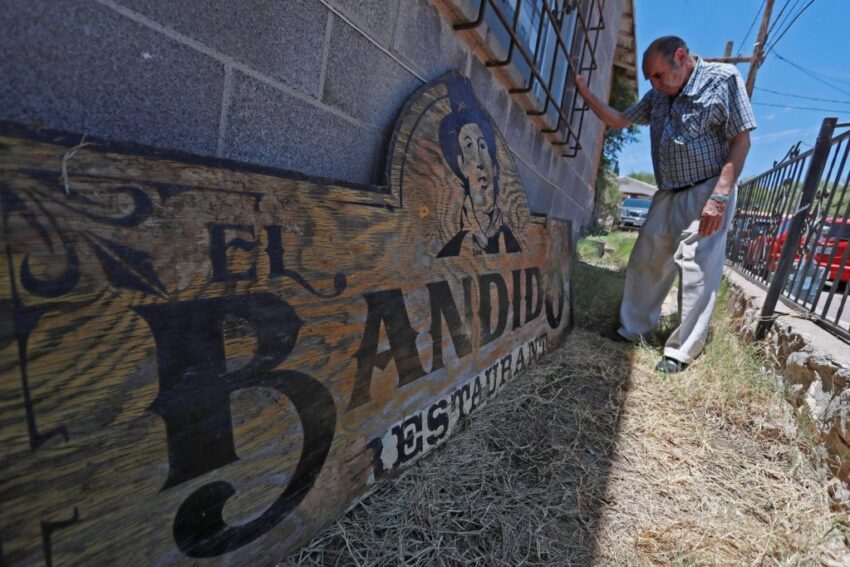

Anne Giangiulio moved to the Borderland in 2004 to teach graphic arts at the University of Texas at El Paso. One of her strongest memories from that time was the abundance of hand-painted signs on businesses around the city, especially around Segundo Barrio.
Giangiulio, a native of Philadelphia, immediately fell in love with the signs, but questioned why they would still be used given available technology. She quickly learned that the signs that often combine words, numbers and images are a cultural connection to Mexico.
“The visual language struck me,” she said about her efforts to promote the work of these overlooked artists through interviews, an upcoming book and “El Otro Muralismo: Historical and Contemporary Sign Painting in El Paso and Ciudad Juárez,” an exhibit that opens July 11 at the El Paso Museum of History, 510 N. Santa Fe St.
Giangiulio, an associate professor of art, is a fan of vernacular signage. She calls it a type of folk art that exudes soul and purity. She sees the beauty and elegance in simple brushstrokes, and a uniquely El Paso mindset of confident artists willing to experiment.
“I can literally see that in the signs when I look at them, and that got me really excited,” she said.

While intrigued by the sign work, other projects kept her from focusing on sign painting until last year. A book she found about sign painters led to her suggesting a small exhibit at the history museum. Officials agreed with the concept, but they wanted something bigger.
Her research into the topic came at the same time that there was a request of proposals from UTEP Press last October. Giangiulio submitted her idea and the publisher approved it two months later.
“Rotulistas: Sign Painters of El Paso,” will be the first book she authors. A university colleague suggested she contact UTEP’s Institute for Oral History to help with the interview process.
During a recent tour of streets in Segundo Barrio, Giangiulio got excited about the different hand-painted signs she saw and would shoot photos with her cell phone camera. She commented on the artists’ choices of colors, the use of shadows, contrasts and asterisks.
“This is like Shangri-La,” she said, comparing her findings to an earthly paradise.
Giangiulio has interviewed about nine artists so far and she expects to speak with at least another five for her book, which should be published next year. She divides the interviewees into two categories: old guard and legacies. They include Sergio Chavez and Monica Chavarria.

Chavez, 85, is an old guard. He started painting signs for his father’s company after he graduated from El Paso High School in 1959. Most of his work consisted of lettering for businesses on their walls or the sides of their trucks. He started his own business, Sign Painting Co., in 1972.
When asked what he liked about his trade, the eyes of the West-Central resident got big.
“The money,” he said with a laugh. “I found out you could make a lot of money with one little can of paint.”
Sign painters, or “wall dogs,” earned from $7,000 to $11,000 a year in the 1960s in El Paso. In 2026 dollars, that equals $73,000 to about $116,000. He said he was able to raise a family on his earnings.
While the money was good, he admitted to also liking the creative aspects of the work, whether in what was painted or how to make the project better, easier or less expensive. He said computers were the game changers. They extended the professional lives of many sign painters, especially those with failing vision.
“You needed to keep up with the times,” said Chavez, who retired in 2016. “You’d fall behind if you rejected (computers).”

Chavarria, 26, is a legacy artist. She is an El Paso native who grew up in Amarillo and earned a degree in media video production in 2020 before returning to her hometown where she also does freelance design and videography work.
She will be one of the exhibit’s featured artists. Hers is supposed to be the first painted sign exhibit patrons will see. The concept is still being finalized, but it will be in the rotulista style, which is a vibrant, traditional style of hand-painted street advertising found in Mexico.
The young artist said she became familiar with the style while visiting family in Chihuahua City, Mexico. She saw it on buses, posters and storefronts. The work fascinated her. She did not realize how prevalent it was in El Paso until she moved back.

She is a self-taught sign painter who designed a traditional-style font for her projects, which usually focus on words using vivid colors.
“I use bright pink a lot because it is so vibrant,” Chavarria said during a telephone interview. “It’s one of the main reasons I love this style because of how vibrant it is. It’s very inviting. I just love how alive it feels.”
The work done by the likes of Chavez and Chavarria lend to the Borderland’s visual landscape, said Erica Marin, director of the El Paso Museum of History. She said interest in sign painters has been trending up for the past 10 years, so she was thrilled when Giangiulio suggested the exhibit.
“It’s an exciting painting genre,” Marin said.

Quetzaly Segovia, the museum curator, said the exhibit will include a variety of contemporary works of the featured artists from El Paso and Juárez, and a historical component. She added that there will be scheduled programs while the exhibit is up to include a panel discussion with participating artists.
Giangiulio said one of her favorite exhibit sets will be the “kitchen,” a re-creation of an artist’s studio to include drafting boards, cloth bundles filled with chalk or charcoal powder, and empty coffee and hominy cans filled with paints, brushes and other tools.
“It’ll look like a disaster, but it’s where all the amazing stuff comes from,” she said. “I’m excited about all of it.”

Yolanda Leyva, who ended her tenure as director of UTEP’s Institute of Oral History in June, said she was happy to add the stories of El Paso’s sign painters to the collection, and was glad that the exhibit would incorporate the interviews at listening stations.
“It adds a lot to hear someone’s voice,” said Leyva, a UTEP professor of history.
She praised the project for its creativity and for highlighting the importance of the sign painters’ voices as artists and entrepreneurs.
“I don’t think anyone before has thought to get the stories of these talented people,” Leyva said. “I think (the exhibit) is going to be great.”

Giangiulio and Marin mentioned how these artists are craftsmen who often work in anonymity. Both hope the exhibit, which closes July 11, 2027, will change that.
“There’s so much talent, so much variety of style just within this city,” Giangiulio said. “These folks are so talented and still doing it everywhere, but flying under the radar.”
The post Exhibit celebrates El Paso, Juárez sign painters’ overlooked artistry appeared first on El Paso Matters.
Read: Read More