



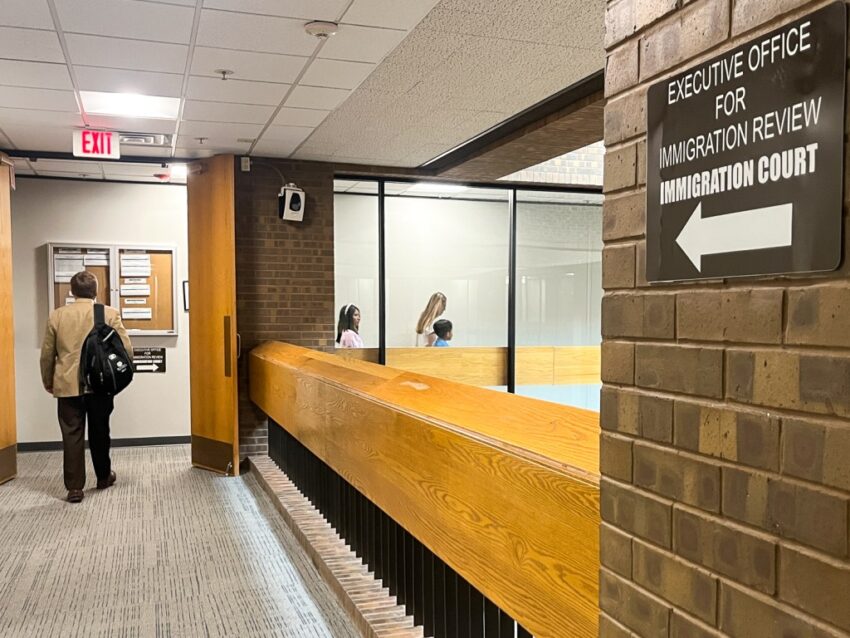

Diego Mendoza-Moyers: Inside small, chilly court rooms in Downtown El Paso, unaccompanied migrant children are facing immigration judges often without an attorney to help them understand the legal system and the proceeding to remove them from the country.
It’s a cold, procedural system in which minors’ cases are being fast tracked even as the few attorneys representing some of these children say they have little time to form a case for why their client should be allowed to stay in the U.S.
El Paso Matters Editor Cindy Ramirez has been attending court hearings in which children are either voluntarily or forcibly deported from the U.S. In just a moment, I’m going to talk with Cindy about her emotional reporting showing how the system churns through these childrens’ cases and why migrant advocates say the government is moving rapidly – and, at times, sloppily – as it seeks to rapidly deport migrants from the country.
First, this El Paso Matters Podcast episode is brought to you by our podcast title sponsor Tawney, Acosta and Chaparro, truck crash and injury attorneys. Their team of local, seasoned trial attorneys are ready to help if you’ve been injured in a crash.
And you can read our free reporting or sign up for our newsletter at our website, elpasomatters.org.
On to the show.
Cindy, thanks for joining me.
Cindy Ramirez: Thank you for having me.
Diego: Before I get into specific questions, can you just kind of give us an overview of your reporting and what you found as it relates to unaccompanied minors left here in El Paso, right, and elsewhere on the border?
Cindy: Sure. So, as part of my beat coverage of all things immigration, this was something that’s been happening around the country for some time. And I think we sometimes forget that it’s also happening right in our backyard, probably more so than in other places.
But we had noted that there had been an increase in the number of unaccompanied minors who were in immigration court. So, the dockets were getting longer. And they were also being expedited.
So, it was something that was happening across the nation. And we decided to see what was happening in El Paso. And, as we checked in with some of the nonprofit organizations that provide legal services to these children in particular, and then just looking at some of the dockets in immigration court, we realized that it’s definitely happening here and probably more so than many other communities. So, we spent a couple of weeks in different immigration judges’ courtrooms and sat through a lot of hearings and a lot of the process.
Diego: It was a very emotional story when I read it about hearing about these – they’re children, right? And, a lot of times, with no representation or anything. Don’t really speak English, right, a lot of times, and they’re trying to navigate this complex and opaque system.
And, so, it was an interesting – it was emotional, but also showed maybe how the system is sort of working, I guess, for some of these unaccompanied minors that are here in the U.S.
One of the main questions I had, Cindy, was you talked with some of the lawyers representing some of these children. And it just struck me that some have legal representation and others don’t. And, so, can you just talk about how do some of these unaccompanied minors acquire legal representation and why do only some of them have lawyers?
Cindy: The vast majority of them don’t. So, the unaccompanied minors are 17 and younger. Sometimes we see 5-year-olds, 7-year-olds, 10-year-olds, and then teenagers sit in front of a judge without, not just no legal representation, but also no adult.
And, basically, the few who do happen to have representation I would say is mostly by luck.
There are a couple of nonprofit organizations such as Estrella del Paso, which is part of the Catholic Diocese of El Paso, and they offer free or reduced legal services. They do have a program that’s specific for minors. So, they have a handful, have a handful of attorneys that help handle some of those cases.
But you’re seeing 20, 30 cases at once, and maybe two of those will have an attorney with them. Sometimes the minor’s parents, even if they are now abroad, maybe they’ve been deported or they were never in the country in the first place, might be able to connect with some of these nonprofits that offer some of these services. But other than that, I mean, they don’t really have a lot of recourse.
Diego: And just to be specific, these children were mainly brought here by their parents or arrived in the U.S. in the last few years for the most part, would you say?
Cindy: It’s about half and half. Some of the older teenagers, the ones that are maybe like 15, 16, some of them may have come on their own or with groups to the border and crossed unlawfully and got detained there.
And many others, however, did get detained in the interior of the country, separated from their parents at the time that their parents were maybe being detained – literally torn away from them at the time that they were being detained, or came home from school to find their parents were gone. And then had no other parent or legal guardian in the country to take care of them. So, then they become unaccompanied.
Diego: Can you just kind of talk through your personal experience covering this story? And you spent time in the courtrooms, right? And you kind of wrote descriptively about how the children looked and just their mannerisms and maybe some tears shed or nervous energy, things like that.
What’s it like for you just as a person to be in court and watching this play out where the vast majority of these kids are trying to navigate the system with no representation?
Cindy: It was very eye-opening. Because we couldn’t necessarily interview the children themselves, we couldn’t hear in a lot of cases from their own words other than what was being said in court. And it’s very little of what the children actually can say or do say.
So, it was important for me to describe the feeling and describe the kids and try to maybe get across some of what I thought that they might be going through. So, it was certainly very moving to see these kids, children in some cases.
I opened my story with a 7-year-old that was particularly moving, but you think that every child in there has a story and we don’t know it, right? And, so, part of what I try to do is to tell that story best I can.
But the court process itself is unlike anything that you maybe see on TV, right? These courtrooms are very small, they’re cold, they’re quiet. It’s very procedural, very impersonal.
As you mentioned, none of the kids speak English, so they have to talk through a translator. A translator is usually there virtually, or sometimes not at all, and they’re just a voice over an intercom. So, the kids are trying to communicate with the judge and with the government prosecutor and answer questions, and all they’re hearing is a voice, a translator coming through. And, so, I think that’s very challenging for them.
Diego: Kind of a cold, hard, unfeeling system, right?
Cindy: Yeah. And it’s because it’s a court procedure after all, so many of us would have difficulty following it, and they’re throwing acronyms around and talking about these documents by “A” this and “B” that. And, so, as an educated adult, it’s hard enough to understand the process. So, imagine a 7-year-old that’s sitting there, they have no idea really what’s happening.
Diego: Yeah. One anecdote that stood out for me in your story was when the judge that was overseeing some of these cases told these children, like, “Make greater efforts to acquire legal representation.” It left me wondering, like, what could these children do to acquire representation, right? Is that even possible?
And, so, the judge kind of saying that, it just stood out to me, to these children that aren’t even really understanding what’s going on. Just the comments stood out to me.
Let me say this, too. So, another part, too, is, like, these aren’t just normal children, right? Like, they’re children that have probably gone through something ahead of this. And one thing that was powerful – I guess it was a photo in your story and you were speaking with an employee at Estrella del Paso, this organization that represents some of them. I don’t remember her exact title. But there was a photo of this stuffed animal that was kind of one of these stuffed animals with big eyes, kind of sad-looking eyes. And apparently this employee uses that to comfort these children, right?
And, so, that was just a really powerful thing because it shows you, like, a lot of these children have been through a lot. Apparently some are very medicated to try to handle the trauma and (anxiety). And, so, can you just kind of talk through that because that was a very powerful image, even though it was just of a stuffed animal.

Cindy: Yeah. So, her name is Lola, the stuffed animal. The director of the Children’s Services Program at Estrella, Natasha, uses Lola, who’s this gray little puppy with big ears and pink bows, to break the ice with some of these children who are very shy. They’ve been through a lot. They don’t really want to talk to anybody.
The 7-year-old that we talked about in our story in particular hadn’t wanted to eat, hadn’t wanted to talk to anybody. So, just like a trauma counselor uses or first responder uses stuffed animals to try to communicate with the children, that’s kind of like the purpose, is to kind of break the ice with them.
Sometimes, the children will talk to an animal and they’ll play talk more than they do to a scary adult that they’ve never met in their life, even if that adult has good intentions. So, very powerful, a way of helping the children cope and open up and communicate with them.

Diego: And can you talk about the medication aspect that was a little bit jarring to me?
Cindy: Right. So, in some cases, because these children have gone through a lot, they are put on some medications.
The one that I referenced was that 7-year-old. And he had appeared in court previously, but he fell asleep, is what the attorney is telling me, because he was medicated and they couldn’t wake him up during that other hearing. So, that other hearing got continued on to this next one that I covered.
So, I mean, this was a 7-year-old who was having some behavioral issues. He was kind of lashing out. His father had been deported previously, maybe a month before. And so, he was alone and he was scared and they put him on medication.
Diego: Yeah. It’s just a tough thing to kind of process and think about – children, again, facing this kind of cold hard system alone. And experienced trauma and having to be medicated to deal, like you said, with the anxiety and so forth. Just kind of dystopian, I guess.
But let me ask you this, too, Cindy. I’m wondering, can you just talk about the cost to go through this process and clarify this a little bit? Because you wrote that, I think, an initial application was about $100. And, so, can you just kind of clarify exactly what that is?
And then you also said that, after a ruling has been made on any of these children’s cases, that they can file an appeal, right? But it costs like $1,000. And, so, can you just kind of talk about those various costs? How do these children pay for that? Do they? How does that work?
Cindy: Yeah, very few of them do. These are basically, like, filing fees with the government. So, you’re filing a legal document with the government. It’s not so much part of the court procedure, but you’re filing a document, whether it’s (because) you’re seeking asylum, or whether you’re filing an appeal to a judge’s ruling. Whatever the case might be, every time you file a document with the government, it costs $50, $100, $1,000 or more. These fees are what the government says are necessary to process the paperwork, to record-keep and all of that.
But a lot of these children, obviously, are children. They don’t work, they don’t have this income at their disposal. Maybe they have a parent or a friend. Sometimes these nonprofit organizations are able to help pay those costs for them.
But, as you mentioned earlier, when you’re telling a child, “Try harder”, what else is left for the child to do?
Diego: Yeah. And that brings up – because one question I had was, is Estrella del Paso and organizations like that, are they covering these costs? And then the secondary question was, like, there’s not unlimited funds for those kinds of things, right?
Cindy: Not at all. There’s actually a lot fewer funds. In the past – so, for children, specifically for unaccompanied children, Congress has allocated funds in the past to help give these children some representation. And, so, federal funds have been used to reimburse some of these nonprofit organizations that provide some of these services, aside from some of their own fundraising and things like that.
But some of that money, or a lot of that money, comes from the federal government. Over the last year and a half, the Trump administration has tried to cut some of that money unsuccessfully, but they have also changed the process so that it becomes more difficult to get those funds.
SEE ALSO: Dismissed, then detained: Immigrants face swift deportation after El Paso court hearings
Diego: Yeah. And I think we had some reporting out yesterday that the Trump administration is denying several hundred thousand dollars in funding to Estrella del Paso, right? Kind of jeopardizing the organization.
Cindy: Very much so. I remember it was like $250,000 or more that they’re owed in reimbursements. This was money that was supposed to go to them that was already approved by Congress. But the Trump administration has failed to provide that reimbursement to them. And, so, Estrella del Paso is one of the organizations that is on the brink of closing if they don’t get this money.
I mean, they’ve already had to shrink a lot of their services in the last couple of years. They’re working with maybe half the attorneys that they were just two years ago. And I know that there’s been other times where they’ve had to temporarily shut down or stop offering certain services. So, it’s just kind of ongoing.
Diego: So, one of the few organizations providing legal representation is now saying “Maybe we don’t have the funding to continue providing these services.”
Cindy: Correct.
Diego: One thing I meant to ask earlier, Cindy: Where are these children living and where are they staying when they’re in the U.S. and without a parent?
Cindy: Great question. So, the children are technically under the care of the Office of Refugee Resettlement. So, through that office, they are placed in shelters that are under government contract to provide that. Some of them are, like, in foster homes. And those facilities then provide them, of course, some of the basic necessities. And then they are also the ones that get them to and from court as needed.
Diego: Is the care adequate, would you say, or the conditions?
Cindy: We are currently looking into that. It’s not, like, an ICE detention facility like Dilley or Camp East Montana or anything like that. So, certainly not anything like that. But whether they’re providing the adequate care, we haven’t heard otherwise, but we also haven’t quite looked into that.
Diego: So, kind of back to the legal process, Cindy. An attorney you spoke with, he said, essentially, immigration authorities and the government have been maybe sloppy, at times, might be the word, right?
Like, I think misspelling names or maybe misrepresenting the nation of origin, things like that in the legal documents. And, so, can you just kind of talk about that, what you saw with regard to this idea that the government is giving little time for migrants to contest their removal proceedings, you know, getting things wrong? Like, what did you see in that area?
Cindy: So, we had already had interviews with Estrella del Paso and other attorneys and had noted that these errors were happening, but sitting in court and hearing it was very different.
So, of course, as part of their defense of these children, they need to look at that – all of the t’s were crossed and the i’s were dotted. And in doing that is when they came across a lot of these issues, which could be very dangerous for the children. Because, for example, one of the mistakes that was in some of these were their country of origin was incorrect. So, imagine that this child gets deportation orders and they don’t have an opportunity to really talk to anybody to correct this paperwork. So, what do you do?
In some cases, somebody’s name was misspelled, which is maybe less of an issue, but what if somebody else has a similar name? They had the wrong ages in many cases, whether it was Border Patrol or Customs or ICE. Some of the documents weren’t signed. And so the paperwork in a sense became inadmissible.
Diego: OK. So, it just seems like the lawyers representing these children have things to point back on and say, “Hey, the government needs to handle this and that better, essentially, and be more precise and accurate.”
Cindy: Right. And, in some cases, the judge, with the agreement of the government’s attorney – with the prosecutor – would agree to give the prosecutor time to go and see if they could correct the paperwork. Other times, depending on the case, they would say, “No, this is too many errors or a grave error that we can’t move forward on.” So, it’s inadmissible, and they went from there.
Diego: So, just going forward – before I get to the last question – I just want to ask, what are you expecting in the near future here? Just for these deportations to continue, basically? As long as the government can, like, charter planes, right? That’s kind of the limitation. But can you just kind of like – you expect this process to continue playing out as it has for the foreseeable future?
Cindy: So, definitely a lot of the reports and a lot of the data that we’re seeing is that these cases are being fast-tracked. And that’s part of what has been the challenge for organizations like Estrella El Paso. But the government will say, “Well, we need to take care of these children and we need to either get them home or give them a reason to stay.”
But what the attorneys argue is that it’s not giving them a fair process in court. And, as we know, the Trump administration is looking at fast and massive detention and deportations. And, so, that’s kind of, like, the goal. And the danger in this, right, is that some of these children don’t have the appropriate due process. But the intent is to deport these children.
Diego: Based on what you saw, do you think the children want to stay here? Or what’s your sense as far as, like, do they want to go back home if their parents have been deported? What’s the sentiment of the children regarding that?
Cindy: I think it’s been mixed. I reported on a couple – one young girl, I think she was maybe 16 or 17 years old, who shed some tears in court because she had requested a voluntary departure. And the judge granted her that. So, within 60 days, she’ll be on some flight home. And she wanted to go back home.
There’s a couple of, particularly some of the older juveniles, that they want to maybe remain in the country. They were escaping poverty. They were escaping abuse in some cases. So, some of them don’t want to go back. They want to have an opportunity to stay in the country, to go to school, to work, even at their young age. That’s what some of them came to do. So, very mixed.
Diego: Yeah. And last question here, Cindy, I just wanted to ask you this because you’ve spent the last several – I mean, you’ve covered immigration for a long time, but particularly in the last, five, six years, it’s been a lot of things going on with regard to immigration in El Paso and, various migrant surges.
And we had the period of people – I spoke with some Venezuelan migrants like sleeping in cardboard boxes on the sidewalk, things like that, a lot of tough things. And you’ve covered this a lot more than I have. And, so, I just wonder, like, as you kind of look back in the last few years, and you’re still going to be covering it, but do you have any big kind of takeaway or thoughts on what you’ve seen or just kind of like the human aspect, right?
I mean, you’ve just talked with so many people in very desperate situations a lot of the time, right? And it just seems like a very powerful thing. And I just wonder if you have any kind of high-level thoughts or takeaways from your last years of immigration coverage.
Cindy: I don’t know if they’d be high-level, but certainly just kind of seeing it from the ground up, I think that part of it is immigration has been one of the most divisive and political topics in the last 40 years or so. More so in the last couple of years since the second Trump administration came in because of the rapidness that they’re trying to do a lot of this in with, sometimes, trying to do things through executive orders and the like.
But immigration is one of those topics that has long been very political. Within all administrations, right? I mean, I think Obama still is the president who had deported the most people. And during the Biden administration, we saw Title 42 go away. That was because of COVID, or implemented because of COVID, but it had a lot of implications with immigration.
And I think one of the takeaways for us is that a lot of these policies that are being adopted in Washington really impact our communities here. And even if we don’t see them – I mean, I think even when we had the big influx of migrants who were sleeping on the streets and on cardboard boxes and such, unless you were in that area or you saw it in the news, you didn’t really know what’s happening.
But I think to put that out there to the community to say “it’s happening and it’s happening in our backyards, It’s happening in our front yards, in our homes. It’s impacting our families. It’s impacting our schools because we’re seeing maybe children whose parents are deported or who they are deported and they’re no longer in our schools.” So, people are losing schoolmates and they’re losing neighbors and they’re losing family members to all of this.
Immigration policy changes so quickly too that it’s really hard to keep up with it. So, I know a lot of attorneys, their heads are spinning and trying to keep up with all of this, the judges.
And then of course the people that are impacted by it, the migrants themselves, some of whom we’ve seen had some protections and then they get taken away. So, now they’re a target of deportation when they had been safely in the country previously.
So one of the things that we try to do at El Paso Matters, that I try to do as a reporter, is to kind of merge those two things. What is the policy and how is it impacting the real people? And sometimes telling the story through the people that it is impacting is very different than just telling it from a policy point of view.
Diego: Yeah. And I think, as a resident of the border, sometimes I look at my journalism as, like, for the people of El Paso, about El Paso, right? And not – because I think that, nationally, people look at us as more, like, this immigration gateway. And sometimes I’m thinking, “No, we have a big community here that we have to write about and focus on beyond just the immigration.”
But, of course, being on the border, immigration is such a key part of our community. And so it’s just interesting all the ways that it’s affected us. And these debates in Washington really play out for us here live. And, so, it’s been important and impactful, I think, your coverage on this. And you’re going to do some more coverage today, is that right?
Cindy: Yeah. So, over the next couple of weeks, and as much as possible, be covering some more of these court cases. And in part it’s because many of the cases, with few exceptions, that I have covered with unaccompanied minors in immigration court, they’ve been granted continuances. So, they have an opportunity to come back and maybe file some of the paperwork that they hadn’t. Maybe they were granted a continuance to find an attorney, to try harder to get an attorney.
And, so, what’s coming up soon for many of these children is a hearing where they’ll probably be ordered to be deported. And then, at that point, these children will very likely go back to their shelters or their foster homes for a couple of days, a couple of weeks, maybe a little bit longer. I think usually they get like 60, 90 days before there’s a deportation flight that can be found for them.
And they work with the embassies and consuls from these different countries to receive the children. And, so, arrangements are made very quickly for them to board a plane and head home.
Diego: Yeah, it’s very interesting that there’s such a deep human element in the emotions of it, but then it’s also kind of met up against this really ice cold system where it’s just systematic and procedural, like you were saying. So, I would just say any listeners, I would recommend to go read your article. It’s very emotional. I think very powerful to put yourself in the shoes of some of these children that, hey, they show up here, they’re here, their parents are gone. How do you navigate the system by yourself? It’s very powerful reporting.
So, anyways, I think we’ll leave it there, Cindy. But just wanted to kind of hear your thoughts on reporting such a tough story, right? I mean, a difficult situation.
And, so, we’ll just kind of look to you to keep us informed on all this stuff that, I think, in the immigration discourse nationally, I think to your point, we forget sometimes about being there in the courtroom and seeing what it’s like to see a tearing-up child that has this cold voice talking to them over the loudspeaker. It’s pretty, pretty cold.
So, anyways, we’ll just hope you keep us informed going forward on this.
Cindy: Thank you. Appreciate it.
The post Podcast: Inside El Paso’s fast-tracked immigration court, where migrant children often lack attorney appeared first on El Paso Matters.
Read: Read More