



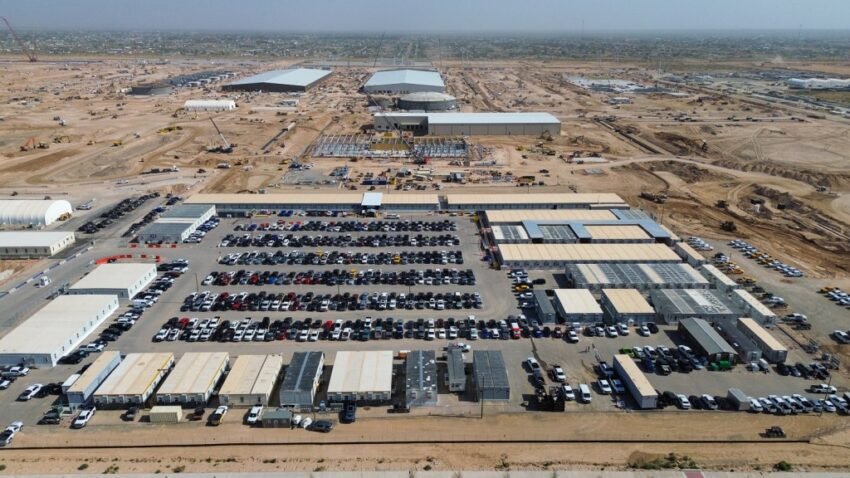

Meta Platforms does not appear to have breached its tax break agreement with the city of El Paso when the technology giant last week sold majority ownership of its data center project to BlackRock Inc., according to the El Paso city attorney’s office.
Meta and BlackRock last month formed a joint venture to develop and operate the data center that’s under construction in Northeast El Paso. BlackRock – the world’s largest asset manager – will contribute cash and own 80% of the project, while Meta will rent the data center and hold a 20% ownership stake.
A BlackRock-controlled company called Sopaipilla Investor sold $12.3 billion in bonds to debt investors late last month to generate cash and finish building the data center over the next two years.

“The City was not provided the terms of the proposed transaction before Meta’s public announcement,” the city said in a statement. “Based on our review of the City’s agreements and the publicly available information, our preliminary analysis is that the proposed transaction does not currently appear to trigger the assignment provisions of the City’s agreements.”
The term “assignment provisions” refers to several clauses in the 2023 contract between the city and Meta subsidiary, Wurldwide LLC, that contemplate what happens if Meta sells all or a portion of the data center to another entity. In most cases, if Meta sold a portion of the data center to another company, the contract would only require Wurldwide to send notice to the city – not ask for approval.
The BlackRock-Meta joint venture “owns Wurldwide LLC (Landlord), which will own and operate the campus,” analysts with S&P Global Ratings wrote in a note detailing the deal. “The project is being developed to help meet the increasing demand for AI computing and will play a vital role in Meta’s AI progress.”
“The City will continue to review any additional information that becomes available to ensure all contractual obligations to the City continue to be met,” city spokesperson Laura Cruz-Acosta said in an email.
The complex and byzantine financial deals underpinning Meta’s data center development – and Meta not briefing city officials beforehand – are a cause for concern, city Rep. Josh Acevedo said.
Acevedo represents District 2, which covers parts of Central, South Central and Northeast El Paso. He acknowledged that Meta likely did not violate the economic development agreement with the city, which granted an 80% break on city property taxes for 25 years as well as $12.5 million in city funds to improve the roads near Meta’s data center.
RELATED: El Paso adopts tougher rules for future data center developments
But Acevedo was critical of Meta for not communicating with the city ahead of the transaction with BlackRock.
“I feel that there’s just no trust with Meta,” he told El Paso Matters. “They’re not a good partner. They’re not telling us of their moves until after they do them. And they’re not even alerting us that they’re moving in that direction.”
Acevedo suggested the city review its sale of 1,039 acres of land to Meta – via Wurldwide – in 2023 at a price of about $8.5 million to determine if the joint venture with BlackRock violates that agreement.
The land sale contract between the city and Wurldwide says neither side can assign, sublet or transfer ownership of the land to an outside entity without written consent of both parties. Wurldwide did not transfer ownership to another entity and it still owns the land and project even after Meta and BlackRock established the joint venture.
SEE ALSO: City of El Paso’s Meta data center incentive agreement to remain in place
“They know that they can get away with whatever they want to. The power is all in their hands,” Acevedo said. “They don’t need to tell us about anything.”
In a statement, Meta said “nothing about Meta’s commitment to El Paso and the entire Borderplex region has changed.”
“Meta’s El Paso data center represents a significant long-term investment in this community – supporting thousands of construction and operational jobs and generating millions in local tax revenue,” the company said.
BlackRock, Meta deal details
Since securing city and county tax breaks nearly three years ago, Meta has made a big investment at the site near the Texas-New Mexico state line. The company valued the land and the partially-constructed data center assets that it put into the joint venture at $2.3 billion combined.
“We’re excited to partner with Mark (Zuckerberg) and the Meta leadership team on the El Paso data center campus, which will create thousands of skilled jobs and help drive economic growth in the local community,” Larry Fink, chairman and chief executive of BlackRock, said in a statement.
Meta said the BlackRock transaction will have no impact on day-to-day operations at the data center, and that all of its binding agreements with the city, El Paso Electric and El Paso Water remain in effect.
READ MORE: Meta data center expected to become city of El Paso’s largest property taxpayer
Meta may have developed a kind of template for how to pay for the multi-billion dollar data center campuses the company is building around the country.
Meta used a similar deal to offload majority ownership of its Hyperion data center in Louisiana to Blue Owl Capital, a different asset management firm. Much like its El Paso joint venture, Meta also retained 20% ownership while Blue Owl acquired an 80% stake.
Investors will ultimately fund construction of both Meta’s El Paso and Louisiana data centers by purchasing bonds issued by each project. In Louisiana, a joint entity called Beignet Investor sold $27 billion in bonds.
The debt associated with the El Paso data center pays higher interest to bondholders compared with the interest paid to bondholders of the Louisiana project. Both projects differ in size and structure, but the higher interest rate is a sign that investors in the market were less keen to fund construction of the El Paso facility versus the Hyperion data center campus.
Meta has massively accelerated its capital spending on physical assets such as data centers in recent years amid the AI boom. Meta expects capital spending to reach around $137 billion this year, roughly as much as it spent from 2023 through 2025 combined. And some Wall Street analysts expect the company’s capital spending to cross $200 billion in 2027.
All of the AI spending is consuming much of Meta’s free cash. Analysts expect the company to generate free cash flow of less than $1 billion this year, compared with $43 billion last year and $52 billion in 2024. In 2027, the company’s free cash flow could turn negative, according to Bloomberg.
The BlackRock joint venture “lowers Meta’s near-term cash funding requirements in comparison to a wholly owned facility,” analysts with the rating agency Moody’s said in a note, “and provides additional strategic flexibility should the company adjust its AI investment strategy over time.”

Meta’s rent payments on the El Paso data center are expected to generate enough money to repay the $12.3 billion in debt plus interest over 20 years. Fitch Ratings, a global credit rating agency, projects that Sopaipilla Investor will have about $1.12 available for every $1 of debt owed.
And if Meta walks away from its El Paso data center, it provides a guarantee to repay bondholders.
“Rapid advancements in AI, semiconductor technology, and cooling systems could render infrastructure outdated before full monetization,” Moody’s analysts said, citing risks associated with the AI data center boom.
The city’s incentive package and property tax breaks are not necessary for the joint venture company to repay the $12.3 billion in bonds, according to Anubhav Arora, a senior director with Fitch Ratings.
“The economic development agreement does not impact debt service coverage ratio of the issuer,” Arora said. Debt service coverage ratio refers to the dollars available for debt payments compared with the dollars of debt owed.
The financing transaction shows that Meta could raise billions of dollars for construction without relying on the city’s tax break deal. The 2023 agreement says the project depended on the city benefits and that Meta would not build the campus in El Paso without them.
Acevedo argued that the transaction demonstrates that Meta was financially capable of building the campus without help from local taxpayers.
“Where did they need help from the taxpayers on this? They didn’t,” he said. “They got a really sweetheart deal.”
Data center power plant
Even as Meta and BlackRock have assembled billions in funding to finish building the data center, El Paso Electric still needs permission from the Public Utility Commission of Texas to build a dedicated power plant next to the site.
Meta’s data campus is expected to demand 1 gigawatt of electricity – equal to about 40% of the power all of El Paso Electric’s other customers use during a hot summer afternoon. The proposed $500 million McCloud power plant would provide 225 megawatts of continuous electricity for the data center. And analysts with S&P Global Ratings said Meta has the ability to ask El Paso Electric to provide another 400 megawatts of electricity in the future if necessary.
Whether the PUC approves the controversial plant is an open question for now. PUC staffers recommended last month that commissioners deny approval of the plant, arguing El Paso Electric did not conduct a competitive bidding process or analyze the impacts to other ratepayers enough. The PUC will likely issue a decision later this year.
Regardless, Meta is required to start paying rent on the data center in 2028. So, for bondholders, there’s minimal risk hinging on the PUC’s decision to approve or deny construction of the McCloud plant, according to Fitch Ratings.
“The tenant commences rent on a ‘date-certain’ basis irrespective of the actual construction status of the project,” Arora said.
The post BlackRock takes majority ownership of Meta’s massive El Paso data center. Here’s what to know. appeared first on El Paso Matters.
Read: Read More