



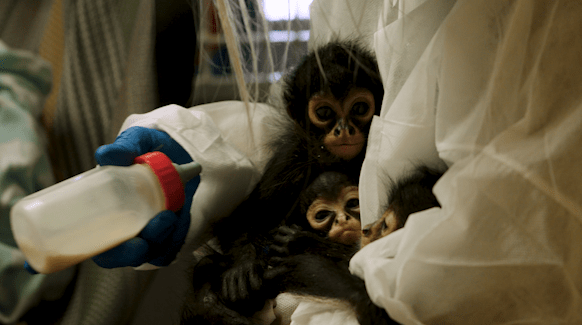
SAN DIEGO (Border Report) — Three baby spider monkeys confiscated at the Calexico-Mexicali border five months ago are now under the care of wildlife specialists at the San Diego Zoo Wildlife Alliance.
U.S. Customs and Border Protection officers at the Calexico West Port of Entry discovered the monkeys — two females and one male — during a smuggling attempt back in August.
The animals are described as a subspecies of Geoffroy’s spider monkey, designated endangered by the International Union for Conservation of Nature Red List of Threatened Species.
According to the San Diego Zoo Wildlife Alliance, the monkeys were approximately two months old at the time of their rescue.
It says the animals were found malnourished and in poor condition, and have remained under close observation for the past several months.
Despite facing initial challenges, including lethargy and mobility issues, all three monkeys are now said to be flourishing.
Initially, the monkeys were placed in quarantine by the U.S. Department of Agriculture Veterinary Services.


Spider monkeys during their care after being found at the U.S.-Mexico border during a smuggling attempt. (Courtesy: San Diego Zoo Wildlife Alliance)

Now under the care of the San Diego Zoo, the animals are reportedly “gaining weight and exhibiting normal behavior and movement.”
A video released by the San Diego Zoo, shows the monkeys’ development over the past five months as they are fed and can be seen prancing around an open area.
“This story illuminates the critically important role of accredited zoos and aquariums in providing world-class care for wildlife and responding in a moment’s notice,” said Lisa Peterson, executive director of the San Diego Zoo Safari Park. “In these difficult moments, we see it as our responsibility to be ready and provide the best care possible, assess their individual needs, give them opportunities to experience environments that reflect their native habitats, and when appropriate, the complex social dynamics critical to their well-being.”
According to the San Diego Zoo Wildlife Alliance, criminal wildlife trafficking is on the rise, and Southern California is considered an epicenter for the illicit trade, which is tied to international crime and drug networks.
It says the U.S. Fish & Wildlife Service seized nearly 50,000 illegally smuggled wildlife between 2015 and 2019, and that accredited zoos and aquariums are frequently called to provide critical care assistance for the seized wildlife.
Read: Read More