



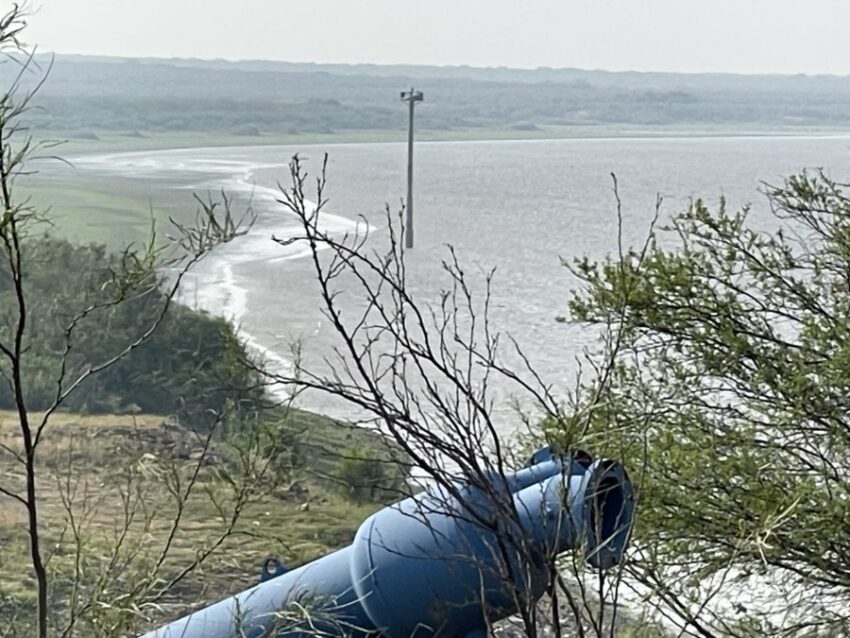
EDINBURG, Texas (Border Report) — A South Texas lawmaker says getting funds and help for the border region that has been affected by drought and lack of water from Mexico is a “top priority” among key lawmakers when the Texas Legislature convenes next week.
State Sen. Juan “Chuy” Hinojosa, D-McAllen, told Border Report that he is working to get political support among lawmakers to appropriate $5 billion in funds to help relieve and find long-term solutions to water issues in South Texas.
“Priority is water right now. Without water, there’s no life. Without water we don’t have an economy. Without water there’s no agriculture. So that will be a No. 1 issue across the board,” Hinojosa said.

He said he’s working with Republican Lt. Gov. Dan Patrick and state Sen. Perry Otto, R-Lubbock, to craft legislation to get funds and resources for South Texas growers, ranchers and municipalities to alleviate what many call a water “crisis.” Otto chaired the Senate Committee on Water, Agriculture, and Rural Affairs during the last session
Hinojosa says they want “to try to set aside $5 billion to be able to increase our water capacity, desalination of sea water, desalination of brackish water.”
Hinojosa was vice chairman of the Senate Finance Committee during the last session, and he is optimistic that he will repeat that role in the next session, which begins Tuesday.
“The area that’s the hardest hit right now is the Rio Grande Valley, and then after us, it’s the Panhandle, and then the Coastal Bend, and then West Texas,” he said.
Gov. Greg Abbott is reportedly exploring a plan to buy water from Houston and send it to West Texas. Houston Mayor John Whitmire told the Houston Chronicle that Abbott called him to discuss the state buying “excess” water from the city to send West. Whitmire is reportedly amenable to discussions if it means Houston will get funds needed to improve its aging water infrastructure, the newspaper said.
Each section has different needs and possible solutions and Hinojosa said he believes that utilizing water from underground aquifers in the Rio Grande Valley, as well as building desalination facilities are key to long-term solutions for supplying enough water for this growing border region.
The state’s only sugar mill shut down in early 2024, taking with it 500 local jobs, the citrus industry is threatened, and several municipalities along the border have implemented water restrictions for months. Hidalgo County has declared a water disaster.
Prolonged drought and excessive heat and population control are contributing to a lack of water, as well as Mexico’s inability to pay the United States water it owes to South Texas to the Rio Grande.
Under a 1944 international water treaty, Mexico is supposed to give the United States $1.75 million acre-feet of water every five years.
The cycle ends in October and so far Mexico has only paid 433,400 acre-feet, as of Jan. 4, according to the U.S. Section of the International Boundary and Water Commission.

Hinojosa says South Texas cannot rely on Mexico, because they simply don’t have the water to give.
“Even if Mexico wanted to pay the water they owe to the United States, they don’t have water capacity,” he said, adding that South Texas must consider other options.
“Here in the Valley, we are on top of an aquifer, Gulf aquifer, where we can take some of the water, underground water, which is brackish water, and clean up the desalination of brackish water. But the cities, counties cannot do it by themselves. The state has to come in because it’s very expensive. Desalination of sea water is also very expensive. So we’re looking at different plans,” he said.
Texas state Rep. Tony Tinderholt, R-Arlington, has filed a bill in the Texas House relating to studying desalination and the feasibility of converting sea water for use in the Lone Star State.
He points to ongoing construction and plans for a desalination plant in Corpus Christi that have already exceeded $750 million. The area is part of the Coastal Bend area and part of his district, and he says once completed, he expects the project will cost up to $1.3 billion.
“These are expensive projects for a city cannot do it by itself. They need help from the state and the federal government,” he said.
Sandra Sanchez can be reached at SSanchez@BorderReport.com.
 Read: Read More