



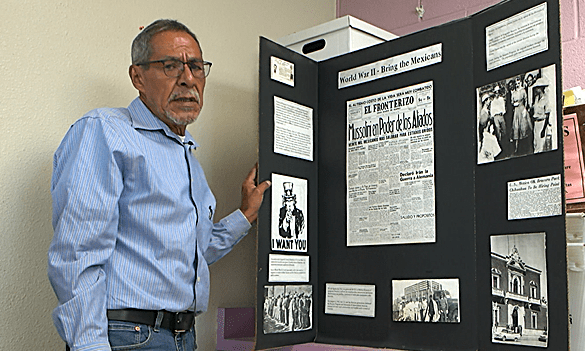
EL PASO, Texas (Border Report) – Carlos Marentes recalls recently speaking to a group of high school students in Fabens, Texas, about the legacy of immigrant laborers on the U.S.-Mexico border.
He spoke about the millions of Mexican farm workers who tended crops and picked cotton while Americans fought Nazi Germany in Europe and the Japanese in the Pacific Ocean war theater.
Those men not only kept vital vegetable and produce coming to supermarkets all over the U.S. during World War II. They also returned year after year on temporary worker visas under the 1942-1964 Bracero Program to help shape America’s agricultural industry into a global leader.
As he spoke about the 80,000 to 90,000 “braceros,” or worker-arms, admitted through El Paso during that period, a Fabens student volunteered that his grandfather came into the United States through the program. The bracero became the patriarch of a family of second- and third-generation Americans.
“The braceros are part of the history of El Paso and Juarez (Mexico). Their contribution is not always appreciated,” said Marentes, executive director of the Border Agricultural Workers Center in El Paso.
The center for decades has compiled the history of these immigrant agricultural workers through its Bracero Project.
That’s why Border Report this week reached out to Marentes for his take on a new House bill called “Bracero 2.0” to increase the number of H-2A agricultural worker visas amid fears of a labor shortage.
The bill comes as undocumented workers stay home for fear of deportation or may already be in removal proceedings under the Trump administration’s crackdown on illegal immigration.
His view of the bill is not favorable.
‘Bracero 2.0’ is a misnomer
“This proposal (by U.S. Rep. Monica De la Cruz, R-Texas) is not a new Bracero Program,” Marentes said. “It’s in reality some changes to the current H-2A program [….] and we are very concerned because they are getting rid of the provisions that currently exist to protect the H-2A workers, who represent almost 20 percent of the farm labor force in the United States.”
The farm labor leader and Bracero Program expert is concerned about the bill’s proposed wage rate. He fears it will drastically cut farm workers’ paychecks.

Wages for H-2A workers ranged from $14.83 an hour in Arkansas to $19.97 an hour in California as of 2023, according to the Federal Register.
De la Cruz’s bill proposes to standardize the pay to $2 above each state’s overall minimum wage.
The register shows 2023 H-2A pay for Texas being $15.79 an hour under the federal government’s Adverse Effect Minimum Wage. The state’s minimum wage is $7.25 an hour; $2 dollars above that comes out to $9.25.
“The idea they get paid a higher wage, so they don’t affect the local labor force. If they did, everybody’s wages would go down,” Marentes said.
Border Report reached out to De la Cruz’s office for comment on Friday morning.
Her position is the lower pay structure will attract more employers. Already, several organizations including Texas Citrus Mutual, Texas International Produce Association and the Texas Farm Bureau have expressed support.

She maintains that the average H-2A visa wage has increased almost twice as much as the average wage increase in the United States in recent years.
Also, members of the House Bipartisan Agriculture Working Group last year acknowledged the need for visa wage reform to make H-2A labor more economically viable for small and medium-sized farms, according to her office.
The bill was introduced in the House of Representatives on July 14. It has since been referred to the House Committee on the Judiciary.
Braceros changed the border economy
In his office at the Border Agricultural Workers Center, Marentes keeps a display of old newspaper clippings. One of Juarez’s El Fronterizo from September 1943 announces “another 20,000” braceros were on their way to U.S farms. It shared the front page with the Allies capturing Benito Mussolini.
Another from United Press International shows the border state of Chihuahua being designated as a primary recruiting ground for braceros.

Marentes said there was a reason for that.
The neighboring state of Coahuila is famous for a region, La Comarca Lagunera, where cotton is grown. Those braceros went to work in Texas farms, particularly in the Pecos County region.
Others came from the traditionally agricultural states of Durango and Zacatecas, where the Pan American Highway provides a straight drive north to Juarez and El Paso.
“The role of Juarez was very important. It changed the demographics to the point that when the bracero program ended, the Mexican government started the Border Development Project – the maquiladoras – in order to provide jobs for those returning to Mexico,” Marentes said.
Those U.S.-run factories remain the principal employer in Juarez and other Mexican northern border cities today, and generate thousands of jobs in transportation, warehousing and logistics north of the border as well.
These cities prospered during the 22-year run of the Bracero Program.
“The braceros would spend a lot of their money in these towns. One who worked in Pecos told me how, at the end of their contract, (he and his peers) would go to shop for clothes and things to take back to Mexico,” Marentes said. “Juarez experienced an economic boom with the money these workers brought back. And they left a legacy on El Paso.”
Marentes, who has spent three decades advocating for the 5,000 to 12,000 farm workers in the El Paso-Juarez-Southern New Mexico region, said most of the braceros have passed away. Those he talked to over the years share bittersweet experiences.
Some faced humiliating communal physical exams and even fumigation at processing centers in the El Paso area in the first years of the program. The food and housing at the worksites left much to be desired, and there were culture clashes.
Marentes said many Mexicans feared being assigned work in Texas in the 1940s and 1950s. They mostly focused on work and kept to themselves, but even then, their actions came into question.
He tells the story of farm workers killing rattlesnakes on the fields and using the fat for muscle ointment. The braceros told him they were chewed out by their employer because they thought the homemade remedy odd and because snakes eat pests like rats.
Another anecdote involves workers being invited to the main house by the farmer’s wife for sandwiches, then being asked to do landscaping.
“They, in a sense, believed it was an honor to be invited to the main house. They didn’t see it as their boss getting free labor,” Marentes said.
The University of Texas at El Paso also maintains an oral history archive of the braceros. You can visit it here.
 Read: Read More