



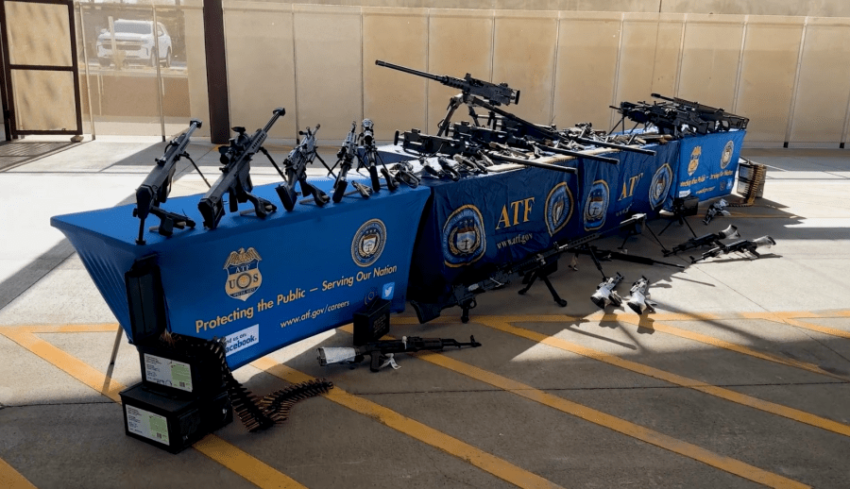
EL PASO, Texas (Border Report) – With less than five months left in fiscal 2025, federal data points to an ongoing sharp decline in firearms and ammunition seizures at the U.S.-Mexico border.
Border officers have seized 435 guns and rifles headed to Mexico since Oct. 1, compared to the 1,110 stopped between Oct. 1, 2023, and last Sept. 30. A total of 1,171 firearms were prevented from going into Mexico in the 12 months before that, U.S. Customs and Border Protection data shows.
Ammunition seizures follow a similar pattern.
Border officers have seized a total of 82,452 bullets, ammunition magazines and gun parts since Oct. 1. That compares to 390,998 seized in all of fiscal year 2024.


The guns typically are bought in the United States by “straw purchasers” – U.S. residents who receive money from criminals. They are expected to transport the weapons to Mexico and paid a fee. The Mexican government is suing U.S. gun manufacturers because those firearms end up killing tens of thousands of people every year south of the border.
Federal officials agree the guns can be lethal in the wrong hands, especially because the drug cartels almost immediately modify assault-style rifles into fully automatic weapons.
But some suggest that if numbers may appear low, it could be because criminal organizations are getting the message the U.S. government has run out of patience with them.
“I’ll just use the immigration context as an analogy,” Acting U.S. Attorney for the District of Arizona Timothy Courchaine said at a public event earlier this month. “The numbers are down 96% along the border. If you are comparing stats from the previous administration to now, there has been a sea of change of how we enforce and how our opponents operate.”
The Trump administration has designated six Mexican drug cartels as Foreign Terrorist Organizations. That not only implies the U.S. government can go after them more aggressively across international borders, but also that those who contract their services to them face enhanced penalties.
“The charges have increased in severity,” Courchaine said. “I can’t give you an exact number, but I can tell you that the focus in on impact and severity.”
Most guns are seized in South Texas
The Mexican drug cartels operate all over the Southwest border. However, it is through South Texas that CBP is seizing most firearms.

Data shows the Laredo Field Office staff have seized 339 guns, rifles and explosives since Oct. 1, compared to 82 in the Tucson, Arizona, Field Office and nine in El Paso. Border officers in the San Diego Field Office have seized five firearms in fiscal year 2025, according to May 12 data.
Seizures of ammunition tend to fluctuate due to occasional large seizures. In El Paso, for instance, CBP officers conducting southbound checks came across more than 4,000 bullets in a vehicle at the Bridge of the Americas port of entry on May 5.
In the first two weeks of May, border officers at Arizona ports of entry seized 6,413 bullets and a gun, according to Guadalupe H. Ramirez, director of field operations at the Tucson Field Office.
Guns are smuggled out of the United States in much the same way drugs come into the country.

“For some of these weapons and weapons parts, they will find the same kind of compartments that are used for narcotics coming into the country, they utilize those same type of compartments for weapons going into Mexico,” Ramirez said.
That may include false floorboards, hollowed out dashboards, merchandise crammed in quarter panels and car doors. Each seizure may yield one or two pistols or a shipment of a dozen rifles and ammunition.
Seizures often take place during “outbound operations.” That’s when CBP surges officers at ports of entry to check vehicles trying to exit the country, typically after receiving alerts from its own investigators or other federal agencies such as Homeland Security Investigations, the Bureau of Alcohol, Tobacco, Firearms and Explosives, and the FBI.
The inspections “add a significant cost in doing business for violent transnational criminal organizations and will continue to serve as a valuable tool in our efforts to keep America safe,” Ramirez said.
 Read: Read More