



EL PASO, Texas (Border Report) – As a former U.S. Border Patrol chief agent in Arizona and West Texas, Victor Manjarrez has come across his share of illicit cross-border tunnels.
He’s seen enormous underground constructions with rails to ferry carts loaded with kilos of cocaine and black-tar heroin. He’s seen sophisticated lighting equipment, vents to provide fresh air, and backpackers sent several feet under electronic sensors and Border Patrol agents keeping watch from their parked vehicles.
That experience leads him to believe a tunnel originating in Juarez discovered last week in South-Central El Paso was being used by a Mexican cartel to send either illegal drugs or “high value” migrants to the United States.
“It would make more sense it was being used to bring people from China, from Southeast Asia or Europe that can pay $25,000 to $30,000 to be smuggled to the United States. If you go for volume, it becomes a risk because someone could talk. This isn’t for the economic migrant you normally see here,” he said. “Also, people coming from special interest areas. They may not be on the list itself but come from a terrorist region. Those are the ones more invested in not being detected.”

On Monday, many questions still surrounded the tunnel’s discovery last Thursday, which wasn’t publicly disclosed until Friday. U.S. federal agencies in El Paso said the case remains under investigation and referred questions to news releases they put out last week.
However, Border Report learned from knowledgeable sources that U.S. authorities heard about the structure months ago but couldn’t locate it until the Border Patrol’s Confined Space Entry Team (CSET) went into the drain system early Thursday and hit paydirt near El Paso’s Boone Street.
Two-hundred thirty miles to the south, a Mexican official confirmed as much on Monday. In a news conference broadcast online, Chihuahua state Deputy Police Chief Luis Aguirre said Mexican officials assisting in the investigation of the tunnel have been briefed by U.S. authorities in the past few days.
“This investigation that brewed for months became clear over time and concluded with the finding and seizure of this tunnel that connected a portion of the Mexican border with the United States,” Aguirre said. “Information is being gathered about its purpose but the information we have is it was being used for the contraband or persons and other things.”

It may not be the only illicit cross-border passageway between Juarez and El Paso.
“It wouldn’t surprise me if a new one was discovered soon. Most tunnels are discovered by human intelligence. […] Somebody gets caught, somebody talks, you start looking,” Manjarrez said. He added at least three tunnels have been found between El Paso and Juarez over the years.


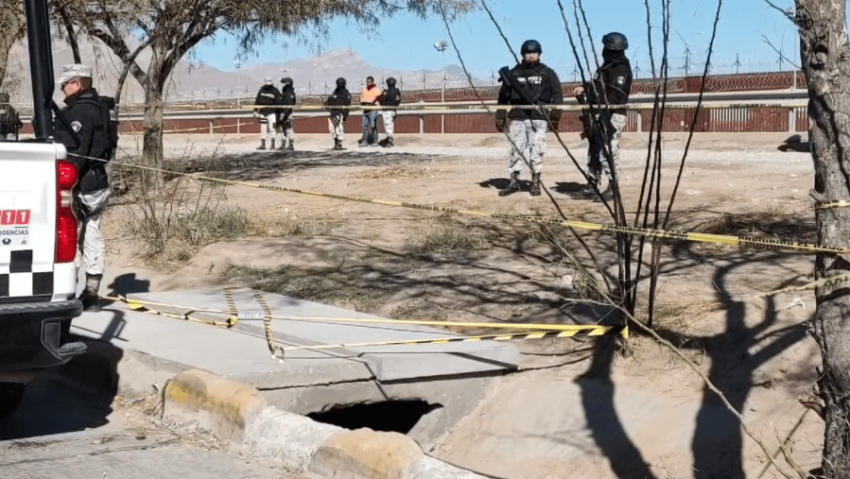
Members of Mexico’s National Guard stand guard after a tunnel was found leading to El Paso, Texas, United States, from Ciudad Juarez, Chihuahua State, Mexico, on January 13, 2025. (Photos by HERIKA MARTINEZ/AFP via Getty Images)
Law enforcement agencies on Friday released photos and a video of the new tunnel. They show wooden beams sustaining the roof of the structure and planks shoring up the sides. The dirt where investigators walk looks well-packed.

A map of the underground tunnel put together from information provided by Mexican sources shows it starts next to a six-lane highway in Juarez, goes under the river levee and under the Rio Grande itself.
Manjarrez said such a structure is not built using “a pick and shovel,” but construction machines working for a length of time in a highly visible area with lots of traffic. Video taken by Border Report news partner ProVideo shows the entrance to the tunnel right next to Avenida Perez Serna being guarded by Mexican police and soldiers on Monday.
“I find it hard to believe someone on the Mexican side did not know of a tunnel. There are too many logistical things that have to occur. One is, you gotta bring the equipment in. You may have started with a pick and shovel or vertical drilling, but ultimately you have to bring in equipment,” Manjarrez said. “You are bringing a tremendous amount of dirt, rocks, things of that nature. You gotta put that somewhere.”
He said not only police patrols but government maintenance crews or the Juarez electrical utility should have taken notice.
“I’m certain the cartel did not hook up to the meter so they could pay their monthly bill on that, so they hooked that up to somewhere else and someone had to have noticed that. To say they did not notice. That they weren’t aware of that at this point is not believable,” he said.

Although Chihuahua state police are assisting, the investigation of the tunnel in Mexico is being led by the federal Attorney General’s Office. The area is regularly patrolled by the Mexican National Guard and the National Migration Institute.
Juarez news outlets over the weekend said smugglers were advertising passage through the tunnel on social media prior to its discovery.
Manjarrez said that might be the case, but he doubts it.
“A tunnel is an asset. It’s a money-maker. The last thing you want to do is advertise it where you can’t control it. I’m sure it’s part of a package deal now that restrictions are being placed on asylum, now that people are trying to avoid detection,” he said. “You wouldn’t advertise such an asset on social media — at least a smart businessman would not, and the cartels have proven to be smart businesspeople.”
 Read: Read More