



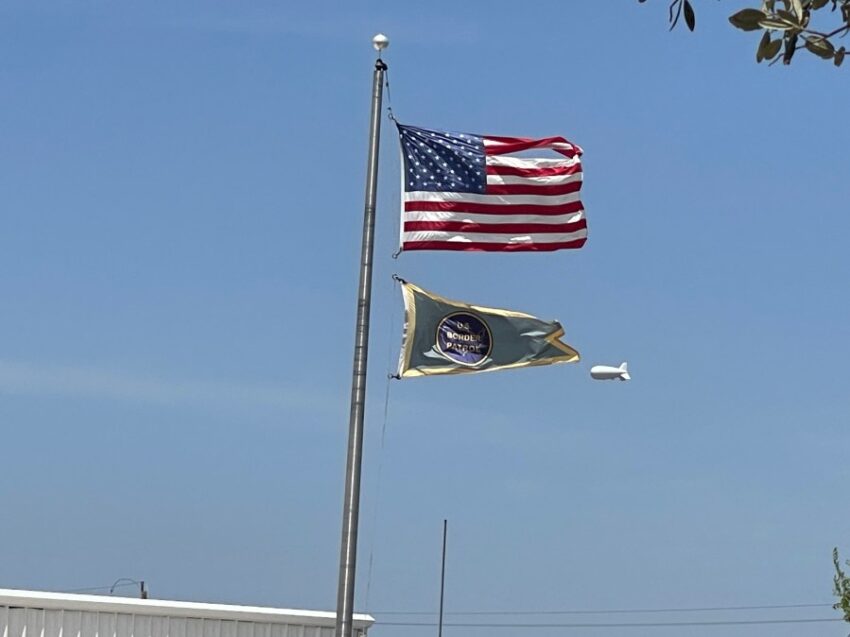
ZAPATA, Texas (Border Report) — A massive tethered air surveillance blimp hovers over the skies of the rural ranching town of Zapata, Texas.
Locals noticed the Tethered Aerostat Radar System earlier this week, the latest of these expensive high-tech devices deployed on the South Texas border.
It’s the first surveillance blimp deployed here in a few years, Zapata County Judge Joe Rathmell told Border Report. And he said he hasn’t heard concerns about it.

“I haven’t had any comments, negative comments come to my office about, the aerostat being back up. You know, we did have a few years ago one and they closed it down,” Rathmell said Monday from his office at the Zapata County Courthouse.
One local said she has heard that some people are afraid that Immigration and Customs Enforcement officers might be watching residents from above. Another, a trucker, said he welcomes any form of border security that will stop illegal immigration. None wanted to be named, or have their photos taken, however.
The aerostats are operated by U.S. Customs and Border Protection’s Air and Marine Operations and can detect and track suspicious border events from the air above. Equipped with dozens of cameras and sensory technology, they have a radar range of 200 miles and cameras that can see for 25 to 40 miles.
The helium-filled devices are over 185 feet long and 62 feet wide and weigh between 1,200 and 2,400 pounds, according to CBP.

CBP says there are eight aerostat sites on the Southwest border from Cameron County, on the Gulf, to Tucson, Arizona.
Several aerostats have been spotted lately in South Texas, including an aerostat north of Roma, in far western Starr County, about 45 miles east, and another in Rio Grande City, about 55 miles east of Zapata.
An aerostat usually flies above western Hidalgo County in the La Joya area, but only if the strong Gulf winds abate.
The aerostats cannot fly in harsh winds or storms.
An aerostat that had been tethered off the tip of South Padre Island, overlooking the Gulf, broke free in strong winds in March and its remnants landed in a field about 600 miles away in Quinlan, Texas, outside of Dallas.
The units are expensive and can cost $400,0000 per month for contractors — mostly retired military veterans — to raise and lower the blimps. CBP personnel operate the actual surveillance and most of the equipment was acquired as Army surplus material from the Afghanistan War.
This is why U.S. Rep. Henry Cuellar, D-Texas, has for years questioned why CBP personnel aren’t trained to raise and lower the aerostats and save that cost.
There have also been discussions about upgrading the aerostats to more modern devices from the Department of Defense.
Border Report has asked CBP what device is flying over Zapata and whether it is a newer model and how far its radar and camera range is. The story will be updated if information is received.
The budget bill signed by President Donald Trump on July 4 includes over $3 billion for new border technology and $2.7 billion for new border surveillance..
Rathmell says he hopes that if border security is increased in this part of South Texas that it includes more aerostats and manpower, and not building border barrier.
“We’re talking about the aerostat and I hope that because of Falcon Lake, and maybe that would be the option that would be most beneficial to our area, and I’m hopeful that we can just keep up the surveillance with manpower and and not have to build any more structure, border structure in our county but we’ll see,” he said.
Sandra Sanchez can be reached at SSanchez@BorderReport.com.
 Read: Read More