



EL PASO, Texas (Border Report) – There’s no divorce between the U.S. and Mexico when it comes to crime, immigration and the economy. What one country does or fails to do in those areas inevitably affects the other. So, what happens in 2024, when both countries hold presidential elections with the potential to bring about major policy changes?
The Center for the United States and Mexico at Rice University’s Baker Institute for Public Policy addresses the question in its Mexico Country Outlook 2024 report published Thursday.
“The most important issue at the center of it is, of course, the presidential election,” said Tony Payan, the center’s director. “Predicting the future is very difficult, so we played with various scenarios.”
A crossroads for immigration policy
Mexico for the past five years has been led by Andres Manuel Lopez Obrador, a president who has taken a hands-off approach to organized criminal gangs and hasn’t stopped millions of migrants from all over the world from traversing his country on their way to the United States.
The U.S. under President Joe Biden has seen many of those migrants enter the country and released those claiming asylum until an immigration court hears their case years down the road. The administration has taken a diplomatic approach when it comes to tackling the fact that most of the fentanyl killing tens of thousands of Americans each year comes through Mexico and in many cases is manufactured by Mexican drug cartels using precursor chemicals imported from Asia.
“This is the one issue that has dogged the Biden administration: irregular and disorderly migration from Mexico. And it’s something Lopez Obrador has used as leverage against the U.S. so he can pursue certain nationalistic policies that may not be to the full (liking) of Washington, D.C.,” Payan said. “President Biden has pressed the Lopez Obrador administration to contain the flow of immigrants and yet the numbers are as high as ever.”
A second Trump presidency will mean a lot more pressure for Mexico, he said.
“Trump is likely to do something the Biden administration is not willing to do. You may remember he threatened Mexico in 2019 with tariffs if he did not contain the disorderly migration,” Payan said, referring to 5% and 25% tariffs on Mexican exports that got Lopez Obrador to allow the implementation of the controversial Migrant Protection Protocols, or “Remain in Mexico” program.
Mexico also deployed 20,000 troops to the Guatemala and U.S. borders to contain irregular migration.
“I think Trump is far more likely to use these strong-arm tactics and essentially threaten Mexico. Mexico is heavily dependent on the U.S. economy for its exports and access to U.S. markets and that gives the United States great leverage,” Payan said.
Biden has chosen not to use such tactics, opting for a more “institutional,” diplomatic approach that does not cause embarrassment for Mexico and relies on binational talks. A drastic change in immigration policy in the U.S. in 2024 and beyond likely will cause stress in the binational relationship, Payan said.
While Biden can be reelected in 2024, Lopez Obrador cannot. Either his hand-picked successor Claudia Sheinbaum, opposition coalition candidate Xochitl Galvez or Movimiento Ciudadano candidate Jorge Alvarez will take over and deal with major migration and crime issues.
Cartels will infiltrate the elections
Transnational criminal organizations have ramped up murders in Mexico to record levels, according to the government’s own numbers, and aggressively branched out to side gigs like migrant trafficking, large-scale fuel theft, and an extortion racket that began with growers and is quickly expanding in urban and rural areas.
Payan said Lopez Obrador’s hands-off approach could continue under Sheinbaum until the Mexican justice system is thoroughly revamped.
“Direct confrontation under President (Felipe) Calderon (2006-2012) did not work; it raised the level of violence. That is something the next president will not do. The strategy of this administration in the past five years has been to do nothing. That hasn’t paid off because violence has stayed at very high levels,” he said. “The next president will have to rebuild the federal police, will have to cooperate more closely with the United States, (something) this administration has been unwilling to do, and it will have to ramp up the judicial system, reform the prison system.”
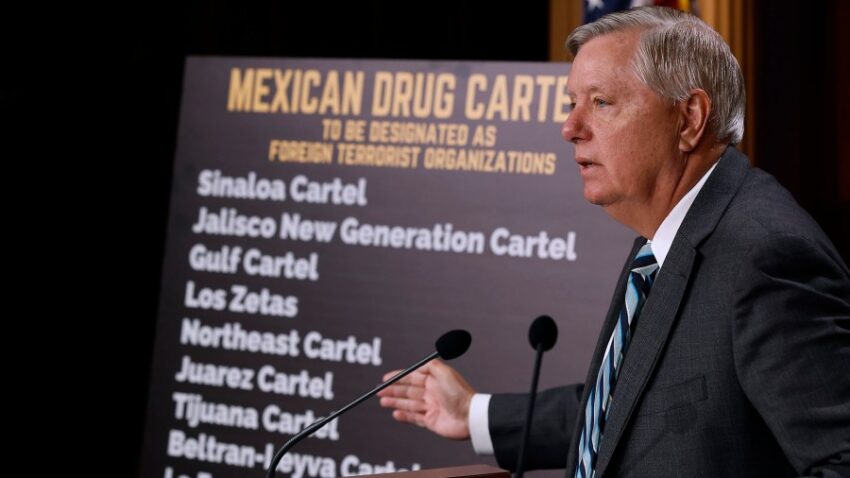
The center’s report has some dire warnings regarding the growth of the Mexican drug cartels in 2024 and beyond. The two major cartels – Sinaloa and the Jalisco New Generation Cartel (CJNG) – continue to expand and absorb other groups, but also experience internal splitting.
“Next year we expect to see major disruptions to the organizational structures and continued diversification of their operations. This shifting criminal landscape could lead to surges in violence. In the election year, political assassinations and threats against candidates to make them (quit) will rise,” the report says.
Mexico remains without a “coherent strategy” to abate corruption, which helps the cartels continue to thrive and even dictate whether more violence is needed at any place at any given time.
“Mexico has lost ground in nearly every global corruption index. Its passive public safety and security strategy is essentially a pax mafiosa with organized crime or an agreement not to interfere in their criminal activities,” the center report says.
Payan said the cartels will play an aggressive role in Mexico’s election by intimidating or coopting candidates to public office. “Every time there is a major election, organized crime begins to calculate their position and what police agents they can buy and who is going to be mayor so they can continue to cooperate,” he said.
He said the government typically makes some high-profile arrests and extraditions during an election year. That is likely not to cause disruptions in the cartels, which have become less like a pyramid with an all-controlling boss and more like de-centralized business networks. Payan estimates the “cartels” now encompass 250 to 300 criminal organizations or family clans.
The center’s report also addresses what some law enforcement officials have dismissed as a public relations campaign by the Sinaloa cartel regarding a “ban” on fentanyl exports to the U.S. “The amount of fentanyl produced in Mexico and seized at the U.S. border and interior will remain at current levels or increase in volume in 2024,” the report states. “Los Chapitos hung banners in Sinaloa that claimed the production of fentanyl has been banned. Regardless of motive, it is doubtful that the Sinaloa cartel will cede any profits generated from fentanyl or any other drug production activities.”
The economy is a bright spot
The report says the Mexican economy will benefit from the continued re-shoring and nearshoring policies of major North American businesses wanting to relocate from Asia.
“Mexico will likely continue to be the United States’ largest trading partner thanks to multiple incentives for nearshoring. These incentives are the result of the U.S.-China trade war and associated tariffs, environmental constraints, supply chain adjustments and a worsening business environment in China,” the report states.
But lingering security issues will make some investors shy away, and Mexico’s energy market will struggle to accommodate many more new industries.
To read the full report, visit the Baker Institute.
Read: Read More