



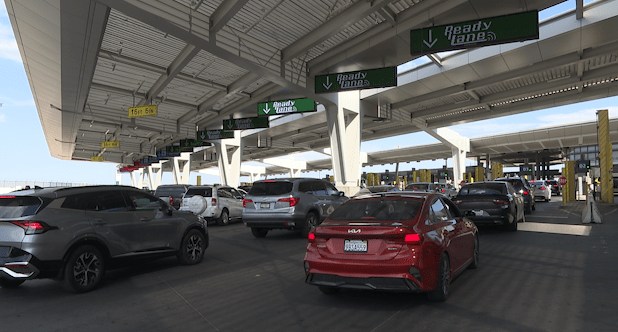
CALEXICO, Calif. (Border Report) — U.S. Customs and Border Protection this week implemented vehicle Ready Lanes at the Calexico West Port of Entry, one of two border crossings between Mexicali, Baja California and Calexico, California.
According to CBP, eligible travelers can save time crossing the border by using these designated Ready Lanes and avoiding general traffic lanes.
Commuters like Gina Nuñez welcomed the move.
“It’s faster, it compensates, and the lines are shorter,” she said. “I like it, I like it a lot.”

In order to use these lanes, drivers like Nuñez and their passengers must be pre-screened and vetted by CBP in advance.
Once they are approved, they can use accepted forms of identification such as U.S. passport cards, enhanced driver licenses, enhance tribal cards, enhanced border crossing cards, enhanced permanent resident cards and SENTRI cards to access the Ready Lanes.
These forms of ID are presented at devices called radio frequency identification readers located a short distance from the actual inspection booths.
They digitally pass on information about the people in the cars to CBP officers.


“That’s where the efficiency is gained, the officer doesn’t have to manually input or re-input all that information presented to them,” said Roque Caza, Calexico West Port Director. “When the travelers arrive at the primary inspection booth, it allows our officers to focus much more on the actual inspection … they can focus on that enforcement mission and responsibility to protect public safety.”

According to Caza, the Ready Lanes also allow CBP to use “active lane management” enabling officers to add additional lanes if needed.
“All of our primary inspection booths may be utilized at any time as a SENTRI booth, as a Ready Lane processing booth or as a general processing booth.”
Caza added that the new lanes did not cost taxpayers additional revenue since they rely on technology built in when the port of entry was constructed a few years ago.
On the Mexican side of border, designated lanes have been put in place to funnel drivers into the Ready Lanes at the port of entry.
 Read: Read More