



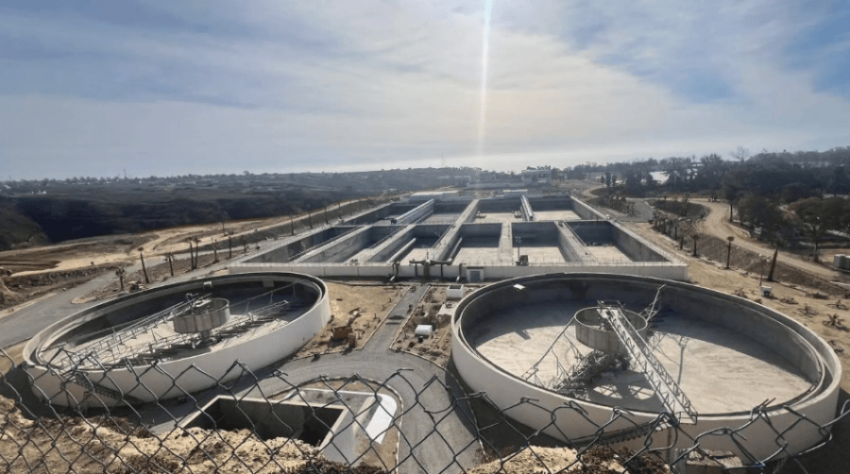
SAN DIEGO (Border Report) — On a bluff just above the Pacific Ocean about 5 miles south of the border, the San Antonio de los Buenos sewage treatment plant is 97.5% finished.
Its opening is widely anticipated by people on both sides of the border, as it was supposed to be in operation back in September.
The construction is being supervised by Mexico’s Secretary of Defense, which says the plant is now in its “last phase of construction and about to begin testing.”
It is replacing an antiquated plant that had not been in operation for many years, allowing for millions of gallons of raw sewage to flow straight into the Pacific Ocean on a daily basis.
On many days, prevailing currents pushed the effluent north of the border, forcing the closure of beaches in cities such as Imperial Beach and Coronado.
“The installation hasn’t worked in several years. Governments came and went without fixing it until the current administration, headed by Baja California Gov. Marina del Pilar Olmeda, stepped in,” said Víctor Daniel Amador Barragán, the person in charge of Mexico’s water supply. “They have literally built a new facility, now it’s time to activate it and start treating the water.”
The plant will be able to treat 235 gallons of water tainted with sewage per second, and Amador Barragán says it will greatly reduce the trans-border pollution problem.
“It’s in the home stretch of construction and set up, all that’s needed now are the tests.”
While the plant is expected to reduce the amount of raw sewage that flows into the ocean, more needs to be done according to WILDCOAST, an environmental group based in San Diego.
“The plant will only be able to treat half or three quarters of the water that will flow into it,” said Fay Crevoshay, director of communications for WILDCOAST. “It’s going to be bad if you still have a river of pollution streaming into the ocean.”
The San Antonio de los Buenos plant is considered part of the solution that will limit the amount of pollution going into the Pacific Ocean from Mexico.
Other mitigation projects are planned for the Tijuana River Valley, located just north of the border between San Diego and Tijuana, where millions of gallons of untreated water tainted with sewage, toxic chemicals and trash enter the U.S. via the Tijuana River.
 Read: Read More