



CHIHUAHUA, México (AP) — Miguel Lara was born to run. It’s in his blood, his people’s history and tied to the land he calls “home.”
“That’s what we do,” said the 34-year-old ultramarathoner near his cabin in Porochi, an Indigenous community in the remote Tarahumara mountains of northern Mexico.
“Tarahumara means ‘the light-footed,’” Lara said. “Long before marathons existed, the Tarahumara people were already running.”
Deep in the mountain range, along the Mexican states of Chihuahua, Durango and Sonora, live about 56,000 Indigenous people. Though they are mostly known as Tarahumaras, they identify themselves as Rarámuris.
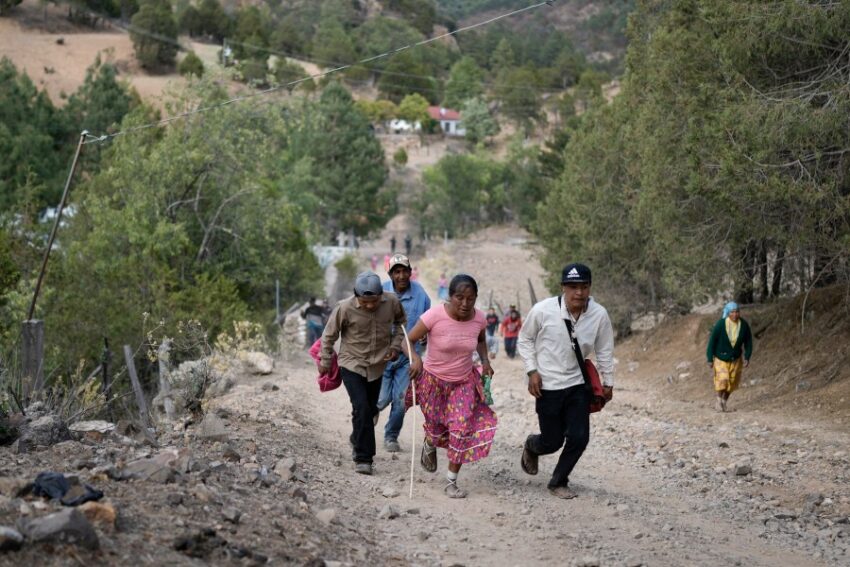
Rarámuri women runners compete in the Arihueta race in Cuiteco, Mexico, Saturday, May 11, 2024. Nestled in a remote mountain range in northern Mexico, the Tarahumaras, who identify themselves as Rarámuris, got used to running to cope with long distances, scarcity and isolation. (AP Photo/Eduardo Verdugo)
Lacking vehicles, paved roads and basic services such as clinics and telephone lines, communities got used to running to cope with long distances, scarcity and isolation.
“When we got married, we used to head to Urique (24 miles or 39 kilometers away) to get food,” said Maribel Estrada, Lara’s wife and mother to their 3- and 11-year-old children.
“It’s a four- or five-hour walk, but running takes less, like three.”
With no vehicles at hand, she runs to pick up her children from school, to attend Mass and to visit her mother, who lives 160 miles (nearly 260 kilometers) away.
“When one runs, one is happy,” she said, her feet wrapped in rubber sandals with white leather laces.
Like her, Lara and fellow Tarahumaras get used to running long distances with no manuals or coaches. They listen to their bodies’ needs; they skip food supplements, smart watches and sportswear.
“We run because we love to,” said Lara, who has caught sports brands’ attention, but has rejected any sponsorship. “We, the Tarahumara, don’t wish to make money; we do this for the thrill of running.”
Ultramarathoner Miguel Lara poses for a photo with some of his medals at his home in Porochi, an Indigenous community in the remote Tarahumara mountains of northern Mexico, Sunday, May 12, 2024. “Tarahumara means ‘the light-footed,’” Lara said. “Long before marathons existed, the Tarahumara people were already running.” (AP Photo/Eduardo Verdugo)
And so he runs. He gets lost in the mountains by himself. He crosses paved roads, rocky terrain and dusty slopes. He sometimes runs for 12 or 20 hours non-stop.
“It’s part of our culture,” Lara said. “When I was a kid, I watched the elders running for hours and I wondered: How can they endure for so many kilometers? Couldn’t I do the same?”
Among his people, running is almost sacred. Local communities organize competitions as part of their religious ceremonies and bet clothing, money and livestock, which inspire runners to run not for themselves, but for their people.
“That’s the goal,” Lara said. “You make a commitment to win for the entire community.”
One of these spiritual celebrations — Yúmari — took place recently in the town of Cuiteco, where dozens of Tarahumaras danced and prayed for good crops and safety.
Between prayers, 13-year-old Evelyn Rascón competed with one of the women’s teams.
“I started running as soon as I entered primary school, when I was 6,” said Rascón, dressed in a bright, violet skirt. “My aunt taught me. She used to run a lot and loved it.”
Rarámuris watch runners compete in the Arihueta race in Cuiteco, Mexico, Saturday, May 11, 2024. Nestled in a remote mountain range in northern Mexico, the Tarahumaras, who identify themselves as Rarámuris, got used to running to cope with long distances, scarcity and isolation. (AP Photo/Eduardo Verdugo)
Shyly, the young runner said that “professionally” she has only run half marathons — around 13 miles — in “no less” than an hour and a half. Average runners rarely travel that distance faster than two hours, but Rascón wishes to break her own record and works hard for her dream.
“When they send me out to pick up something, I run,” Rascón said. “And when I head back home from school, I also run through the slopes.”
Although Rascón jogs in sneakers, her stepmother Teresa Sánchez — the fastest runner during the Yúmari in Cuiteco — never abandons her rubber sandals with leather straps.
“I always run in sandals,” Sánchez said. “I wear them every day and they last up to 2 or 3 years.”
Sánchez’s mother — a runner, of course — inspired her as a child, but she achieved speed and resistance by working her land. “By walking through the mountain, taking care of the crops and watching my goats,” she said.
In her community, the land is what identifies the people as Rarámuri.
“The Earth is our mother because she provides us with everything,” said Candelaria Lechuga, an Indigenous woman who placed a bet during the Cuiteco race. “Everything around us connects us. The air, the sun, the trees, the plants.”
Living simply, close to their land, is inherent to the local culture, said Michael Miller, an American ultramarathoner who treasures the lessons he has learned from the Tarahumaras and works at True Messages, an organization that supports local runners.
“They’ve dealt with centuries of challenges — cartel violence, logging, drought — and they still have their connection to the Earth,” Miller said. “That’s the wisdom that we, outsiders, have to understand and appreciate.”
Homes dot the mountain landscape in the area of Areponapuchi, Mexico, Tuesday, May 14, 2024. (AP Photo/Eduardo Verdugo)
A few decades ago, his friend Michael Randall Hickman — another American athlete better known as “Micah”— met some Tarahumara runners at a race in Colorado. He soon fell in love with their culture, moved to the mountains and spent the rest of his life among the locals.
“I knew him well,” said Lara, who has won several White Horse Ultramarathons, the annual race founded by Hickman, who died in 2012. “He told me: You have to compete with yourself, to break your own record.”
His advice touched his heart. Since then, Lara has run side-by-side with the best ultramarathon runners in the world.
Yet he always yearns to come back home. “I’ve never though about moving to another country,” he said. “We, the Tarahumaras, are not used to the cities.”
When he’s not racing against international champions, Lara does construction work in nearby villages and raises crops that feed his family. This is the land where his mother — the only coach he has had — became a runner and shared her wisdom with him.
“She didn’t tell me how many kilometers to run,” Lara said. “She taught me what I would feel while running, what I would suffer.”
At the beginning, his mother told him: You’re going to be fine, but after two or three hours, you’ll get hungry and thirsty. Eight or nine hours later, she said, when the cramps hit you, you will need to ignore them, because if you sit and cool down, they will hit harder.
“It’s all about enduring,” Lara said. “You have to finish the race no matter how long it takes.”
He has no rituals or special pre-race routines prior, but he always turns to God. “I ask him to take care of me, to allow me to get safely to the finish line even if I don’t win”.
Injuries are common among long-distance runners, Lara said, which makes him hesitate to encourage his youngest admirers to follow in his footsteps.
He asks his children, ages 3 and 11, to be patient, to grow up a bit more before becoming long-distance runners like their ancestors. They nonetheless wait near the finish line at the local races he usually wins.
“They feel the thrills and run the last five, 10 kilometers with me,” Lara said. “And not just them. When their classmates watch them running with me, they run too. We call them ‘The Little Horses.’”
And so, during those sunny, magical days, Lara, his children and a dozen Tarahumara kids, cross the finish line as one.
“They tell me they feel the emotion, and I tell them that’s okay,” Lara said.
“Maybe one day, if they like to run, they will be champions too.”
____
Associated Press religion coverage receives support through the AP’s collaboration with The Conversation US, with funding from Lilly Endowment Inc. The AP is solely responsible for this content.
Read: Read More