



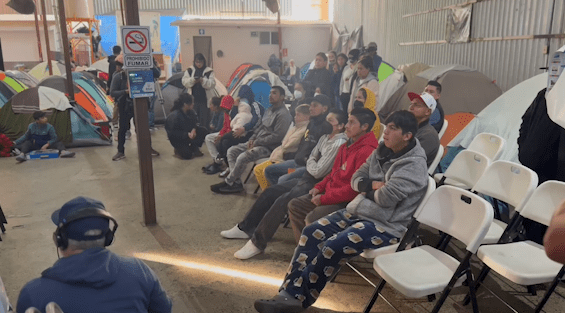
SAN DIEGO (Border Report) — Melanie Mendoza arrived in Tijuana 18 months ago and spent her time waiting for her CBP One appointment date to arrive.
Unfortunately for the from Venezuelan native, her session was scheduled for Jan. 20, the day President Trump ended the use of the CBP One for asylum seekers and canceled all appointments.
“A year and a half waiting,” Mendoza said. “At the very hour it was set for, they tell us that the appointments aren’t valid anymore.”
Mendoza told Border Report she had put “a lot of work and effort” into waiting for the opportunity to legally cross the border with a CBP One appointment to begin her asylum case.
“There were times we had nothing to eat and we slept on the streets of Tijuana,” she said.
For the last few months, she and her two children had been staying at the Agape Shelter in Tijuana. Now she doesn’t know what she’s going to do.

“I’ll probably have to get a coyote, smuggler, to get across,” she said crying.
Pedro Rios, an immigrant rights advocate, say Mendoza is a perfect example of a desperate asylum-seeker who will likely take matters into her own hands and cross the border any way she can, even if it means putting her family’s life in danger.
Rios said now that the Migrant Protection Protocols program, or Remain in Mexico as many call it, is back in play, it will create “chaos among the migrant community.”
“CBP One was the only legal pathway to seek asylum,” Rios said. “Now that it’s gone, migrants will be forced to cross the border illegally to seek asylum.”
Rios predicts a return to what was seen during 2023 and the first half of last year when migrants crossing the border in large numbers before turning themselves into Border Patrol agents to ask for asylum.
“That’s the only way to seek asylum now,” he said.
Under MPP, according to the American Immigration Council, “Individuals who arrive at the southern border and ask for asylum (either at a port of entry or after crossing the border between ports of entry) are given notices to appear in immigration court and sent back to Mexico. They are instructed to return to a specific port of entry at a specific date and time for their next court hearing. MPP is distinct from a separate process known as “metering,” whereby U.S. Customs and Border Protection officials turn asylum seekers away from ports of entry without processing them or providing any specific date or time to return.”
The American Immigration Council, a nonprofit advocacy group, argues that MPP fails to provide due process to migrants.
“Representation rates for the people subjected to MPP are exceedingly low. Data suggests that just 7.5 percent of individuals subject to MPP 1.0 ever managed to hire a lawyer, though the true representation rate may be even lower because that number includes individuals who were initially placed into MPP and then were later taken out of the program and allowed to enter the United States.”
While MPP has been reinstituted, mass deportations have begun to materialize.
During most of the day on Tuesday, only a handful of Border Patrol vehicles could be seen coming into the San Ysidro Port of Entry with a few migrants who were being sent back to Mexico.
Late in the day, two buses did pull up with several dozen people who were escorted off the buses and returned to Mexico.
They could be seen walking back along the Mexico side of the crossing.
According to photo journalist Osvaldo Samaniego in Tijuana, the deported migrants were led away by Mexican Customs agents and taken to an unknown facility away from the cameras and the border.
Samaniego did not know if the migrants were taken to a shelter that is being set up a for Mexican nationals who are deported.
Jose Luis Canchola, the director of the city’s Migrant Affairs Office, says the facility will be able to handle 500 migrants per day.
Migrants will be housed there briefly before being offered bus rides back to their homes in the interior of Mexico.
Canchola says the deported migrants won’t be forced to leave and can remain in Tijuana if they choose to.
On Tuesday morning, Mexico President Claudia Sheinbaum said each deported migrant will receive 2,000 pesos, about $100, to help with their transportation costs.
 Read: Read More