



EL PASO, Texas (Border Report) – Cocaine again is making headlines 40 years after Pablo Escobar and his Medellin cartel flooded America with “blow.”
Coca-plant cultivation has shot up in South America. Farmers, particularly in Colombia, have become so efficient at growing it that they have doubled their yield per acre. A report last October by the United Nations Office on Drugs and Crime suggested a 53 percent rise in cocaine production from one year to the next in 2023, with a yield of 2,664 metric tons.
This increase is being felt at the U.S.-Mexico border.
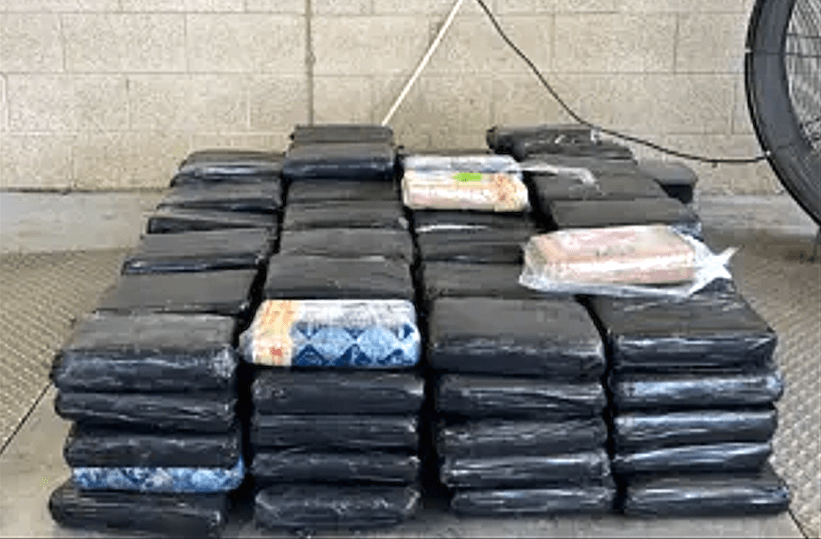
Customs and Border Protection officers at the Hidalgo (Texas) International Bridge on Feb. 24 stopped a passenger bus coming from Mexico with $2.7 million in cocaine hidden inside the vehicle.
Less than two weeks later, CBP officers at the Pharr (Texas) port of entry cargo facility seized $6.2 million in cocaine concealed in a shipment of plastic roll.
A Lockheed P-3 Orion surveillance airplane crewed by a CBP Air and Marine Operations crew last week tracked a boat off the coast of El Salvador on suspicions it was hauling drugs. Joint Interagency Task Force South relayed the information to the Salvadoran navy.
Three men were arrested and 1.5 tons of cocaine worth $37.5 million on the streets of the United States was seized.
“Cocaine never left,” said Omar Arellano, special agent in charge of the Drug Enforcement Administration’s El Paso Division. “Cocaine continues to be one of the primary drugs of choice […] so, it’s never left our radar.”
U.S. law enforcement in the past few years has shifted resources to the fentanyl crisis that has killed nearly 300,000 Americans in the past three years through overdoses.
The drug cartels next door in Mexico, until very recently, kept fentanyl labs running 24-7 to meet the demand in the U.S. However, drug overdose deaths are starting to trend down as fentanyl content in illicit pills has begun to decrease amid U.S. and Mexican government pressure.
Fentanyl seizures along the Southwest border decreased last year in comparison with 2023 and have continued to decline in the first few months of 2025. CBP data shows cocaine and methamphetamine seizures are now going up.

“Our focus, because we are dealing with the fentanyl crisis, shifted in that direction,” Arellano told Border Report this week. “But our (law enforcement) groups, whether it’s domestically or internationally, continue to focus on the cocaine problem. That is not going away. It is the bread and butter of many a drug trafficking organization.”
Those groups include Colombia’s Clan del Golfo, whose leader Dairo Usuga David was extradited to the United States in 2022, guerrilla groups like Fuerzas Armadas Revolucionarias de Colombia (FARC) and Ejercito de Liberacion Nacional (ELN) operating along the Colombia-Venezuela border and Mexico’s Sinaloa cartel and Jalisco New Generation Cartel.
At least 40 Mexican citizens were jailed on drug trafficking charges in Colombia as of 2023, according to Florida International University research.
In a tweet dating back to 2019, a Colombian senator named Gustavo Petro said: “The Mexican cartels today control everything from coca leaf to the sale of cocaine in a New York street corner. They are more powerful than Pablo Escobar […].”
Petro is now the president of Colombia.
The DEA says cocaine is part of the Mexican cartels’ portfolio. However, synthetic opioids like fentanyl, semi-synthetic opioids like heroin, and artificial stimulants like methamphetamine still account for much of the illicit drug trade.
“Mexico has moved into methamphetamine and heroin. We have kind of seen it (cocaine); it’s still there, but not as prevalent as what we saw 15-20 years ago,” Arellano said. “Fentanyl continues to be a major problem for us. We continue to attack it on all levels.”
 Read: Read More