



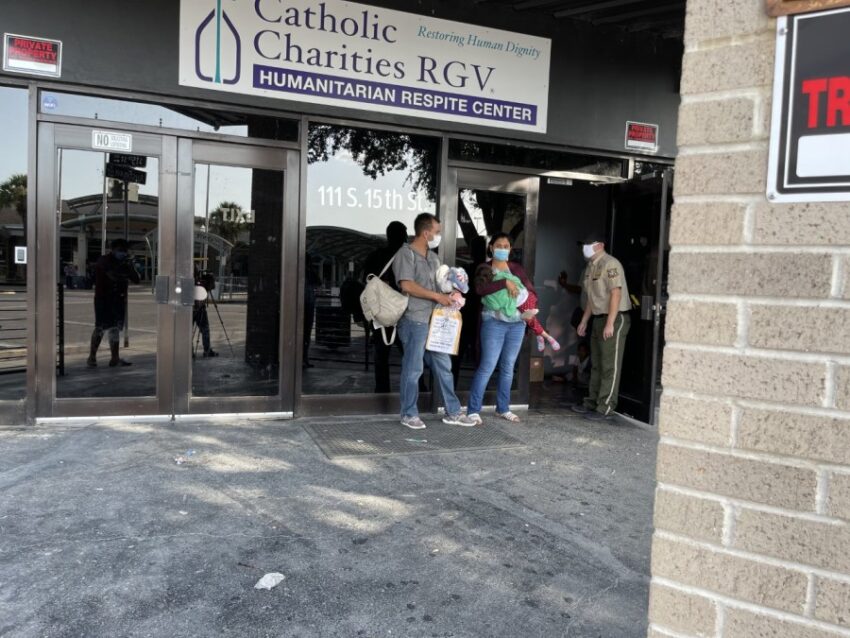
McALLEN, Texas (Border Report) — The Humanitarian Respite Center in downtown McAllen recently has had days without immigrants released to the shelter for help by Border Patrol since President Trump took office. And because of that the director says they are spending less federal funds to help them, Border Report has learned.
Sister Norma Pimentel, executive director of Catholic Charities Rio Grande Valley, said although her organization received over $7 million in Fiscal Year 2024 through FEMA’s Food and Shelter Program to help reimburse the nonprofit organization for the care of migrants, she says she is not using the money as long as the numbers at the shelter remain so low.

“Our numbers are basically almost to zero. We do have one, or three families, maybe one day arrive and the next day nobody and the next day maybe one family. And so it’s very uncertain right now as to who we are receiving and how many and so those funds are subject to those because we have to report it according to that number that every single individual has and so if you don’t have families then we don’t spend money,” Pimentel told Border Report earlier this week from her offices in San Juan, Texas.

This week the Trump administration clawed back $80 million in federal funds given to New York City for migrant care under the previous administration.
Republicans in Congress are pushing for no funds allocated for the reimbursement of immigrant care to nonprofits, communities or municipalities as they have yet to still finalize the Fiscal Year 2025 budget and are arguing over border spending, U.S. Rep. Henry Cuellar, a Democrat on the House Appropriations Committee says.
Cuellar told Border Report on Friday that when he helped to start appropriating FEMA funds for this program in 2017, it began with $30 million and it was only to reimburse border communities for immigration-related expenses.
But he says it ballooned to $650 million Fiscal Year 2024, and was expanded to cities nationwide, including many far from the southern border, like places in Maine and New York.
“I got the first $30 million and once people saw that money. Then, with all due respect, San Antonio said, ‘Hey, we’re getting folks.’ So we started providing money to San Antonio, Maine was the next area that started asking for this money. And so it went on. During COVID, it went from $30 million to $100 million,” Cuellar said.

He said he disagrees with overspending for the program or giving funding up front rather than as reimbursements.
“Once people started getting this amount of money they don’t want to see that money drop. Even though the number of migrants have dropped on it. So if the number of migrants have dropped then certainly, from my perspective, those numbers should go down as reimbursements,” Cuellar said.
Republicans in Congress want $300 billion in added funds for border security as they negotiate the budget, according to The Hill.
However, Cuellar, a senior member on the House Appropriations Homeland Security Subcommittee, says they haven’t been told what’s called “top lines” or how much money they’re going to spend.
“Once we have the top lines, we can work out the differences quickly. But the majority leadership has not given us the top lines, and that’s what we’re waiting for,” he said.
However, if they can’t agree then they’ll do another Continuing Resolution, or CR.
“If we don’t get top lines or get an agreement, then we do a CR, and with a CR, that means we keep everything the same, which is under FY-24 and if you talk to any agency, they don’t like that. I don’t like that. It’s better than a shutdown. I prefer a CR over shutdown. But we’re hoping that people can sit down and talk,” he said.
Sandra Sanchez can be reached at SSanchez@BorderReport.com.
 Read: Read More