



by Santiago Cotera
There’s a cool feeling I get in my dreams occasionally. It doesn’t have anything to do with other people or with unresolved fantasies. It is entirely evoked by the locations or spaces in the dream through which I’m moving, be they natural or architectural. The feeling is primordial, of surprise, wonder and discovery with a little bit of caution mixed in. Walking through a limestone and dolomite canyon that has suddenly appeared near my house, with the bright blue sky a sharp contrast behind it, I am taken by a skewed sense of its scale and proportions. It dwarfs or has completely obliterated the familiar urban areas that used to be there and replaced them with its chaotic, stratified majesty. I will eagerly scale its sides hoping to see the view (or something else?) from the top, despite its imposing size, and am relieved to find that the climb is easy, as things sometimes are in dreams. Or I’ll find myself in a perfectly preserved but abandoned old building, a train station, say. As I walk from room to room I’m captivated not only by their bigger-than-life size, or by the implied multiplicity of rooms, but by the unsettling impression that they are simultaneously alien and familiar. I am entranced, there is no way I can resist exploring their weirdness. It isn’t always that things are far, but that they are big. In fact, sometimes things appear a lot closer than they should. A meteor for example, a mountainous, tumbling mass of burning rock barreling across the sky over my head so close that you can see details turning on its surface! Growing up in what was back then the outskirts of Juarez, I got to see my share of fireballs streaking across the night sky, but nothing like this!
This common streak of bigness leads me to believe that maybe these kinds of dreams have their roots in infancy, when the whole world must have felt that way, toddling through it on uncertain legs. But I think that there’s more to it than that; some mystery about our perspective of the universe that I can’t pin down. Whenever I think about this, in an effort to tease out some meaning, I bring up memories of places I’ve actually been to in the waking world that have evoked similar feelings in me.
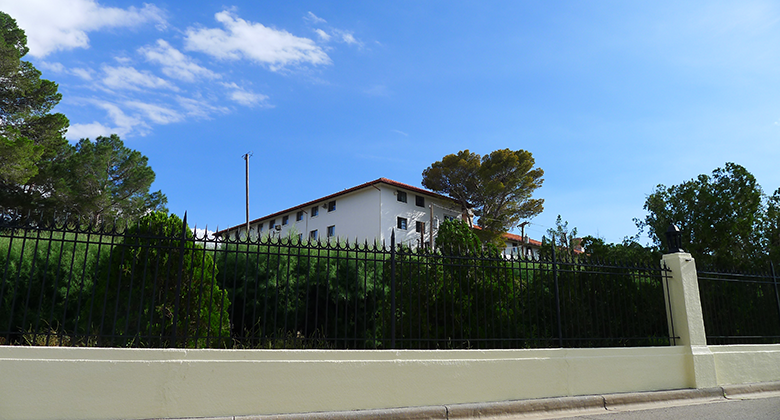
I grew up in Juarez with 4 male cousins (like me) who were all within 2 years of age of each other. We were inseparable and unfortunately, incorrigible. When we were teenagers our mothers were concerned that we were losing our faith. But unbeknownst to them, we had already spent countless afternoons on the roof of my parents’ house smoking cigarettes, tearing our faith to shreds and savagely desecrating it. One day I was informed by my mother that we would be going to El Paso to visit the Franciscan monks at the St. Anthony Seminary. I started asking questions to find some excuse to get out of it but she immediately got cagey which made me worry. I relented however once I found out that my cousins would also be there. I don’t remember what I had imagined that seminary would be like, but when we arrived at the James G. McNary house I was completely blown away. It was all I could do to restrain myself from trespassing all over that place. The gardens, buildings, history and the understated opulence there, seemed completely out of place for El Paso. I felt like I had stepped through a wormhole into medieval Tuscany. I have no memory of the conversation we had with the Franciscan monk, beyond the satisfying feeling that he turned out to be more on our side than our mothers’. All I remember is the aesthetics of the place itself.
Visiting the Straight American Whiskey distillery in Juarez as a child most likely also contributed to this fascination. My grandfather, Don Pépe Gomez, managed that place for his uncle for many years. Because I was the youngest of my siblings, by then the novelty of going to visit the old distillery had run out for my parents. I didn’t get to go but once or twice, but I remember the first time well. I remember the apprehension of driving through downtown Juarez; the confusion as to why they were bringing me to this dismal place. The sudden transition to an unknown state. I walked through that old-school industrial place wide eyed, in awe and wonder, absorbing everything about the old neoclassical brick buildings, the giant copper stills in the cavernously dark warehouses, and the endless collection of turn of the century machines.

St. Anthony’s and the Straight American distillery have many things in common as far as this goes. But one notable thing here is that they are both completely surrounded by walls. They exist within a thick perimeter of insulating air that keeps them separated from the banalities of the outside world. Somehow, perhaps because of that protective shell, they remain unnoticed and ignored, despite being very beautifully well-built places. They are, for now, monuments from a glorious past that are still close enough to know directly.
This reminiscent longing that many people experience with certain places can be profound, driving some to try to recreate it themselves for others. Is it worth it? It seems like a fool’s errand; trying to cement an ephemerous and difficult-to-define feeling into a child’s ‘Memory Palace’. And for what purpose, exactly? I am reminded of the case of Trey Parker and Matt Stone, creators of South Park, who at great expense (even for them) bought and renovated Casa Bonita, a Mexican themed restaurant in Denver that enthralled them as children (there’s a whole documentary about it, if you’re interested). Or as exemplified by the creators of The Cabin Bar (portrayed in El Chuqueño by Bob Chessey) who hoped to summon a sylvan shrine in the middle of the high desert of El Paso. Why bother? The payoff here transcends personal gain. It is a hail-Mary gift given to an impossibly unknown recipient in hopes that they in turn will derive some hope out of it. Maybe everyone that ever built some crazily exuberant space was stimulated by this feeling, whatever it is.
Read: Read More