



By Kent Paterson
Ciudad Juárez keeps showing signs of a cultural renaissance. For instance, seeds of a new era can be found where Avenida Juárez blends into the Gran Plaza of 16 de Septiembre. There, on the third floor of the historic Edificio San Luis building and perched catty-corner from the old Customs Building and current Regional Museum of the Mexican Revolution (MUREF), sits an independent art gallery and small cafe, San Luis Contemporáneo.

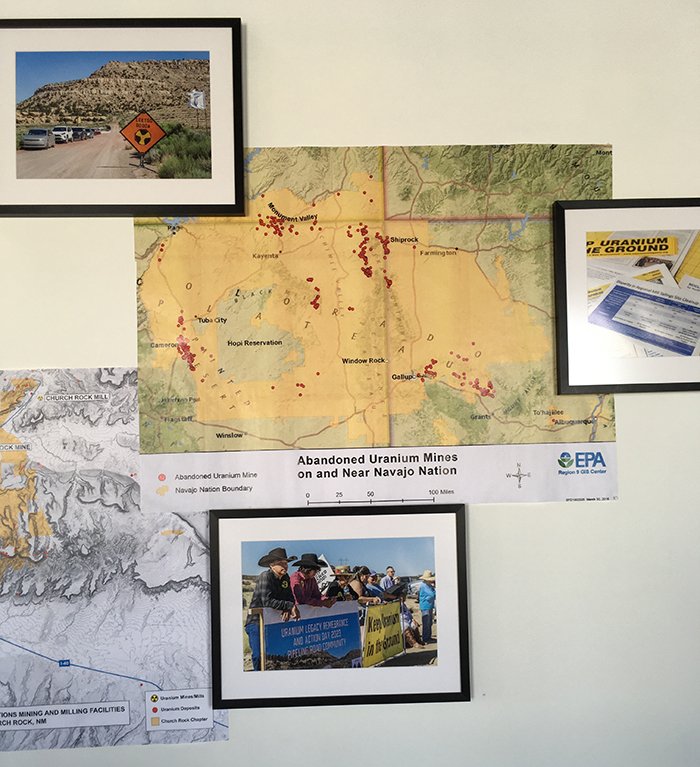
Inaugurated August 21, the multimedia exhibit “From Church Rock to Juárez” connects the environmental and public health ravages of the nuclear production cycle, colonialism, capitalist extractivism and transborder popular resistance. The three principal themes of the exhibit encompass uranium mining on indigenous lands in New Mexico and the U.S. Southwest, the historic (and successful) binational struggle against the proposed Sierra Blanca nuclear waste dump in Texas and the ecological significance of the Sierra de Juárez, the small mountain chain threatened with various forms of human-caused degradation that overlooks the Mexican city and connects to Sunland Park, New Mexico.
Weaving together photography, mapping, oral history and videography, the exhibit is the fruit of a binational collaboration that includes the art gallery, the Juárez Valley Regional Museum in San Agustin, the Sierra Juárez Collective, and Shayla Blatchford, a Diné (Navajo) photographer living in New Mexico whose striking images form a good part of the exhibit.
Blatchford has a website, antiuraniummapping project.com, which portrays the stories of exploited Diné uranium miners who sickened and died from workplace exposures, abandoned mines scattered across sprawling Diné Bikéyah (Navajoland), and the devastation wrought on the Diné community of Church Rock, New Mexico, where United Nuclear Corporation’s uranium tailings dam burst on July 16, 1979 and sent 1100 tons of radioactive mill waste and 95 million gallons of mine process effluent gushing down into the Puerco River.
According to Blatchford’s website, “This tremendous flow of water backed up sewers, affected nearby aquifers, left pools along the river, and transported contaminants 130 km downstream to a point near Navajo, Arizona. Moreover, “Livestock were swept away in the surge, and people and animals in the water suffered acid burns.”
The amount of radioactivity released from the Church Rock spill surpassed that from the better publicized Three Mile Island nuclear reactor accident in Pennsylvania the same year, states the website.
“People are grateful and interested. This is a different form of messaging that few experiment with,” says Luis Carlos Aldrete, San Luis Contemporáneo coordinator.
“This isn’t part of a scientific or journalistic exhibition. It’s a more emotional collection in the context of artistic exhibition. There is a lot of interest among the people, a lot of information that people don’t know about and are impressed with when they learn about these things happening.”
As evidenced by current events, Blatchford’s work is far from a chronicle of stories and images from yesteryear. Even as Diné and other indigenous peoples continue to grapple with the effects of previous rounds of uranium mining and demand a genuine clean up the environmental contamination left behind, new schemes to mine uranium near Church Rock, sacred Mount Taylor and other places in New Mexico are in the offing. At the same time, fresh movements of resistance are taking shape throughout New Mexico.

In 2005, the Navajo tribal government banned uranium mining on the reservation. On September 4, 2026, New Mexico State Land Commissioner Stephanie Garcia Richard issued an executive order banning new uranium-related production leasing on state-owned lands.
The order directed the State Land Office to focus on cleaning up at least 50 legacy uranium sites within state jurisdiction while urging the uranium industry and the federal government to prioritize, fund and meaningfully address the legacy problems caused by uranium production. According to Garcia Richard, who’s the Democratic candidate for Lieutenant Governor in the November election, New Mexico hosts more than 1,000 former uranium mining, milling and exploratory drilling sites, of which 250 are considered abandoned.
“Indigenous communities and New Mexico families have suffered the environmental and health effects inherent in living near a uranium pit or downwind from a nuclear testing site. The Trump administration’s push for aggressive uranium development is a low blow to these communities, and I will keep doing everything in my power to fight back,” Garcia vowed in a news release.
On her website, Blatchford writes: “Yet, the profound need for platforms like the Anti-Uranium Mapping Project arises from a troubling reality—the deliberate censorship and systematic erasure of voices and testimonies. This intentional silence has perpetuated a void in the representation of stories like those affected by uranium mining. My work is a dedication to empathy, a commitment to taking on these stories with reverence, and a promise to give these individuals and their narratives the justice they deserve in their fight for human dignity.”
The Sierra Blanca Struggle Revisited
Newcomers to the Paso del Norte might be unaware of an epic, cross-border environmental struggle that unfolded in the region during the 1990s, when Mexican and U.S. residents united to oppose a national nuclear waste dump proposed for Sierra Blanca, a small low-income community of predominantly Mexican descent located southeast of El Paso in Hudspeth County and across from the southern tip of the rural Mexico’s Juárez Valley
In Sierra Blanca, the specter of a nuclear dump added insult to injury to a locality which was already a dumping ground for sludge from New York City. Yes, human waste from the Big Apple was transported across the U.S. from the early 1990s to 2001 and deposited in little Sierra Blanca, Texas, not too far from the Rio Grande and the Mexican border.
On the U.S. side, locally-based groups including ACES, Save Sierra Blanca and the Sierra Blanca Legal Defense Fund led the charge against a nuke dump while Juárez-rooted organizations such as the Rio Bravo International Ecologist Alliance and the Binational Coalition against Toxic and Radioactive Dumps waged the struggle in Mexico.
Greenpeace, the Southwest Network for Environmental and Economic Justice, and the Group of 100 were among national and international organizations supporting the struggle. In the U.S., individuals playing a prominent role in the movement included Bill Addington Guerra, Graciela Avila, the late Ed Patrykus, Richard Boren and Isabel Santos, among many others. Numerous leading Mexican activists included the late Manuel Robles and the late Josefina Reyes in the Juárez Valley as well as Felix Perez, Francisco Diaz and Marcos López.
Nuke dump opponents raised several concerns-storing radioactive substances in a geologically unsuitable zone, threats to groundwater and the Rio Bravo/Grande and cross-country transportation hazards. Activists charged that a nuclear waste dump would violate the 1983 La Paz Agreement between Mexico and the United States that pledges to prevent and control environmental contamination within about 60 miles on either side of the border.

In 1997 and 1998 the movement escalated. In March 1998, the Border Environmentalist Coalition emerged at a Ciudad Juárez conference that united anti-Sierra Blanca dump activists with Native American opponents of the proposed Ward Valley nuclear waste dump in California (canceled in 2002) and Mexican residents of Hermosillo, Sonora, who were battling toxic lead waste disposal in their own community. The spring witnessed a hunger strike by Juárez City Councilman José Luis Rodríguez and the first protest by the city’s public school students.
“Teachers are participating and talking to their students and parents,” commented activist Felix Perez at the time. “They’re educating themselves on this subject in order to have sustainable development in the future. This obviously doesn’t stop here. This is a permanent struggle.”
For his part, U.S. activist Ed Patrykus also conducted a lengthy hunger strike on an international bridge linking El Paso and Ciudad Juárez.
In August, hundreds braved the summer heat for a three-day march from two starting points in El Paso’s Lower Valley and the Juárez Valley to Sierra Blanca. In September, anti-dump activists delivered petitions with nearly 30,000 signatures to Gov. George W. Bush and the Texas Natural Resources Conservation Commission. On the political front, Sierra Blanca became an issue in the 1998 Texas state gubernatorial race. Although the administration of Mexican President Ernesto Zedillo hedged in opposing the planned border nuclear dump, opposition was solid in the Mexican Congress, a body then shifting away from one-party dominance.
In issuing two resolutions against a Sierra Blanca dump, the Mexican Congress cited violation of the La Paz Agreement, environmental and health concerns and environmental racism.
On Sunday, October 11,1998 about 150 people from Mexico and the United States joined hands on the Bridge of the Americas between El Paso and Ciudad to symbolize the international alliance against the waste dump. As witnessed by the reporter that day, U.S. bridge security personnel chased demonstrators off the bridge, warning photographers not to take officers’ pictures, The same day, Greenpeace-Mexico and other organizations rallied outside the U.S. Embassy in Mexico City. Mexican actress Ana Colchero and members of the popular rock group Cafe Tacuba were among the protestors, the Mexican daily La Jornada reported.
Next day, on October 12, Dia de La Raza, hundreds of school children briefly blocked three international bridges on the Mexican side of the border. Finally, on October 22, the three member Texas Natural Resource Conservation Commission voted unanimously to reject the nuke dump because the proposed site was located on an earthquake fault.
Nowadays a Juárez university professor, Sierra Blanca veteran activist Felix Perez reflects on the exhibition and historical importance of the cross-border movement, especially during a time when there is “a kind of rupture between (Mexico and the U.S.) in various aspects.”
“I think it’s very important to not lose historic memory. It’s very important that young people conserve many historic stories and give continuity to the things that are important to society, many stories that are at risk of being forgotten,” Perez says.
For Perez, the Sierra Blanca movement was exemplary in many ways, as it unified not only activists and everyday people from three states and two nations but even elected officials from Mexico and the United States who made common cause. Perez characterizes the movement as a broadly diverse one involving different sectors of society -non-governmental organizations, people of faith, businesspersons, professionals, etc.
“(Sierra Blanca) is something that should be remembered…these are stories that should be in textbooks,” he says.

Opposition to a Sierra Blanca nuke dump coincided with a long-running battle over the U.S. Department of Energy’s ultimately successful bid to open the Waste Isolation Pilot Project (WIPP), a facility dedicated to storing ‘low-level” nuclear waste from the U.S. nuclear weapons program, in underground salt caverns near Carlsbad, New Mexico
Like Sierra Blanca, WIPP generated binational opposition. Similar to Sierra Blanca, Mexican and U.S. activists highlighted transportation hazards, unstable geologic conditions, proximity to the Pecos River tributary of the Rio Grande and the La Paz Agreement as good reasons for nixing DOE’s plan. Opened in 1999, WIPP remains contentious to this day.
The facility was closed for nearly three years after a February 2014 truck fire that sent six workers to the hospital briefly for smoke inhalation was followed by separate, subsequent radiation leaks which reportedly resulted in the exposure of at least 17 workers.
Visitors to the San Luis Contemporáneo exhibit will see a resolution against WIPP signed by former El Paso County Commissioners Carlos Aguilar lll and Miguel A. Teran as well as former County Judge Dolores Briones. Dated September 1, 1999, the resolution contended that WIPP violated not only the La Paz Agreement but also the environmental clauses of the North American Free Trade Agreement.
“Bringing together different phenomena-the (Sierra Blanca) archive, Sierra de Juárez, Shayla’s photojournalism and activism-makes the argument that the processes of environmental racism and extractivism are processes that we share and are experiencing today,” San Luis Contemporáneo Coordinator Aldrete says.
“It’s not a specifically isolated situation only experienced in Church Rock, New Mexico, but one all of us in marginalized populations experience. We not only wanted to raise consciousness that this continues happening, but perhaps also send a more positive message that things can be done. There have been victories..”
The exhibit “Church Rock to Juárez” is scheduled to run through October 11. Aldrete says he expects additional events to coincide with the exhibit. The San Luis Contemporáneo art gallery is open Thursday through Sunday from 11 am to 4 pm. Visitors should expect to climb stairs.
For more information:
Instagram: sanluis.contemporáneo
https://www.antiuraniummappingproject.com
https://www.facebook.com/Sierradecdjuarez
Read: Read More