



by Tim Holt
Recently, I submitted a long-form editorial to El Paso Matters that I thought was worthy of posting. It was about how the federal government had, through a series of enforcement actions, begun to systematically take away consumer choices for better products simply because they came from China. A decent topic for consideration, I thought. (You can read a variation of that editorial here: “Drones for them but Not for Us” https://elchuqueno.com/drones-for-them-but-not-for-us/ )
After being first accepted for publication, the editor asked for a shorter version and then eventually rejected the entire piece after running it through an AI checker program Pangram. Pangram can analyze finished text and classify patterns in that text as resembling the human or AI-generated material on which it was trained. Its decision? My commentary was “100% AI Written.” (Ironically, AI checkers use AI to check for AI.)
Of course it wasn’t AI written. Helped, perhaps? Yes. 100% written? No.
Because I knew I had written the original, I ran it through a similar “AI detector” and got a significantly different result. Did AI write my essay? No. Or Yes. Depends on your definition of “written,” I suppose.
What Pangram, and any AI detector cannot possibly determine from a final draft is which ideas originated with me. It doesn’t know that I wrote an earlier draft. It doesn’t know that I supplied the sources. It doesn’t know what prompts I used. It doesn’t know which sentences were originally mine and subsequently polished by AI.
Even so, the original idea was mine, the main points were mine, the references to the exact laws and regulations were mine, and even pointing out how these laws affected everyday El Pasoans was mine. Where I crossed some ambiguous line, apparently, was asking AI to polish the final product for publication, shorten for brevity, and reword for clarity. The editor said he “became suspicious” when he compared the tone and style of an older piece I had submitted to this newer piece using his “40 years as an editor” Spidey senses. Fair enough. It is his party, and he can invite or disinvite whomever he wishes. (By the way, the El Paso Matters Commentary Submission Guidelines have no guidelines on what percent, if any of any AI can be used. https://elpasomatters.org/commentary/)
I suspect that I did what many of you do: write something, then have your computer check the grammar, the spelling, the punctuation, shorten it or lengthen it, perhaps make a clarifying suggestion or two. Not too unlike what a human editor would do, just faster. Excuse me for using technology to make my life easier.
And that left me with a question that I had only considered in my other life as a photographer, but now as a writer: How much AI is too much AI? If I ask a computer to fix a comma, is that AI writing? Probably not. What if it suggests a better word? Rewrites an awkward sentence? Cuts 200–300 words because an editor says the piece is too long? At what point does a writing tool stop being an editor and start becoming a co-author? And perhaps more importantly, who gets to draw that line?
As a photographer, I can say that the photographic community has been struggling through that same question for years now. AI is actually built into most new cameras as well as your smartphones. AI tools like facial recognition, autofocus, HDR stacking, sharpening, noise reduction, and many more are simply blended into your final image behind your back. Does that make your image an “AI image”? Photoshop allows AI to assist with almost every type of image modification. Does that make the image “AI?”
At what point does a human-created photo become an AI-generated image? If one were to take things literally, then the answer would be, “It is an AI image the second you press the shutter, unless you are using an old-school camera with film.” Smartphone cameras have been using “computational photography” pretty much since their inception.
The same is true of writing. Modern consumer and newsroom word processors have AI tools embedded into the software as a matter of course. One cannot avoid them. Tools such as spelling correction, grammar checking, contextual spelling, predictive text, autocomplete, punctuation suggestions, word-choice suggestions, and many more are all part of the AI universe in just a simple consumer word processor. If someone writes something and uses those tools to polish it, is it not human-created but AI-polished?
Which brings us to the press.
Modern newsrooms in the big cities use AI for everything from finding images to writing captions for pictures. In fact, AI routinely is used for automated public-safety stories, press releases, AI transcription, transcript summarization, automated news alerts, sorting news tips, headline generation, and story summarization, as well as detecting AI. As far back as 2019, Forbes reported using an AI tool called “Bertie” and Bloomberg an internal AI tool named “Cyborg” to auto-generate articles from financial earnings reports.
Amber alerts? Auto-generated. Sports scores and statistics? Computer-generated and AI-assisted. Grandma’s obituary? Probably AI-generated by the funeral home but unquestionably posted because, well, they are essentially paid advertising. Thanks for dying granny, you are supporting local media!
News outlets like El Paso Matters, El Paso Times, and almost all the visual media in town also do not seem to have any issue with taking “Partner” or “Sponsor” advertisements that are disguised as news stories and suspiciously sound like they were AI-generated. I recently took two of these “Partner” articles found on the El Paso Matters website and asked ChatGPT to estimate the probability that each was AI-generated. “Family Medicine Residents At Texas Tech Physicians Of El Paso Transmountain Create A Model For Physician Wellness” was found to have between a 60–80% likelihood. “Building Flood Resilience In El Paso: Inside El Paso Water’s Stormwater Improvements” was estimated to have between an 80–90% likelihood. Perhaps my true mistake was not also paying to have my editorial posted.
I realize, of course, that by doing this I was committing exactly the same sin I was complaining about. That was the point. ChatGPT had no more ability to prove those Partner articles were AI-written than the detector had to prove mine was. It was simply another machine assigning a suspiciously precise number to something it could not actually know. Does saying that there was an “80% chance” prove that AI wrote the articles? No, it does not. And that is the point. No AI detector can say who or what wrote an article simply by examining the finished work.
One AI source said my article was probably 100% AI-generated. Another looked at “Partner Articles” on El Paso Matters and estimated a 70–90% likelihood that AI was involved in the writing process. We are now, it seems, at the point where we are allowing AI to determine what is and what is not human-generated. Shouldn’t humans be making that decision? If I used an AI tool to clarify my point, does that make the article “AI”? And even if it were, is that a bad thing if the reader benefits?
Some of America’s largest news organizations already recognize that “AI-written” and “human-written” are no longer two cleanly separated categories. USA TODAY’s own guidelines distinguish between AI-generated and AI-assisted content, allow both under certain circumstances, and require human review. So perhaps the more useful question isn’t whether AI touched a piece of writing. It’s what AI actually did. (Gannett, the owner of USA TODAY, also is the owner of the El Paso Times, which often partners with El Paso Matters for content.)
Clearly, news outlets do not shy away from using AI for mundane tasks, generating content, or accepting AI articles if someone is paying them to take it. So what is the beef with taking in a commentary that was originally created by a human and then reformatted using AI tools?
There is an old thought experiment called the Ship of Theseus that goes something like this: If a wooden ship has its boards replaced one at a time due to age or damage, until all of the wooden planks are eventually replaced, is it still the original ship, or is it a new ship?
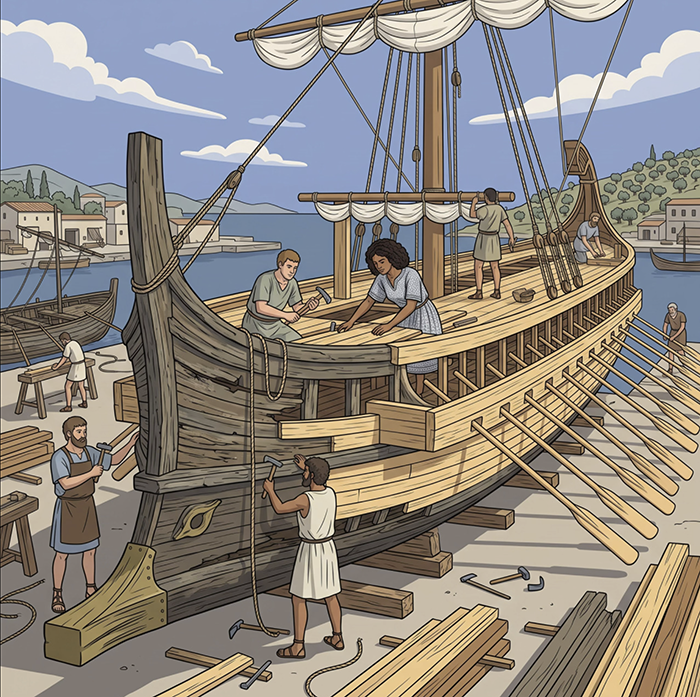
If someone like myself came up with an idea for a commentary, mapped out its outline, wrote a draft, and then, because the tools were available, had AI replace a sentence here, rewrite a paragraph there, correct spelling and tenses, smooth transitions, and eventually nearly every original sentence had been touched, but the original idea and argument had not changed in the slightest, at what point does it stop being the author’s writing, and when does it become AI? If the idea is mine, the argument is mine, the research is mine, and I remain responsible for every word that appears under my name, but a machine has helped replace many of those words, whose article is it?
When does Theseus’ old ship become a completely new ship?
At what point does the photo become an AI work and not the photographer’s original?
I’m not sure I know.
But I’m increasingly certain that an AI detector doesn’t know either.
Note: AI was used to assist with grammar, punctuation, spelling, clarity, and editing in this article because, unfortunately, I do not have a paid editor standing by at my house.
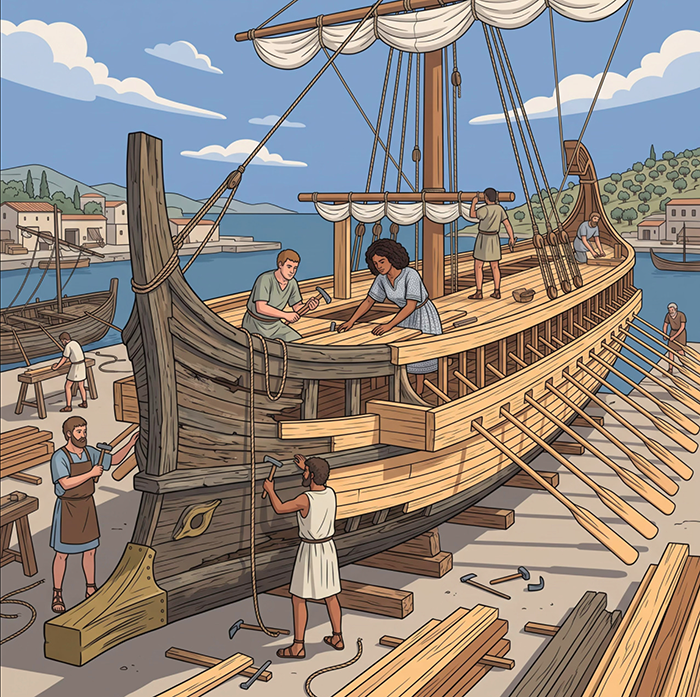
Editor’s note: I used ChatGPT to generate the feature image of a computer reading a book.
Read: Read More