



By Kent Paterson
Here’s a binational border institution many of you might haven’t heard of-the wordy Joint Advisory Committee for the Improvement of Air Quality in the Paso del Norte (JAC/CCC), better known as the JAC on this side of the border.
Founded in 1996, the JAC grew out of the 1983 La Paz Agreement between Mexico and the United States, an accord which formally recognized that the nearly 2,000 mile border environment shared by the two nations merited consideration in the binational agenda.
An international trailblazer in its mission and composition, the 22 members of the JAC include federal, state and local officials from Mexico and the United States; private citizens of both nations; and a representative of the San Antonio-based North American Development Bank, another binational institution that funds environmental projects on both sides of the border.
The body is co-chaired by Kim Ngo of the U.S. Environmental Protection Agency’s Region 6 office in Dallas and Jose Ernesto Navarro of Mexico’s Secretariat of the Environment and Natural Resources.
Meeting quarterly, the JAC has no power over air quality policy but has rendered recommendations, conducted studies and managed joint projects over the years
Energy and water consumption from pending data centers in El Paso and New Mexico are a hot issue these days. For instance, official greenlighting of the huge Project Jupiter/Stargate/Miner data center under construction in Santa Teresa, New Mexico is currently the object of two lawsuits filed against the Doña Ana County Commission by the New Mexico Environmental Law Center (NMELC) on behalf of Santa Teresa and Sunland Park residents.
Reflecting the times, the agenda for the JAC’s March 3 hybrid meeting from Ciudad Juárez included the New Mexico Environment Department’s current consideration of air quality applications for two gas-fired plants that developers want to build for powering the data center.
A New Mexico Environment Department power point prepared for the meeting, outlined the ongoing permitting process, reporting that letters from the NMELC and more than 1,000 comments were received during the recently closed public comment period for the permit applications. According to the presentation, the target date for permit issuance, denial or extension request is April 22, 2026. The state’s decision, however, could be appealed.
Meantime, the NMELC and 15 other New Mexico community and environmental organizations have demanded that the Environment Department schedule a bilingual public hearing on the air permit applications in Santa Teresa. The request was made in a January letter sent to New Mexico Environment Secretary James Kenney and Governor Michelle Lujan Grisham by the NMELC, WildEarth Guardians, Los Jardines Institute, Pueblo Action Alliance and American Friends Service Committee, among others.
“The Department has additional analysis to complete before making a recommendation to the Secretary, NMED spokesperson Jorge Estrada said in an email to the reporter. “While we do not have an estimated timeline for this determination, a decision on the permit must be made by April 22, 2026.”
Another contentious issue on the JAC’s meeting agenda involved the January 2026 citizen complaint filed with the Montreal-based Commission for Environmental Cooperation (CEC) by the Ciudad Juárez Transporters Association and other export industry interests over U.S. plans to permanently remove commercial truck traffic from the Bridge of the Americas connecting El Paso and Ciudad Juárez.
Community residents and organizations of South-Central El Paso have long protested the truck traffic, linking it to serious health problems in their neighborhoods and citing the problem as glaring example of environmental racism.
The grassroots movement scored a hard-fought victory last year when the U.S. General Services Administration selected a preferred alternative that would remove commercial truck traffic from the bridge after modernization of the customs area is finished; the construction project’s completion date is now moved back to the summer of 2031, according to a March 12 report by El Paso media outlet KVIA.
Still awaiting action, the CEC complaint ironically contends that closing off the Bridge of the Americas to truck cargo will disproportionately increase cargo traffic and air pollution in the area south of the Zaragoza–Ysleta crossing, home to thousands of Mexican residents in the city of Juárez.
According to the CEC: “The Submitters argue that by failing to evaluate impacts on air quality on the Mexican side of the border, the US violated its obligations under the 1983 La Paz Agreement, which requires both countries to assess significant environmental impacts in the border zone (100 km on each side) and consider mitigation measures..”
For their part, proponents of removing commercial trucks from the bridge argue that other alternatives exist for redirecting the traffic including the U.S. Port of Entry at Santa Teresa and the underutilized Tornillo border south of El Paso.
A trinational institution that grew out of the environmental side agreement to the old North American Free Trade Agreement, the CEC has no enforcement authority but is tasked with preparing comprehensive reports on citizen complaints of environmental law violations and then forwarding its findings to the appropriate authorities of the nation that is the subject of a citizen complaint.
The Latest Air Pollutant Monitoring Reports
In addition to brick kilns in Ciudad Juárez, other matters on the JAC’s March 3 agenda included the “roadmap” for continuation of the major U.S.-Mexico border environmental initiative that will now be known as Border 2035. Similar to the expiring collaboration, Border 2025, the upcoming one will commit Mexico and the U.S. to joint actions around air quality, water, water management and emergency preparedness and response.
(Past U.S.-Mexico border collaborations such as the Border 2012 and Border 2020 programs co-crafted by the Obama White House have also touched on children’s health, climate change, conservation, urban development, environmental stewardship, and environmental performance through compliance and enforcement.)
Notably, Border 2025 identified the Paso del Norte as a priority region for U.S.-Mexico actions designed to “prioritize environmental justice and endeavor to address disproportionate air quality impacts and focus on activities in or near vulnerable communities in areas that do not meet one or more of the national ambient air quality standards… “
The NMELC contends that ozone concentrations emanating from the two gas powered plants Santa Teresa data center developers are planning will “permanently solidify” the long-running EPA ozone standard non-attainment status of the Sunland Park area, a designation also held by El Paso County. According to the environmental legal advocates, the quantity of “toxic and dangerous emissions” proposed by Project Jupiter’s microgrid facility “will only further pollute an overburdened airshed-significantly harming communities already bearing the adverse impacts from air pollution.”
With all this as a backdrop, the JAC’s quarterly meeting was the occasion for the release of a annual report on overall air quality in the Paso del Norte region in 2025. Delivered by Dr. Mayra Chavez of the Texas Commission on Environmental Quality, the annual report-some of it preliminary- depicted both positive and negative trends.
Air quality monitoring of the binational Paso del Norte airshed facilitates regular briefings to the JAC on the state of a shared binational airshed.
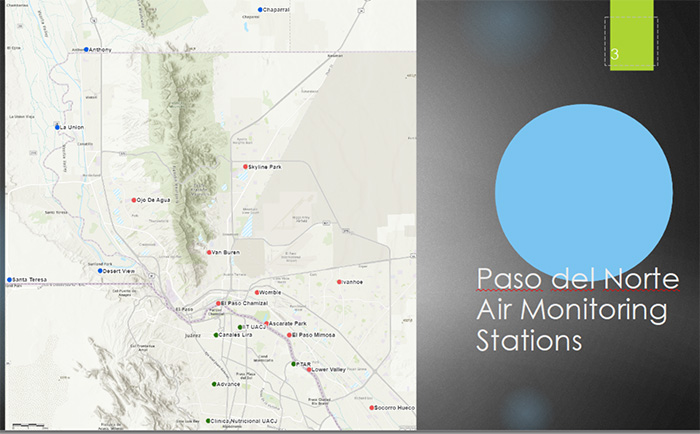
Containing data from 20 air monitoring stations scattered across southern Doña Ana County (5), Ciudad Juárez (5) and El Paso County (10), the report examined seven different air pollutants, including carbon monoxide, ozone, PM 2.5, PM 10, sulfur dioxide, nitrogen dioxide and hydrogen sulfide. While reporting that carbon monoxide, sulfur dioxide, nitrogen dioxide and hydrogen sulfide were within U.S. and Mexican standards, charts showed problematic areas with ozone and the two types of particulate matter, PM 2.5 and PM10. “These particles can penetrate deep into the lungs and even enter the bloodstream, causing serious health effects,” the report noted.
According to preliminary information, all the monitoring stations on both sides of the border measured PM2.5 as above U.S. and Mexican 24-hour average standards, with the New Mexico stations of Desert View in Sunland Park and Santa Teresa showing the highest averages.
Associated with dust storms, construction and unpaved roads, PM 10 24-hour averages were highest in Chamizal and Socorro Hueco in El Paso County and at Desert View.
Charting exceptional high wind events for Doña Ana County, the JAC report showed the number of such occurrences grew from 6 events and 14 observed exceedances in 2023 to 19 events and 48 exceedances in 2024. Pending EPA review, 2025 data was unavailable.
Separately, University of Texas and NASA researchers tallied 2025’s dust storms in the Paso del Norte borderland as the most numerous since the Dust Bowl era of the 1930s. Fresh additions to this year’s seasonal dust come from the “controlled blasts” the U.S. Border Patrol is conducting at the foot of sacred Mt. Cristo Rey overlooking Sunland Park as part of the construction of a new border wall. In case you haven’t seen it already, the El Paso sector of the Border Patrol has released a short video (with music) of one such blast.
As the El Paso Times reported March 17, El Paso musician-and border wall opponent- Jim Ward is furious about his band Sparta’s sounds being used in the video and demanded that the Border Patrol remove the music from its video.
For more details on the 2025 air quality and the other agenda items on the March 3 JAC meeting, readers can download the full presentations/reports at the following website:
https://www.cccjac.org/93rd-meeting.html
Read: Read More