



by Tim Holt
Imagine taking a trip to the El Paso Zoo and, instead of seeing all of the animals that live there, you are told that you can only see one out of every twenty. Or going to the library and being told that 95% of the books cannot be read or checked out.
Sounds crazy, right? Yet that is exactly what happens when you visit the El Paso Museum of Art. At any one time, approximately five percent of the entire collection of the museum is on display. Five percent. One in 20. For every painting you are seeing on a wall, there are nineteen others sitting in a climate-controlled warehouse somewhere, just awaiting their time in the spotlight.
Those aren’t just my numbers. Those numbers come directly from the El Paso Museum of Art. The museum says it has more than 7,000 works of art and about 35,000 square feet of exhibition and programming space. In another description of its collection, EPMA gives the exact number as 7,049 works and says only 3 to 5 percent are on view at any given time, or 211 to 353 works.
Do a little math and you realize that thousands of pieces owned by the museum are not being seen by the public at any particular time. You own quite a collection there, Mr. and Ms. El Paso. Too bad you can’t see it.
You can see the Kress Collection, or at least the 59 pieces El Paso received back in 1961 that are on permanent display. You see the Tom Lea stuff, and we’ll throw in some early Hispanic pieces as well. Subtract the “on permanent display” items and the number of unseen works grows even higher.
Before anyone starts firing off angry emails to the museum, this is not just an El Paso Museum of Art problem. It is a common museum problem. Museums collect things. That’s what museums do. Unfortunately, collections tend to grow faster than buildings do. Eventually, museums wind up with far more art than they have walls on which to hang it.
The problem isn’t unique to El Paso. Major museums have accumulated collections so enormous that simply cataloging and making them accessible is a Sisyphusian task. New York’s Museum of Modern Art, for example, says its collection contains almost 200,000 works of modern and contemporary art, while only about 2,400 are on display at any time. That is only 1.2%. The other 98.8% is sitting in climate-controlled storage somewhere, or maybe buried deep inside one of those Kansas salt mines where people actually store valuable things. Who knows? The point is, the art is not hanging on a wall where anyone can see it.
There are good reasons museums keep so much art in storage. Some artwork is fragile. Photographs, prints and drawings cannot be exposed to light forever. Some pieces need conservation. Exhibitions change. Some museums collect objects for research and historical purposes, not simply so everything can be hung on a wall.
But still, 95 percent is a pretty big number not to show. If thousands of works of art are being held for the benefit of the public, it seems reasonable to ask whether there is a way for the public to see more of them. What is the plan for rotation so that we can see all of that work? Do I have to live here 50 years to make it through the collection?
Not necessarily. Here is where, I think, it can get interesting.
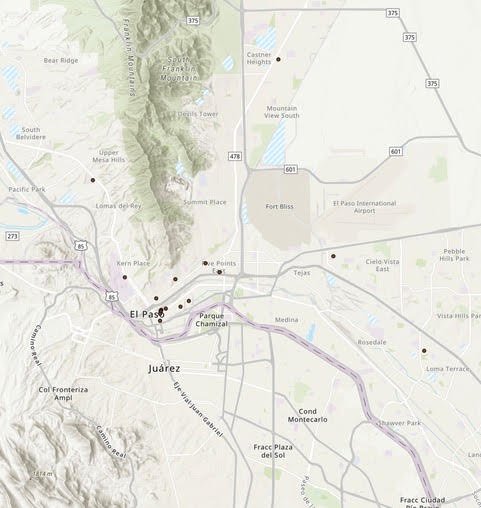
The City of El Paso maintains an official geographic information system, or GIS, with all kinds of useful information presented as layers on a map. One of the layers has a wonderfully straightforward name: Underutilized City Buildings. That isn’t my description of the buildings. It is the City’s. The City maintains this database, hosted on its own GIS system, and it can be viewed on the web. The layer identifies underutilized City buildings and includes information such as location and square footage.
Look at the attached image. All those little dots? Underutilized buildings. You can see the City’s GIS data here:

So we have two interesting facts sitting next to each other. The City has thousands of works of art that aren’t being seen. The City also has buildings it officially describes as underutilized or not being used to full capacity.
Seems like maybe those two ideas need to be introduced to each other.
What if El Paso took some of those “underutilized buildings” and converted them into mini El Paso Museums of Art? People in various sections of town could visit and see parts of the collection that are normally hidden away. These wouldn’t be other El Paso Museums of Art in the traditional sense. We already have one of those, and it suits our needs. These mini-sites could whet the appetites for people to want to go to the big museum Downtown.
I am not suggesting that we build another multimillion-dollar museum. Instead, I propose that the City look at the existing inventory of underutilized buildings and determine whether one or more of them could be adapted to allow the public to see more of the collection we already have. Buildings like the recently purchased Morehead Middle School or the Northeast Transit Terminal, which has over 16,000 square feet of unused space just sitting there gathering dust.

There is already a museum concept for this. It is usually called “visible storage” or “open storage.” Instead of displaying 20 paintings with lots of empty wall between them, visible-storage facilities allow museums to display much larger portions of their collections while still protecting the objects.
Paintings can be placed on hanging systems. Sculptures and objects can be displayed on shelves or behind protective glass. Photographs, prints and drawings can be rotated because they cannot remain exposed to light indefinitely. Instead of a traditional museum, it might look a little like a museum warehouse. A Sam’s Club for art. Wouldn’t you love to wander through a museum warehouse?
Imagine walking into a room and seeing 100 paintings instead of 20. Imagine discovering a painting that hasn’t been exhibited in El Paso since 1967. Imagine seeing photographs, prints, sculptures and other objects that have spent most of their existence sitting safely in storage.
Technology could make the idea even more interesting. Put as much of the collection as possible online and make it searchable. Let people discover works they are interested in, then tell them where to go see the actual version. Researchers and college students could request access to particular pieces, while schools could schedule collection visits. Artists and photographers could study original works instead of looking at little JPEGs on their phones.
Of course, this doesn’t mean every painting gets the warehouse treatment. Some works are too fragile or require special environmental conditions. Others may need conservation, and there may be legal or loan restrictions associated with still others. Those decisions should continue to be made by museum professionals. But if we can rotate those collections through multiple sites on a regular basis, soon a lot more of us are looking at a lot more art.
And converting an old building into a place suitable for storing and displaying art isn’t as simple as sweeping the floor and changing the locks. Artwork requires climate control, security, fire protection and proper lighting. The building has to meet accessibility requirements. It has to be staffed. Some of the City’s underutilized buildings might cost more to convert than the idea is worth.
Fine. Find out. The ones that we can’t use, we can’t use. But the ones we can use? That is where the magic begins.
The City already has one of the lists we need. It has identified underutilized City buildings, and EPMA knows what is in its collection. Put the two lists next to each other and see what happens.
Which City buildings are underutilized? How large are they? What condition are they in? Which ones could reasonably be converted into usable art cultural space? What would renovation cost?
Then ask the same questions about the art. How many works does EPMA own? How many are displayed today? How many haven’t been displayed in five years? Ten years? Twenty years? Are there pieces in the collection that haven’t been publicly exhibited in a generation?
Maybe the answer is that an Open Collection Center would be ridiculously expensive. Maybe none of the City’s underutilized buildings would work. Maybe conservation requirements make displaying significantly more of the collection impractical. If that’s what the numbers show, so be it.
But we won’t know until somebody asks.
There is something strange about having thousands of works of art held for the public while most of the public will never have an opportunity to see them. At the same time, there is something strange about a city owning buildings that it officially describes as underutilized. Neither situation necessarily means anyone is doing anything wrong or nefarious. Museums have limited space. Cities accumulate property. Buildings outlive their original purposes.
But art, especially publicly purchased or donated, or even entrusted to us for long-term care, belongs to everyone, and it should be as widely displayed as possible. Sometimes two problems can become one amazing solution.
We already have the art. We already have the buildings. It’s time we put the two together and let El Pasoans see more of what we’ve got.
Read: Read More