



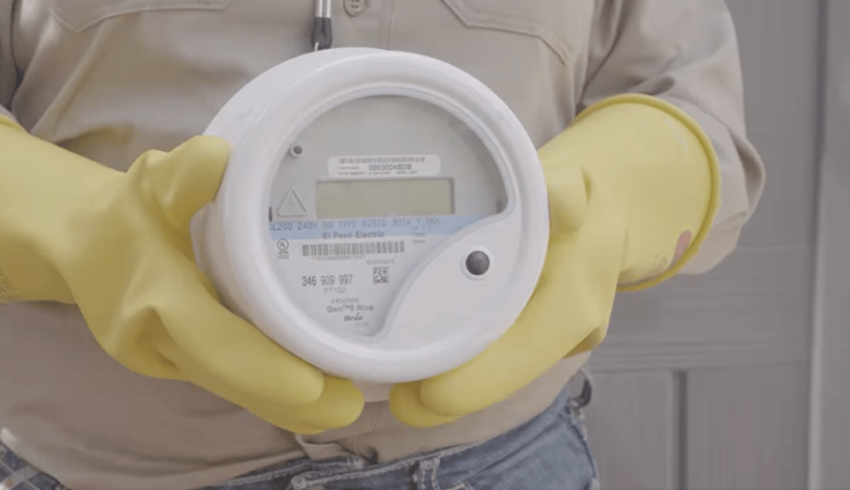
By next August, El Paso Electric will have installed over 500,000 smart meters in nearly every home and small business in the utility’s service area, which spans from from Hatch, New Mexico, to Van Horn, Texas.
There’s a common refrain in the utility industry that Thomas Edison – the American inventor who developed the first electric power plant in 1882 – could walk around today, 93 years after his death, and would still recognize most of the elements of today’s power grid: the wooden poles, wires and central generating stations.
To move beyond the grid of a century ago, utilities across North America have been trying to enable the next-generation power grid by swiftly installing new smart meters at virtually every home and business they serve. As of the end of 2023, power industry analysts estimated 80% of homes and businesses in the United States and Canada had smart meters.
The Texas Legislature in 2019 passed a bill introduced by Democratic State Rep. Joe Moody of El Paso which allowed utilities not tied into the state’s main grid – such as El Paso Electric – to deploy advanced meters and then collect the cost from customers through a bill surcharge.
El Paso Electric last year began replacing its meters with “smart meters” such as this one seen in a video created by the utility to inform customers about the process. Installations will continue through 2025. (Video screen shot courtesy El Paso Electric May 2023)
EPE won approval from Texas regulators for its smart meter rollout in late 2022, and started installing them in May 2023. As of mid-July, EPE said it had installed 312,000 smart meters. It expects to finish installing all 528,000 new meters by next August.
But why did EPE decide to spend $146 million to swap out old meters with smart ones? And how much is it costing you?
Here are 6 things to know about El Paso Electric’s rollout of smart meters:
1. How are smart meters different from my old meter?
The smart meters use radio frequency to remotely send information to EPE every 15 minutes about how much energy a home or business is using. Previous meters featured one-way communication with EPE – measuring your energy consumption so EPE could calculate your bill. Smart meters have two-way communication that can, for example, measure power a customer sends back onto the power grid from rooftop solar panels or a home battery storage system.
And in the past, meter readers employed by EPE had to physically enter properties at least every three months to read how much electricity the customer used during the billing period. EPE had to sometimes estimate how much electricity a customer used during a billing cycle if a meter reader couldn’t enter the property.
The smart meters allow customers to view on EPE’s website detailed data on how much energy they used during any 15-minute period during the month.
If you don’t yet have a smart meter, you can check the utility’s installation schedule at EPE’s interactive map.
2. Why does EPE want to know every 15 minutes how much power I’m using?
For customers, electricity generally costs the same regardless of when it’s used. For now, your bill won’t change whether you run your clothes dryer at 5 p.m. or at 3 a.m.
But for EPE, the time of day that a customer uses electricity matters a lot.
The amount of electricity that customers across EPE’s service territory are using usually peaks every day between 5 and 6 p.m., during the warm, early evening hours. That’s when solar panels stop producing power and after many EPE customers get home and crank their air conditioners or use appliances.
Since demand is higher in the early evening hours, there’s less electricity to go around. And when supply goes down but demand stays high, that means electricity is more valuable. So, EPE next year wants to test out charging some customers more for the electricity they consume during the afternoon and early evening, from 2 to 7 p.m. On the flip side, the utility wants to charge customers less for power they use during all other hours, from late at night through the early afternoon.
El Paso Electric last year began replacing its meters with “smart meters” such as this one. (Video screen shot courtesy El Paso Electric May 2023)
The installation of smart meters is the first step that will enable EPE to create new, so-called “time-of-use” rates that incentivize customers to, for example, run the dishwasher or laundry machine at night time or early in the morning instead of the early evening. But EPE has to install smart meters before it can implement time-of-use rates on a big scale.
Ideally, smart meter installations will allow customers to help ensure there’s always enough electricity for the region by lowering peak demand – or the maximum amount of electricity customers are using at any moment during a day – instead of the utility increasing the supply of electricity. EPE’s executives don’t want to spend hundreds of millions of dollars to build a new natural gas power plant that EPE likely would only need to run on a handful of hot summer afternoons. Those are the few times during the year when the supply of electricity across the Borderland gets tight; most of the time in El Paso, there’s a comfortable margin between supply and demand.
3. How much is this new meter costing me? And do I have to get a smart meter?
EPE’s residential customers are paying a monthly surcharge of just over $2 to fund the installation of smart meters in the region. In all, EPE is spending $146 million to buy and install 528,000 smart meters.
El Paso Electric ratepayers can choose not to get a new smart meter from the utility. But customers who opt out have to pay a one-time fee that ranges from $106 to $171 depending on the customer, plus a monthly fee of over $13.
4. Will I save money under new “time-of-use” rates?
Possibly.
EPE is trying to get utility regulators in Texas and New Mexico to approve a pilot program in both states where EPE next year would sign up a few thousand customers and test the impact of time-of-use, or TOU, rates. EPE wants to see how much customers respond to higher prices in the evening and lower prices the rest of the day by changing habits around power usage.
EPE in May told the Public Utility Commission of Texas that household customers could save something like $2.50 to $3.50 on monthly bills under the proposed rates if they shift a chunk of their electricity usage to the hours outside of 2-7 p.m. (From 7 p.m. at night through 2 p.m. the next day.)
The utility wants to eventually get most or all of its customers on time-of-use rates, depending on how the pilot program goes next year.
For perspective, EPE currently charges customers just over 10 cents for each kilowatt-hour a customer uses from May through October, and about 9 cents per kilowatt-hour from November through April.
Under the new TOU rates, EPE’s monthly flat charge of $9.25 would stay the same.
El Paso Electric last year began replacing its meters with “smart meters” such as this one. The smart meters track energy use in real time and sends the data directly to the utility through a secure communication network. Installations will continue through 2025. (Cindy Ramirez / El Paso Matters)
Here’s one of the big changes EPE is proposing for Texas customers: During the weekday “peak” hours of 2-7 p.m. from June through September, customers would have to pay 38 cents per kilowatt-hour – almost four times more than the current price – and just under 10 cents per kWh during the rest of the “non-peak” hours in the day.
For the rest of the year, from October through May, EPE would charge under 4 cents per unit of power, less than half the current rate for non-summer months. That’s why EPE says customers can save money – but only if they change their habits.
TOU rates enabled by smart meters “could allow customers to realize bill savings by adjusting demand and energy usage based on price signals, while enabling EPE to reduce overall costs in the future through more efficient use of grid and generation capacity,” George Novela, a director with EPE, told the PUC.
In the long-run, TOU rates can allow EPE to avoid or delay building a new power plant, and could lead to “reduced average rates for customers than would otherwise be needed” without TOU rates, Novela said.
5. Is my smart meter making my electric bill go up? Why have customers of other U.S. utilities tried to halt smart meter installations?
Some local ratepayers tried to get the PUC to deny EPE’s request to deploy smart meters. They cited concerns that EPE would be able to remotely control customers’ thermostats, or that the utility would be able to inaccurately inflate the amount of electricity the meter said a customer used. Others worried about the utility’s workers coming on their property to install a new meter. In other parts of the U.S., ratepayers have said the radio frequency used by smart meters can affect human health.
And nationwide, some utility ratepayers have also said their power bill ballooned after receiving a smart meter.
However, smart meters are not the same as smart thermostat products; EPE has no control over customers’ thermostats, and can’t see how customers’ use individual appliances in their home. And smart meters likely read power usage more accurately than old meters, particularly compared with older meters where the utility had to physically read usage at a customers’ home, or estimate it. The amount of radiation from smart meters is a small fraction of the radiation given off by cellphones or microwave ovens.
Meanwhile, EPE – and every other electric utility – has maintained that smart meters don’t lead to increased bills beyond the monthly surcharge that funds installation. EPE has said customers likely saw bill increases because summer temperatures drove more air conditioner usage, or because of some individual factor.
6. What are other impacts of EPE installing smart meters across the region?
EPE said smart meters will also allow the utility to pinpoint where power outages are happening and see what the cause is so that the utility can respond more quickly. Also, consider that the Newman 6 natural gas power plant is the biggest source of heat-trapping greenhouse gas pollution in El Paso County. If smart meters allow EPE to delay or avoid developing new gas-fired power plants, that means the utility will produce less air pollution than it would if it hadn’t deployed smart meters.
The post 6 things to know about El Paso Electric’s smart meter rollout appeared first on El Paso Matters.
Read: Read More