




This is the second in a two-part series about pecan farming in the El Paso region. You can read Part I here.
Inside a nondescript building off North Loop Drive, where longtime farmland sits adjacent to new housing developments, Girisha Ganjegunte is one of several Texas A&M University researchers studying how to save – or maybe just prolong – agriculture in the Lower Valley.
He talks about math formulas and soil chemistry, and pulls up graphs on his computer indicating some of his experiments have shown promise at reducing salt levels in pecan orchards, one of many things bedeviling farmers in the El Paso region.
Farmers, he said, don’t always care to know the mathematical details of his work. They just want to know how to maintain their pecan orchards or crop farms with the salty groundwater they’re forced to use when the Rio Grande only flows for a couple of months like it is this year – hardly long enough to sustain a crop.
Ultimately, it’s all about fighting off drought so that farmers can keep farming and pass on the practice to future generations instead of selling their land to urban developers.
“Farmers want to do one thing most of all: They want to make sure that the ground is in good shape so their family can keep farming in the future,” said Isaiah Ulmer, a farmer who grows pecans on several hundred acres in Canutillo, near the New Mexico-Texas state line. “It’s just that simple.”
Borderland researchers such as Ganjegunte – a professor of water resources salinity management with Texas A&M’s AgriLife Research Center in El Paso – are trying to help farmers here sustain and innovate in the face of drought, escalating temperatures and increasingly salty groundwater.
Ganjegunte said the idea of selling land becomes more alluring to growers as environmental challenges mount and land prices increase to as high as almost $1 million per acre for plots near Interstate 10, he said.
“Then put it in the bank and just retire. Why fight with lack of water, salinity and an uncertain future?” Ganjegunte said during an interview at his office at Texas A&M’s research farm in Socorro. “It’s uncertainty that’s kind of making people worried about agriculture.”

This year, farmers have been grappling with a brief river season – the Rio Grande began flowing in June and will run only through August – about five months shorter than a typical season. And when the river doesn’t supply enough water to grow a crop, farmers have to spend money to pump groundwater with higher salinity that some crops such as pecans don’t like.
Researchers have a confluence of factors to untangle: water use, the cultural history of farming in the region, and the economic importance of agriculture in the borderland – one of the major pecan-growing areas in the United States.
A water future for residents and farmers?
The challenge facing agriculture – and especially pecan growers – in El Paso is clear.
Growers in the Upper and Lower valleys rely on water flowing through the Rio Grande to irrigate their crops.
The length of time that the Rio Grande flows in any year – and the amount of water available for farmers – depends on how much snow packs up in the mountains of southern Colorado and northern New Mexico and then melts and flows into Elephant Butte in New Mexico.

Elephant Butte, about 120 miles north of El Paso, was built in the 1920s to control the flow of water to prevent flooding and so that planners could divide the water. Over the last 20 years, drought has led to consistently low levels of water stored in the reservoir – especially compared with the 1980s and 1990s.
In recent years, that’s left farmers far more reliant on pumping the region’s salty groundwater to sustain their crops. For pecans, salty water can lead to smaller nuts and lower yields, which makes farming less economical.
“From when I was born, it was the golden years – until I was 21 or 22, it was only surface water, no groundwater,” said Shannon Ivey, a 45-year-old fourth-generation pecan farmer in Tornillo in far East El Paso County.
In the early 2000s, Ivey’s father salvaged old wells on the family’s farm to start pumping groundwater as the drought that persists today first set in.
“My entire life, I had never seen (wells on the farm) because, sometime in the ’70s, when the drought had broken, my dad had pulled the motors, engine blocks, pump, column pipe, everything, and stored a lot of it or sold a lot of it,” Ivey said. “And they were capped with just covers on a hole in the ground.”

Short river seasons could become the norm.
Researchers at the University of Texas at El Paso have used computer models to predict water levels at Elephant Butte based on snowfall trends at the head of the Rio Grande watershed.
“It does look like there’ll be less water – substantially less water – and that the number of consecutive years where we’re below the full (river) allocation will increase,” said UTEP professor Alex Mayer, director of the university’s Center for Environmental Resource Management. “And that’s primarily due to climate change in the headwaters.”
Less river water means farmers shift to rely on the underground aquifers that El Paso and Ciudad Juárez also tap for drinking water supplies.
Mayer said it’s difficult to measure how much water is stored in either the Mesilla Bolson aquifer west of the Franklin Mountains or the larger Hueco Bolson that’s on the east side of the mountain range, where water sits deep below the surface in between particles of sand and rock.
But from his calculations, he said there’s only “a matter of decades of fresh water left in the Hueco Bolson.”
In recent years, city-owned El Paso Water has dialed back its groundwater pumping to preserve the aquifers. And water managers with the utility say there’s still a vast amount of brackish – or slightly salty – groundwater available to meet the city’s water needs for many years to come.
That’s why El Paso Water built the Kay Bailey Hutchison Desalination plant near El Paso International Airport in 2007, which it’s expanding to produce as much as 33.5 million gallons per day. That’s equal to about 30% of the average amount of water the utility’s customers use every day.
Still, Mayer warned that El Pasoans have no control over how much water residents use in Juárez – which doesn’t get any water from the Rio Grande.
“It’s quite clear that the aquifers are being overdrawn,” Mayer said. “The brackish water, you could say there’s a lot and that it’ll never be threatened. But I think that’s what we thought about the freshwater, too.”
El Paso Water is also reducing its reliance on the Rio Grande for drinking water so that, if no water flows through the river in any given year, it could still meet the city’s demand and avoid a water shortage.
In addition to desalinating groundwater, El Paso Water is building the cutting-edge Pure Water Center near the Ysleta-Zaragoza Port of Entry to treat wastewater to drinkable standards and pump as much as 10 million gallons per day back into the city’s drinking water system.
Longer-term, El Paso Water plans to pipe in water from the aquifers beneath Dell City, Texas, about 90 miles east of El Paso.
While El Paso’s water supply appears secure for decades into the future, water bills will continue to rise. Pumping and treating an acre-foot (about 326,000 gallons) of groundwater costs El Paso Water roughly $250, and an acre-foot of river water costs about $340 to produce.
An acre-foot of water from the desalination plant or the Pure Water Center will cost about $500 for the utility to produce, while importing water from Dell City could cost around $1,300 per acre-foot.
“El Paso Water has demonstrated that they can diversify,” Mayer said. “But there’s a consequence to that. That’s the cost to consumers.”

Solutions to sustain pecan crops in El Paso
A future with shorter river seasons and more aquifer pumping appears bleak. But farmers and researchers aren’t giving up on agriculture in El Paso – and for good reason.
Several novel and innovative techniques have shown promise to help sustain farming here by increasing water efficiency – essentially, helping trees drink up more of the water used in irrigation. There’s also emerging ideas about how to reduce salinity levels in the water that results from using brackish groundwater, especially in the Lower Valley.
Soil and groundwater in the Upper Valley generally contain lower levels of salt; groundwater becomes saltier the further east you are of the Franklin Mountains.

When farmers flood irrigate with brackish water, it leaves a hard-crust on the soil surface that’s hard for water to permeate to reach pecan tree roots. That can lead to “stunted growth and lower nut production,” in pecan trees, said Kimberly Cervantes, an assistant professor and extension horticulture specialist with Texas A&M’s AgriLife Research Center in El Paso.
There are a lot of ideas about how to stop salt from building up, or how to break up the salty, hard soil. Some ideas are higher-tech than others.
“While these strategies cannot fully eliminate the risks of saline water, they significantly improve the soil’s resilience and help mitigate negative effects on trees,” Cervantes said.
Both Cervantes and Ganjegunte said farmers can implement different tillage practices – essentially, turning up the earth – to help mitigate the salt accumulation.
“Tillage practices like excavation can help stir and overturn the soil by breaking down clay particles,” which improves water infiltration, Cervantes said.
Ganjegunte developed his own method of mixing a certain kind of powdered polymer with irrigation water, which reduces salinity in the soil and improves trees’ water intake.
Sodium “makes the soil so impervious it will just pond,” Ganjegunte said. Applying the polymer can allow a farmer to excavate their land every four or five years instead of every year or two, he said.
“We need to make the farmer’s life better,” he said.

Ivey said a private company is operating a kind of pilot lab on 65 acres of his 600-acre property, where they’re experimenting with using micro-algae that is “basically, creating an environment that’s less sodic, which increases leachability and permeability and better soil health,” he said.
While optimistic, Ivey said new technology and practices come with limitations – especially at a big scale.
Introducing the polymer Ganjegunte developed into irrigation is still too costly – as much as $1,000 per acre. Instead of using the polymer, the material gypsum has helped reduce salt levels and increase soil porosity, but farmers have to buy huge quantities.
And the micro-algae has to be developed to fit the specific soil profile where it will be applied. Implementing the micro-algae also requires electricity, water and an on-site lab. But more research on farms could yield results in the future.
“To mitigate salts,” Ivey said, “I’m open to anything and everything.”
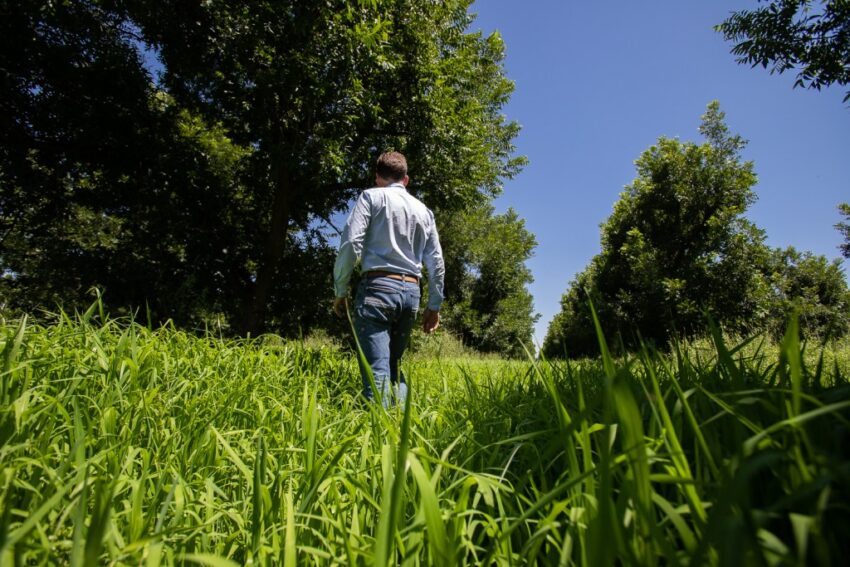
Perhaps the most promising change for pecan farmers is simply allowing vegetation to grow on orchard floors instead of mowing and clearing them constantly.
So-called cover crops – a variety of different grasses and plants, including sunflowers – that sprawl across orchards generally aren’t a source of revenue for farmers. But they help in the orchards in several ways, Ivey said, including by avoiding the cost of cleaning them with machinery.

“There’s more benefits, in my opinion, than cons to allowing the vegetation. Chief amongst those is you’ve got cooler soil temperatures,” he said, “you’ve got longer soil moisture retention, and then you’ve got better permeability.”
Ulmer said allowing cover crops to grow in orchards is the best way to mitigate the record-setting heat El Paso has experienced in recent years, which stresses trees.
“Planting cover crops out there, one of the number one things it did that I was just blown away by … It grew quicker than the weeds could, so it over-competed with the weeds,” he said. “We reduced our broad leaf weed population, I would say, by somewhere between 80% and 90%. Which means we weren’t using any Roundup.”
Orchards with cover crops also feature more biodiversity, which helps trees grow and remain healthy, Ulmer said.
“We’re creating our own little microclimates in those orchards,” he said. “You walk into an orchard with a cover crop, and the humidity index is noticeably higher.”
Farmers and academics don’t always agree. Researchers have said farmers should shift to drip irrigation systems instead of flood irrigation, which results in water lost to evaporation. But the infrastructure can be costly and not necessarily more water-efficient, Ivey argued.
Other ideas include gradually planting pomegranate trees on more acreage, or introducing quinoa, which is valuable and highly tolerant to salt. But the economics of alternative crops and how to set up a supply chain to get the product to market still has to be evaluated.
That already exists for pecans in this region. Ivey uses a pecan-shelling plant a short drive from his farm, which also includes a massive cold-storage facility where hundreds of tons of pecans are stacked in massive sacks waiting for forklifts to haul them off. Growers can hold nuts there if they’re waiting for a buyer or for prices to rise.
Mayer, the UTEP water professor, said farmers will likely need to convert to different crops that require less water than pecans or plan to convert the farmland to other uses.
“I think it’s time that we really sit down and consider what to do in the next several decades to help farmers convert to something different,” he said.

Agricultural researchers are also trying to sustain farming here to preserve the region’s culture, an unquantifiable element that’s hard to parse out with data and formulas.
But for the rural, largely Spanish-speaking communities surrounding El Paso that have for decades relied on farming as a way of life, maintaining the culture of growing is as important as anything else.
“Sustaining the pecan industry is not just about economics – it’s also about preserving a way of life and a vital part of West Texas’ cultural heritage,” she said. “With innovation, stewardship and community support, pecan farming in El Paso can remain a vibrant and sustainable industry for generations to come.”
Ulmer acknowledged the “problems” such as rising heat and greater reliance on brackish groundwater may force some local farmers out of business in the coming years. But he said those challenges also create opportunities for pecan growers.
“The farmers that I know are working their butts off every single day to stretch these resources,” Ulmer said. “And they’ve been doing it for years now, working with less and less and figuring it out and producing some pretty decent crops.”
“A lot of guys will sit around and cuss the heat,” Ulmer said, “and say ‘Man, we’ve got all of these problems.’”
“But, for some guys out there, we might just get really lucky and live through this thing,” he said. “And, if we’ll really listen to what the environment is telling us, to change what we’re doing and implement some really positive changes, they might just help us do things better.”
The post As drought, climate change pressure El Paso water supply, farmers innovate to sustain orchards in one of nation’s biggest pecan-growing hubs appeared first on El Paso Matters.
Read: Read More