




A growing measles outbreak in West Texas – the state’s worst in decades – signals the resurgence of a highly contagious, vaccine-preventable disease.
The Texas Department of State Health Services reported 90 measles cases in the South Plains region, about 250 miles away from El Paso, as of Friday. More than a dozen people were hospitalized. New Mexico health officials also confirmed nine measles cases in neighboring Lea County, as of Thursday.
Almost all the cases were unvaccinated patients, mostly children.
The epicenter of the Texas outbreak, Gaines County, has one of the lowest vaccination rates in the state. Only 82% of Gaines County kindergarteners received the measles-mumps-rubella, or MMR, vaccine last school year compared to 96% of El Paso County kindergarteners.
A community needs an immunization rate of 95% to prevent the spread of measles, according to the Centers for Disease Control and Prevention.
The measles outbreak highlights how quickly vaccine-preventable diseases can spread when immunization rates decline, said El Paso public health director Dr. Vinny Taneja in an email provided by the city.
“Vaccines have long been a critical tool in preventing serious illnesses and keeping communities healthy,” Taneja said. “Ensuring families have access to immunizations and trusted information allows parents to make the best decisions for their children while also helping to reduce the risk of outbreaks.”
The two-dose MMR vaccine is one of six vaccines Texas requires for public and private school students in kindergarten through sixth grade, along with:
- Diphtheria/tetanus/pertussis (whooping cough)
- Polio
- Hepatitis B
- Hepatitis A
- Varicella (chicken pox)
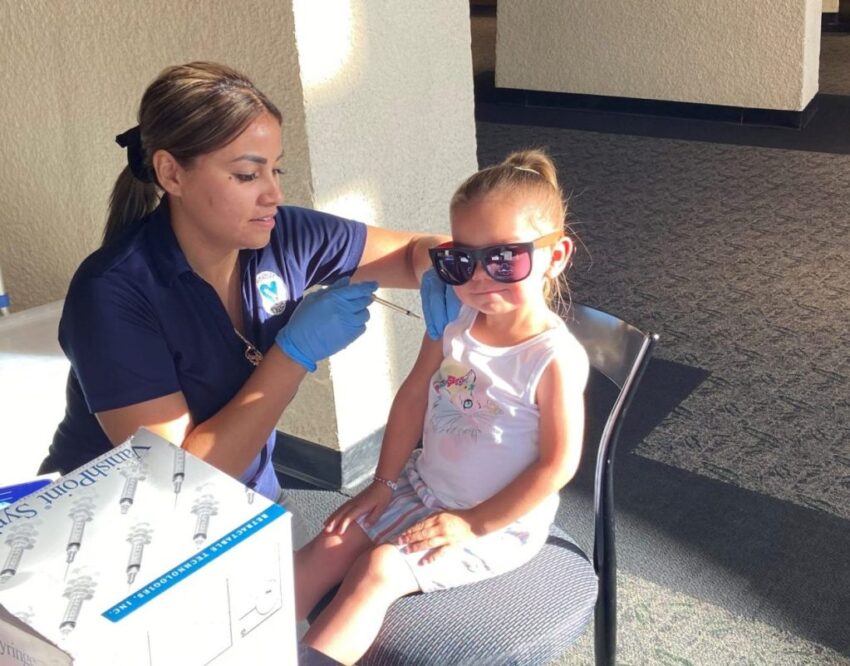
Vaccination efforts in El Paso include immunization clinics, outreach events and collaborations with schools and health care providers, he said.
The El Paso Department of Public Health released an advisory Feb. 13 asking health care providers to report suspected measles cases to the city’s epidemiology team while the patient is still in their facility.
Measles is a contagious respiratory virus that spreads by breathing infectious droplets, such as from a cough or sneeze, and by touching contaminated surfaces. The measles virus can survive in the air and on surfaces for up to two hours. A person is contagious four days prior to and four days after developing a rash, according to the advisory. Blotchy red spots typically appear first on the face before spreading to the rest of the body.
Unvaccinated children are most at risk for severe complications, including pneumonia, from measles. Vaccinated children rarely get measles and though breakthrough infections may occur, their symptoms are usually mild and they are less likely to spread the virus to others, said Ivan Luna, director of Immunize El Paso.
Five of the 90 people infected in the ongoing West Texas measles outbreak were vaccinated, according to the state health department.
Of the 15 largest counties in Texas, the three with the highest immunization rates among kindergarteners – Cameron, Hidalgo and El Paso – are located along the U.S.-Mexico border, according to state health data.
Border counties also tend to have lower rates of vaccine exemptions.

vaccine, school year 2023-2024. (Screenshot from Texas Department of State Health Services Annual Report of Immunization Status of Students)
Many cases in the growing West Texas measles outbreak were in the close-knit, undervaccinated Mennonite community in Gaines County, near Lubbock. The last measles outbreak in El Paso occurred in 2019, which health officials linked to an outbreak in New York City’s Orthodox Jewish communities, the El Paso Times reported.
Some religious groups tend to shun vaccines more than others, but faith leaders – including Mennonite and Orthodox Jewish authorities – have come out to endorse vaccines for the greater health of their communities or oppose vaccine exemptions based on doctrine.
“El Paso’s consistently strong vaccination rates reflect a culture that deeply values medical professionals and their expertise,” Luna said.
While other Texas counties rely solely on their health department, El Paso also taps into resources from additional organizations such as Immunize El Paso to have a robust, community-driven approach to vaccine access, he added.
El Paso’s childhood vaccination rates are higher than the state’s overall rate, but declined during the COVID-19 pandemic, with a significant dip in the 2021 school year. Numbers have not quite returned to pre-pandemic levels — part of a nationwide decline.
Since the pandemic, social media misinformation has affected people’s day-to-day lives and many parents have opted to claim vaccine exemptions for different reasons, Luna said. Having a high vaccination rate is important, however, because it creates a shield of protection for everyone, especially vulnerable children who can’t get vaccinated because of health issues, he said. Herd immunity makes it harder for diseases to spread.
Nationally, charter schools and private schools tend to lag traditional public schools in vaccinations, though students are required to submit proof of immunization.
The Texas Department of State Health Services publishes an annual data report of school vaccine coverage and exemptions by district and county. Private schools and charter school districts, which have far fewer students than El Paso’s major public school districts, are listed individually, which can skew comparisons.
Among traditional public school districts, El Paso Independent School District, which has 48 elementary schools, had the lowest MMR vaccination rate for kindergarteners at 94% last school year.
Among private schools, Jesus Chapel School, El Paso Adventist Junior Academy and Immanuel Christian School had the lowest MMR vaccination rates among kindergarteners.
Jesus Chapel School in East El Paso has a kindergarten class size of eight with one student’s family submitting an affidavit for vaccine exemption, said the school’s principal Andrew Reynoso in an email.
Schoolwide, a few parents choose to exercise their right to an exemption from immunization for reasons of conscience, including religious beliefs, and submit the state-approved affidavit, Reynoso said.
Immanuel Christian School in East El Paso had among the lowest coverage against measles for both kindergarteners and seventh graders in the county last school year, despite having no families requesting exemptions, according to state data.
“This year we have worked diligently with our families, communicating with them by phone, through email, and in person, and we are pleased to see our numbers improving dramatically,” said Rachel Frecka, head of Immanuel Christian School, in an email. “Our goal is always full compliance with state requirements, and we will continue to work with our families to that end.”
Among charter schools, 4% of students at Vista del Futuro Charter School had a vaccine exemption. Vista del Futuro, its own district with one elementary school, and Burnham Wood Charter School District, which has three schools, are part of the private company El Paso Education Initiative Inc.
Burnham Wood and Vista del Futuro Superintendent Joe E. Gonzales said in a phone call his charter schools fell behind vaccination rates and recordkeeping because of a personnel gap. After El Paso Matters contacted Gonzales for comment and a school nurse brought the topic to his attention, the schools began asking parents for updated immunization records and, with parents’ consent, taking students to a health clinic to get their missing school-required vaccines, he said.
Potential policies on the state and federal level, however, could hinder local efforts to protect children from dangerous, vaccine-preventable diseases including measles, polio and whooping cough.
Republican lawmakers in Texas have pushed several bills to weaken vaccine mandates and make it harder to immunize the population, including:
- SB 118, which takes away the authority to exclude unvaccinated students from attending school during an epidemic or public health emergency
- HB 468, which prohibits the state from requiring immunizations against additional diseases to attend school without legislative approval
- SB 623, which gives pharmacists the authority to not administer vaccines
Texas Sen. Bob Hall of Rockwall, who introduced SB 118, has previously said COVID-19 vaccines are “killing more people than they are saving.”
President Donald Trump, who appointed a vaccine cynic as the nation’s top health official, has also suggested a false link between childhood vaccines and autism, a common myth in the anti-vaccine movement despite an enormous amount of data that shows no connection.
New Secretary of Health and Human Services, Robert F. Kennedy Jr., has promised to investigate the childhood vaccine schedule, telling agency employees at his Tuesday welcome ceremony, “Nothing is going to be off limits.”
Kennedy denies being anti-vaccine, though health officials in Samoa have criticized Kennedy for fueling an anti-vaccine campaign during a 2019 visit to the island country in 2019. Samoa suffered a deadly measles outbreak later that year that led to at least 83 deaths, mostly in babies and young children, The Guardian reported.
Two doses of the MMR vaccine is about 97% effective at preventing measles, according to the CDC.
Taneja said the El Paso health department’s priority is to ensure families have access to both vaccines and trusted health information so they can make the best decisions for their children.
“Regardless of changes at the state or federal level, we will continue to focus on providing immunization services, working with healthcare providers and schools, and engaging in community outreach to support overall public health,” Taneja said.
The post As West Texas measles outbreak spreads, how protected are El Paso school children? appeared first on El Paso Matters.
Read: Read More