



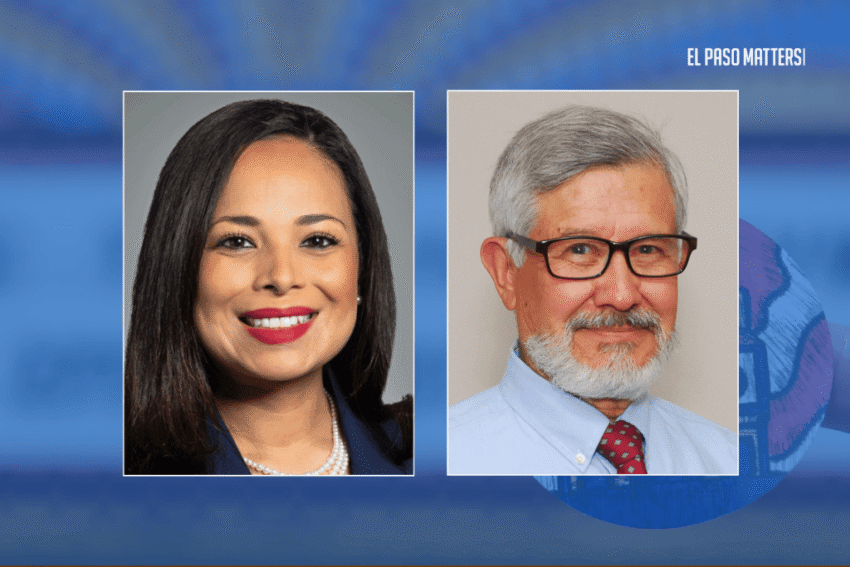

The race for House District 79 state representative pits Democratic incumbent Claudia Ordaz against Republican Jesse Romero, a retired Realtor and Navy veteran who previously ran unsuccessfully for El Paso city representative.
Ordaz, 40, is seeking a third term as state representative. She previously represented District 76, covering part of the Lower Valley, before redistricting took effect in 2022. Her political career began in 2014, when she was elected as City Council District 6 representative.
Romero, 73, is a first-time candidate for the state representative seat. Currently a security officer, Romero had an unsuccessful run for El Paso City Council District 3 representative in 2024.
The winner will represent District 79, which stretches from Northeast El Paso, Fort Bliss, to East El Paso. State representatives consider proposed laws and resolutions, propose constitutional amendments, file bills that may become state law and appropriate funds for the operation of state government. They serve two-year terms and are paid $7,200 a year.
Both candidates were unopposed in the March primaries.
Claudia Ordaz
Accomplishments Ordaz listed during her term include strengthening state animal cruelty laws, securing economic development funding for the city and supporting students with intellectual and developmental disabilities.
Six of 52 bills authored or jointly-authored by Ordaz related to animal protection rights. Among them is House Bill 285, which went into effect September 2025, and defines offenses of cruelty toward nonlivestock animals – like transporting or confining animals in a cruel manner or unreasonably abandoning an animal in a person’s custody.
She said her work supporting “furry friends” has earned her the moniker of “animal lady.” If reelected, Ordaz wants to continue giving a voice to “voiceless” animals.
“One idea I’m exploring is dedicating a scratch off Texas lottery ticket that could generate funding for shelters across the state,” Ordaz said. “And I’m also looking at whether a portion of the revenue associated with pet food sales could be directed back to the shelters that are carrying for those animals.”
Additionally, Ordaz wants to build off momentum toward childcare accessibility in El Paso. House Bill 2652 — authored by Ordaz and jointly authored by other El Paso state representatives — is an El Paso-specific bill that would bring together employers, workforce partners and child care providers to accommodate caregiver services to parents who don’t work a typical 9 to 5 job. Passed by the House in the 89th Legislature, HB 2652 is being referred to the Senate Economic Development Committee.
Currently going through fertility care, Ordaz brought forth legislation for women’s healthcare issues she’s personally experienced, as well as from other women she’s spoken to going through similar health challenges.
“I want to continue to address some of the experiences women have in the healthcare system,” Ordaz said. “That includes pain management for IUD procedures, fertility care, maternal health, and just making sure women have better information about their reproductive health much earlier in life.”
She said she especially wants to look at how to support veterans and military families experiencing infertility.
Ordaz said she’s eyeing mobile reproductive and maternal health units that could bring free and affordable services to different neighborhoods, including a full range of birth control options, screenings and treatments for sexually transmitted infections, diabetes, and breast and cervical cancer screenings. These units are currently available in South Texas.
On school vouchers: Noting she’s a “product of public schools” and that her late mother was a retired educator, Ordaz said public education is a top priority. In the 89th Legislature, Ordaz supported House Bill 2, which gave teachers with at least three years experience a raise.
Ordaz said she supports private or home schooling, but not expanding the voucher system without proper funding for public schools.
“We can’t support putting billions more into expanding the voucher program, while Texas has not properly funded the public school system,” Ordaz said. “We have a constitutional responsibility to provide that (public schooling).”
In its inaugural year, school vouchers cost Texas taxpayers $1 billion. Ordaz said these numbers are projected to grow to $3.3 billion by 2028 and $4.8 billion by 2030.
On Meta data center: While the $14 billion data center under construction in the Northeast may bring “significant investment and significant economic opportunity,” Ordaz said, the salient question is “how we manage this extraordinary growth and make sure that the people who already live, and do business here, aren’t paying the price.”
Opportunity comes at the price of “enormous electricity demands, significant water and infrastructure needs,” she said.
Ordaz said state regulations surrounding data centers fail to include the El Paso area.
In August, Gov. Greg Abbott announced that Meta would comply with new state data center standards overseen by the Public Utilities Commission of Texas and the Electric Reliability Council of Texas to protect residents’ quality of life. However, ERCOT’s service region does not extend to El Paso and Hudspeth counties.
Ordaz said she’s had conversations about economic and environmental impacts of data centers with the city of El Paso, El Paso Water and the main author of the data center regulation bill asking that El Paso “have a seat at the table.”
On unfunded state mandates: Ordaz said her experience as a city and state representative has allowed her to be on both the giving and receiving end of unfunded state mandates. Much too often the cost falls on local taxpayers, Ordaz said.
“I’m a big proponent of local control, but it doesn’t mean a blank check either, right?” Ordaz said.
In speaking with local superintendents, Ordaz said she found frustration with school-specific unfunded mandates clear: “They (schools) were being asked to comply with more requirements, and at the same time, they’re dealing with declining enrollment, limited resources, and budget pressures.”
So in handling unfunded mandates, she said, “it goes both ways.”
“We, as in Austin, shouldn’t pass the buck to local governments, and local governments should also be accountable for those public dollars,” Ordaz said.
Jesse Romero
Despite his unsuccessful run for office two years ago, Romero said the campaign was a fruitful experience that prepared him to run for state representative. He said each attempt at an elected position, even if unavailing, is a building block for the “long haul.”
If elected, Romero’s priorities are tourism and economic development. Among his checklist of proposed tourism developments, Romero would like to expand San Jacinto Plaza and renovate Scenic Drive. Both are city-owned and operated, though state programs could help provide funding.
To spur economic development, Romero would like to attract manufacturers to El Paso to spur more jobs and revenue for the city, though he didn’t specify what type or give any specific plans on how he’d accomplish that.
On school vouchers: Romero critiqued local public school expenditures, saying funds focused on “nicer and nicer stadiums and buildings” rather than on academic efforts. He incorrectly stated that school vouchers covered charter schools, arguing they may “have a better chance” of the fixed amount of money going into the school through tuition fees and now school voucher allocations.
Romero said public school budgets are more prone to fluctuation due to their dependence on enrollment numbers, property taxes, and state and federal funding.
He admitted he “does not know enough about it to compare.”
The state sets funding formulas for public schools and provides more than 30% of their funding, while local property taxes account for about 50%.
On Meta data center: To resolve some environmental concerns for Meta data centers, Romero said it would be more efficient to swap to “HVAC systems” to cool the equipment rather than using a planned closed-loop liquid cooling system that recycles water.
He also faults the City Council for not negotiating well with Meta, resulting in more harm than benefit to the city, he said. He mentioned it “wasn’t a good contract” because of the tax breaks for the data center.
On unfunded mandates: Though Romero in an interview did not offer a clear response on how’d he approach unfunded state mandates, he referenced House Bill 2127, or the “Death Star” bill, that went into effect in 2023 limiting the ability of cities and counties to pass and enforce local regulations that go beyond state law.
On the El Paso Matters candidate questionnaire asking what the state should do about unfunded or underfunded mandates, Romero said Texas should pay for “services rendered” by the city and county.
Campaign finance
When it comes to campaign finance, Ordaz far outpaced her opponent.
Ordaz received about $25,600 in political contributions from January to late September, according to campaign finance reports filed with the Texas Ethics Commission. AGC of Texas PAC – which supports candidates whose policies favor “heavy highway construction” – and Jobe Concrete owner Stanley Jobe donated the biggest sums of $5,000 each.
She received donations from several political action committees, including $4,000 from the Texas Sands PAC that promotes casino legalization, $2,500 each from the Texas Realtors PAC and the healthcare HOSPAC, and $1,000 each from the Phillips 66 PAC that influences energy sector legislation and the Texas State Teachers Association PAC. She also received a $1,000 contribution from Democrat Elizabeth Pannill Fletcher, who is seeking reelection to Congress in the Houston area.
Ordaz has about $80,000 cash on-hand, her reports show.
Romero raised $340 in contributions from January to September, and reported donating $17 to his own campaign, his filings show. He also reported an in-kind contribution of $300 from Texans for Greg Abbott for a travel bus and loaned his campaign $1,100.
Romero has about $295 in outstanding loans and $125 cash on-hand.
Early voting runs Oct. 19 through Oct. 30, with Election Day on Nov. 3.
The post Democrat Claudia Ordaz seeks third term as Republican Jesse Romero makes first run for Texas House appeared first on El Paso Matters.
Read: Read More