



Years after being deemed a largely unsuccessful effort, El Paso’s recycling program is on the cusp of success.
The program is nearing its goal of reducing the contamination rate — the percentage of non-recyclable items mistakenly placed in blue bins — to 23%. This threshold is crucial for the program, as it could save the city from hefty fees associated with hauling away contaminated recycling material.
In the first six months of 2024, city officials said the contamination rate is at 25.5%, a slight increase from 24% last year but a marked improvement from six years ago, when nearly a third of all items placed in blue bins weren’t recyclable.
Even as a downward trend in contamination is evident, El Paso has seen a puzzling drop in the amount of items recycled recently, said Nicholas Ybarra, assistant director of the city’s Environmental Services Department.
Last year, the city reported a sharp decline in recycled material compared with a decade ago, when nearly 32,990 tons of recyclables were reported in 2014. In 2023, the city’s recycling program recycled about 19,400 tons of material, a 41% decline.
Ybarra said the city has collected an estimated 16,000 to 17,000 tons of recyclables in the first six months of 2024. He said the city expects to see 18,000 tons by the end of August.
“Typically, we see closer to 25,000 to 30,000 tons of recyclable material at the facility,” he said. “I think we just need to get out there and do more outreach about recycling.”
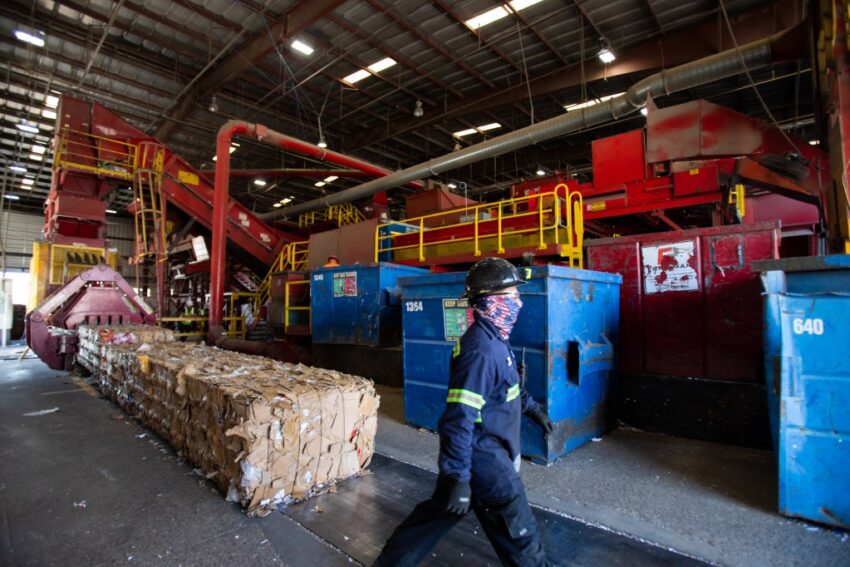
A truck carrying cardboard arrives at the BARCO Recyling plant, Aug. 2, 2024. (Corrie Boudreaux/El Paso Matters)
For residents, recycling is “not on the top of their head when they’re living their everyday life,” Ybarra said. “So we’ve just got to get out there more and just give them a friendly reminder that we have our recycling program, how much it helps the city and the environment.”
Last year, the city paid BARCO, the company that manages El Paso’s recycling plant, $129,000 to haul away trash, Ybarra said. This year, the city has paid about $85,000, which Ybarra said is the result of a lower volume of recyclables.
In early 2022, the publicly-traded company, Waste Connections, bought the city’s recycling plant that was owned by Friedman Recycling, and adopted the name BARCO for the company’s operation in El Paso and Albuquerque. BARCO employs 44 people at the recycling center, an increase from 38 at this time last year, according to Roussel Acosta, BARCO’s El Paso plant manager.
Waste Connections owned 83 recycling facilities throughout the U.S. as of last year, which generated $147 million in revenue in 2023 – less than 2% of the company’s total annual revenue of more than $8 billion.
Aside from lowering costs, the more material the city can recycle, the more space is saved in the two city-owned landfills. The Greater El Paso Landfill in Clint was just over 51% full as of August 2023 and has an estimated remaining life of 10 years, according to city figures. The McCombs Landfill near Chaparral, New Mexico, was just over 7% full with a useful life of 40 more years.
El Pasoans pay for the city’s recycling program through their El Paso Water bill, which includes a $19 monthly fee that covers “the cost of collection of gray household trash bins and blue recycling bins,” Ybarra said.
To help raise the number of recycled tons and encourage proper recycling skills, Ybarra said the city is reworking its educational recycling Black Belt program. The program worked by having city employees check a household’s recycling bin and then award some swag if the resident placed the right items in the bins. Nearly 1,200 El Pasoans participated in the educational program over five years.
“We’re currently in the process of revamping it. It’ll be a recycling-plus challenge, so we’re changing it up,” Ybarra said. “The Black Belt program worked really well. We were able to get our contamination from 35% to 24%. And with any program, you have to refresh it every couple years.”
A bulldozer lifts items into a bin, from which they will be sorted by employees, Aug. 2, 2024. (Corrie Boudreaux/El Paso Matters)
Ybarra said the new program will be implemented early next fiscal year. Changes to the program include more community engagement, where residents can participate in community cleanups or educational events in the city to get more points, which can be used to purchase swag.
“Recycling is really all about education,” Ybarra said. “The more you educate the residents, the more reminders they get, the better they are recycling.”
What’s recyclable?
Acosta said residents sometimes have common misconceptions of what is recyclable.
For example, car parts, aluminum cans inside cardboard boxes or water bottle plastic covering, rubber hoses, and flammable lithium batteries are all not recyclable.
Roussel Acosta holds ammunition that employees of BARCO Recyling found as they sorted items, Aug. 2, 2024. Acosta said that employees have found ammunition, deceased animals, and even a grenade. (Corrie Boudreaux/El Paso Matters)
Some of the non-recyclables can pose a hazard to recycling sorting employees in the BARCO facility. Acosta said that the facility has seen non-recyclables ranging from bullets to dead animals.
“We’ve gotten Chihuahuas, dead or alive, horse heads. We get all kinds of bullets, medical waste like syringes,” Acosta said. “All that is a danger to our employees. We have to invest in personal protective equipment so they’re well protected.”
Acosta said the facility has remained accident-free and hasn’t experienced a fire since Waste Connections took over the facility. Fires are common at recycling facilities across the country; earlier this year separate fires at adjacent recycling centers on Paisano Drive merged into a massive blaze and prompted one of the biggest-ever responses from the El Paso Fire Department.
In addition to the personal protective equipment, BARCO installed FireRover at the plant, a $500,000 fire protection system with automated infrared cameras that can see hot spots in the massive pile of recyclables at the facility’s entrance. If the camera spots a heat source in the pile, a cannon on the ceiling loaded with a foam fire retardant will shoot at the hotspot. The system reduces the risk of the facility setting ablaze in case of an accident.
Under Friedman Recycling, the facility had seen at least three fires between 2013 to 2019.
Sorting recyclables
El Paso residents use the “single stream recycling” method, meaning all the recyclables are put into the same bin. Big cities, like San Francisco, use the “multiple stream recycling” method, where residents separate their recyclables into labeled bins. So, recyclables are sorted at BARCO’s plant instead of at El Paso households.
Roussel Acosta, plant manager of BARCO Recycling, explains how the single-stream materials recovery facility operates, Aug. 2, 2024. (Corrie Boudreaux/El Paso Matters)
The recycling facility holds an assortment of sorting machines, including one with built-in magnets to separate metal recyclables from plastics as well as “star” machines with star-shaped teeth to separate lighter recyclables, like paper, from heavier ones like cardboard or metal.
Numerous conveyor belts run throughout the building, ferrying different recyclables into massive holding containers before the material is compressed into big, 40,000-pound cubes that get loaded onto trucks.
According to Acosta, 50% of BARCO’s volume is cardboard. Other recyclables include plastic bottles, mixed plastics, milk jugs, tin cans, shredded office paper, mixed paper, all of which are made into a variety of things.
“Aluminum cans get made into more aluminum, or (NASA) makes them into space shuttle parts,” Acosta said. “Water bottles are made into the lining of carpets, (and cardboard) gets sent into mills in Juárez or Louisiana, where they make it into more cardboard.”
Although glass is commonly recyclable in other cities, Acosta said the city’s recycling program is still unable to accept it because there isn’t a market for it nearby. But he said the company is “in the process of doing so.”
El Paso Matters reporter Diego Mendoza-Moyers contributed to this report.
El Paso Curbside Recycling
The city’s Environmental Services Department collects recyclables every other week on your regular garbage collection day. Recyclables go into the blue bin and should not be bagged. Here’s some of what can and cannot be recycled. For a complete list, visit Recycle Right El Paso.
Recyclable
Paper
Newspaper and advertising inserts (bags and strings removed)
Junk or advertising mail and envelopes
Office paper; colored or white paper; construction paper
Paperback and hardback books (all soft, hardcovers should be ripped off)
Magazines, catalogs, postcards
Unused paper cups and plates
Cardboard
Cereal and dry food boxes (without the liner)
Cardboard egg cartons
Cardboard boxes (Cut up and flattened, free of styrofoam or peanuts)
Kitchen or toilet paper rolls
Shoe boxes (must be empty)
Gift boxes (free of wrapping paper, ribbon or tape)
Plastic (don’t forget to rinse!)
Plastics #1 and #2 (labeled on the product)
No film or plastic bags
Aluminum/tin (rinse free of food or liquid residue)
Soda and any another aluminum cans
Canned food cans and their caps or lids
Not Recyclable
Bagged recyclables
Textiles
Yard waste
Food and liquids
Glass
Pizza boxes
Plastic bags and Styrofoam
Tanglers such as wires, electronics or hoses
Citizen Collection Stations
El Paso residents can take trash, household hazardous waste, and bulky items to one of five public drop-off locations, known as Citizen Collection Stations, within the city. No commercial business / contractors allowed.
Greater El Paso Landfill
If you’d like to take your trash directly to the landfill, you can go to the Greater El Paso Landfill in Clint at 2600 Darrington Road. Haulers require a permit. Industrial waste, hazardous waste, radioactive materials and automotive products such as gasoline, batteries and motor oil are not allowed.
The post El Paso aims to increase recycling, reduce contamination appeared first on El Paso Matters.
Read: Read More