



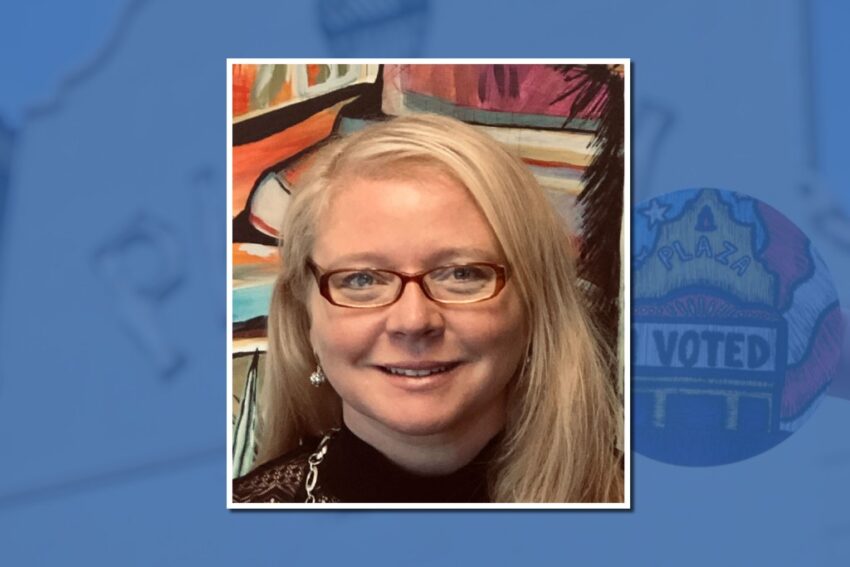

Even as a child, Lisa Wise was drawn to the mechanics of decision-making — writing letters to elected officials and asking questions about how government worked. That early curiosity never faded.
“I was always fascinated with elections,” Wise said. “I really do believe in the power of elections and the power of the vote.”
Today, Wise serves as El Paso County’s elections administrator, overseeing the planning and execution of elections for one of the largest counties in Texas — a role that places her at the center of a process that is both highly technical and deeply scrutinized. From securing polling locations and training workers to managing ballots and ensuring compliance with state law, her office is responsible for carrying out elections that affect tens of thousands of voters each cycle.
With the primary runoff elections taking place May 26 — along with the May 2 uniform elections for the town of Anthony and the city of San Elizario — Wise and her team are again preparing for complex election cycles.
The upcoming elections follow the March primaries, where technical issues with electronic poll pads forced some sites to temporarily revert to paper check-ins, underscoring both logistical challenges and the importance of maintaining public trust in the process.

Both major political parties in El Paso County say Wise’s office plays a critical role in maintaining confidence in local elections. Republican Party Chair Michael Aboud said the job comes with inevitable challenges but described Wise as responsive and effective in addressing issues as they arise.
“Sometimes there’s things that happen that are completely unexpected,” Aboud said. “She does a pretty good job … she’s very responsive to any information I request.”
El Paso County Democratic Party Chair Michael Apodaca also pointed to the pressures of administering elections in a politically charged environment, saying Wise must navigate “a lot of personalities” and heightened scrutiny. Still, he said her transparency and knowledge of election law have helped build trust.
“She’s been very transparent and very quick to solve an issue,” Apodaca said.
ELECTION 2026 VOTER GUIDE: Everything you need to know about the May 26 primary runoffs in El Paso
Wise joined El Paso County in April 2015. She holds a bachelor’s degree in political science and public administration from Park University in Missouri and a master’s degree in public administration, with a focus on state and local government, from the University of Nebraska at Omaha.
As election preparations continue, Wise spoke with El Paso Matters about the responsibilities of her office, the challenges of administering elections and what voters should know ahead of the upcoming elections. Responses have been edited for brevity and clarity.
What do you love most about your job? Do you have a favorite day?
Wise: I do love elections. I love the principle of them. I love the philosophy of them. Every day there’s some joy in that. Because I really do believe in the power of elections and the power of the vote. That it’s something I’ve been interested or fascinated with, even since when I was a kid.
The thing that probably I do love the most is, when we do outreach. When we do things for the public, whether it’s a mock election, whether it’s speaking to classes, whether it’s talking to a group, community leaders, talking about elections.
I could talk about elections probably for five or six hours – and my kids would tell you that. So, I do like to go out and do that, and find out what’s on their mind. What are they seeing? What are they concerned with? But it’s kind of taking it from our department and finding out what voters are interested in.
Is this what you wanted to be since you were younger?
Wise: I wanted to be a lawyer when I was young, but I was always fascinated with elections and the process.
I didn’t know that I wanted to be an elections administrator. That wasn’t really, like, a job. But I can remember being in second or third and fourth grade, and we had, like, our county tax assessor come and his name was Mr. Takechi and I was fascinated with local government even at, like, the tax assessor’s level when I was in elementary school. I remember I had him sign this piece of paper and I kept his autograph for a long time.
I remember I wrote to my legislator about homelessness when I was in third or fourth grade. I was always interested in how things got decided, on how decisions were made and who was my representative. I had my neighbor over, and I remember we wrote letters to him about, “Why do we see all these abandoned buildings that could be turned into homeless shelters?”
What does your typical day-to-day look like, or is every day different?
Wise: Every day is pretty different. It really depends where we are in the election cycle. If we’re looking at toward the beginning of the election cycle, we’re working on contracts with (government) entities, locating polling sites, getting the poll workers, doing the training, doing the testing of the ballots. There’s a long process that starts well before Election Day, usually about 90 days out.
If we’re closer to the poll, then we’re working on ballot by mail, we’re working on voter registration deadlines, we’re working on the ballot printing and all of those things.
Then, if we’re at the after – the post-election wrapup – it’s the audits, the required manual hand count. It’s the picking up all of the machines, getting all of the sites wrapped up, working on payroll for our 1,000 people, and on that side of it, and then usually we’re really probably about to start again.
It’s pretty cyclical. We have on average about five elections a year, so, when you’re starting 90 days out, you’re constantly just really back-to-back in election mode.
Do you have a lot of challenges at your job?
Wise: Yeah, we do have a lot of challenges. We’re always looking for additional poll participant workers. It seems like we always have a need for that. We’re always looking for locations that are ADA (American Disability Act) compliant, have ample parking, have room, internal space that can accommodate the machines and voters.
READ MORE: How to become an election worker
There’s some logistical challenges. The election law changed every two years, (when) the Legislature meets, and it seems that elections continue to be on the forefront of legislation over in Austin. So, a lot of times we’re just learning the new legislation or how it will be implemented. So, there’s a challenge in constantly changing processes and procedures.
Could you walk me through what happened during the March primaries with the poll pads, and how you resolved it?
Wise: Sure. We used to have the poll books, they were in paper. Now, they’re in an electronic form. We’ve had that system since 2018. We conducted 34 elections with no issue, so we did our testing on Saturday, which is what we always do, the day after early voting. They’re updated with all of the voters who voted early.
They’re not touched again until they’re set up on Tuesday (Election Day). So, we started to get calls Tuesday morning from some of our sites, not all of them, but from some of them, that the poll pad wasn’t letting you pick a party, which obviously in the primary, you have to pick a party. And, so, that screen wasn’t coming up, which meant you couldn’t move forward on checking voters in. And so, we started to get those calls, and we reached out to our vendor pretty much immediately.
READ MORE: Voting hours at El Paso County polling sites extended to 8 p.m. after glitch
So, we had to kind of revert to the old poll pads – paper poll books, and have people sign in. So they still were using those to look everyone up that was coming in, making sure they were registered and then they were having to sign on the paper, just like we used to. An actual pen-to-paper signature. They obviously were looking all day as what was the problem.
They found it around 10:30 in the morning. We had to actually touch each pole pad. It wasn’t something where they could handle it from the management side. So, we went out and got those all fixed at every location.
So what was the root cause?
Wise: Their reasoning, their root cause, was that we had been with them before this new version came on, so when they onboarded the new counties with the new version they never came back and changed ours, updated ours.
What should voters know now?
Wise: If you did vote in March, you have to align with the same party (in a May runoff). So if you picked a Republican ballot in March, you’ll have to vote a Republican ballot in May, and vice versa. If you pick a Democratic ballot in March, they’ll have to pick a Democratic ballot in May. If you didn’t vote in March, you’ll have that opening in May to pick whichever one you want to align with. But we also get questions: “What if I’m, like, an independent and I don’t want to align.” Well, this election is not for you. This election is strictly a party activity for the parties to decide who they want to go to the general election in November.
How do you install trust in the integrity of elections, both with the community and the party chairs?
Wise: So, the way that I think that you do that is you maintain constant communication. You are transparent when there is an issue, you’re upfront about it. You identify it, you fix it, you don’t repeat it.
Party chairs are invited, especially in the primary, they’re here during our testing. They’re allowed to be here during the central count, which is the counting. They test all the ballots.
They are also involved and they’re allowed to be poll watchers, (doing) monitoring. They can be involved in so many steps. That’s what the law allows for, almost every step of the way, to have a checks and balances.
We do have people sometimes, especially if it’s their first time, helping with the testing (who) are skeptical, and once they see all of the safeguards in place, once they see, how thorough the process is, how many times you check everything – that you do a manual hand count, match up, that the ballots are actual paper ballots – they seem to have a better understanding. I think they also have a restored trust in the process.
Is there anything else you’d like to add?
Wise: We do like to remind our voters that these poll workers are community members. They’re your neighbors. They go to your kids’ school, they’re just citizens of El Paso like everyone else, and so we really want them to be treated respectfully. We always have some sites that people do get aggressive with our workers, and they’re doing the best they can.
Michelle James Thorpe, a senior journalism student at the University of Texas at Austin, is a contributing writer for El Paso Matters as part of a capstone course this semester.
The post El Paso elections chief outlines challenges ahead of May votes appeared first on El Paso Matters.
Read: Read More