



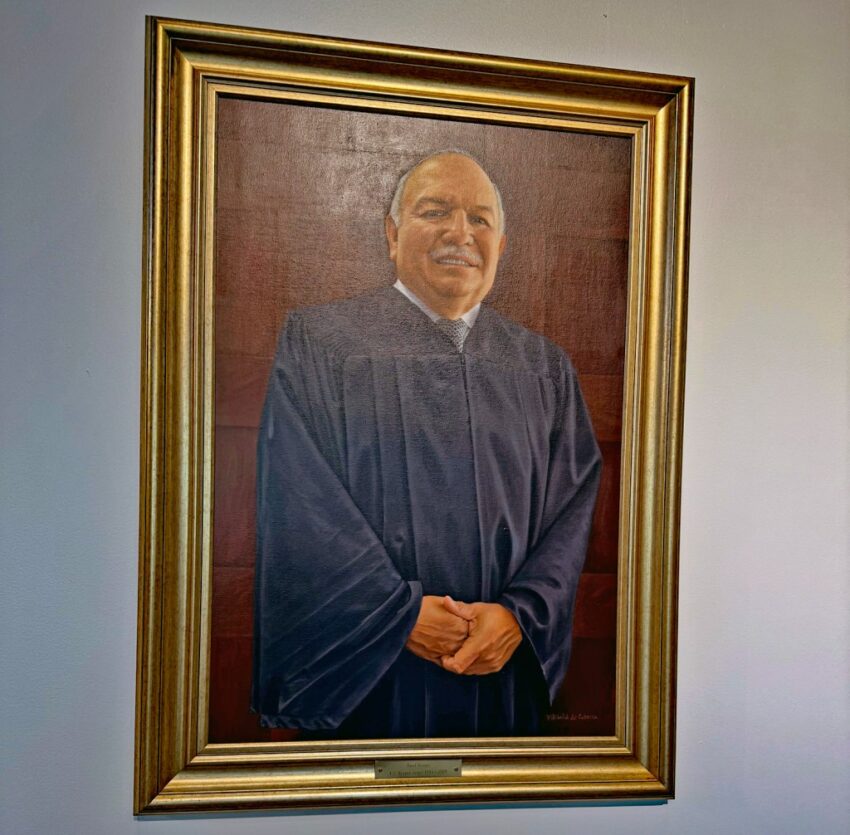

Decisions last year by the Board of Immigration Appeals, perhaps acting at the direction of President Donald Trump, have unleashed a torrent of cases on federal courts where detained migrants are seeking a bond hearing long seen as their right, an El Paso federal judge said in an interview with El Paso Matters.
“The law has always been that they’re entitled to a bond hearing, but last year, the immigration appeals court changed it, just out of the blue,” Senior U.S. District Judge David Briones of El Paso said.
“I’m sure Trump is the one that got the Board of Immigration Appeals to change it,” he said Monday in his chambers at the Albert Armendariz Sr. United States Courthouse in Downtown El Paso.
The shift has upended long-standing immigration court practice and pushed thousands of detention cases into the federal system, overwhelming judges and turning habeas corpus petitions into one of the primary paths for migrants seeking release while their cases proceed. Federal judges across the country have largely rejected the policy, setting up a looming decision by the Fifth Circuit Court of Appeals that could shape immigration bond rights nationwide.
White House media officials haven’t responded to an El Paso Matters request for comment.
The immigration appeals court – which is part of the Justice Department and not an independent judicial body – issued rulings in 2025 that limited or eliminated bond opportunities long available to people taken into custody while their immigration claims were decided in court. Thirteen of the 15 BIA members were appointed by Trump’s attorney generals, William Barr in Trump’s first term and Pam Bondi in the current term.
The rulings of the Board of Immigration Appeals, or BIA, gave legal force to policy changes by the Trump administration that sought to largely end bond releases in immigration cases. But federal courts across the country have repeatedly ruled against the Trump administration on the issue.
The change in bond policies came as the Trump administration ramped up mass deportation efforts. As a result, thousands of detained immigrants have turned to federal courts for what is known as a writ of habeas corpus, a judicial order finding that a person is being unlawfully detained.
Many of the immigrants have been successful in gaining a bond and their eventual release, as hundreds of federal judges across the country have ruled that the BIA rulings and the Trump policies violate due process rights.
The Western District of Texas, home to numerous Immigration and Customs Enforcement detention facilities, saw more habeas corpus filings in January than it had ever seen in an entire year, according to an El Paso Matters review of federal court records.
A handful of federal judges have sided with the Trump administration on the bond issue. A review of court rulings by Politico found that more than 300 federal judges had ruled against the administration on the issue, compared to 14 in favor.
The Fifth Circuit Court of Appeals – which has jurisdiction over federal courts in Texas, Louisiana and Mississippi – will hear arguments Tuesday on the immigration bond issue. It’s not clear when the three-judge panel might issue a ruling, and the case may ultimately go to the Supreme Court.
Briones said the overwhelming number of judges rejecting the Trump administration’s position speaks volumes.
“And I don’t know who the other judges are that aren’t agreeing, but there sure are a small number compared to the ones that are,” he said.
Still, he’s not certain how the Fifth Circuit – long viewed as one of the most conservative appeals courts in the country – will rule on the issue.
“Quite frankly, I wouldn’t be surprised if they overturned or they disagree with what we’re doing,” he said.
The appeals court judges hearing the immigration bond case are Edith Jones, appointed by President Ronald Reagan; Stuart Kyle Duncan, appointed by Trump; and Dana M. Douglas, appointed by President Joe Biden.

Briones, appointed to the federal bench by President Bill Clinton in 1994, is among the hundreds of judges who have ruled against the practice of limiting bonds in immigration cases. The vast majority of his decisions on habeas cases since December have led to detained immigrants being granted a bond.
“My clerks, they go over the (cases). When I come in, they say, ‘OK, we got another one. Here’s this one.’ Anything different? It’s all the same. The same thing. He’s been here since 2009, he was picked up at the bank or coming back from school or something, and he’s got a clean record.”
Two other judges in the El Paso division of the Western District of Texas – Kathleen Cardone and David Guaderrama – also have overwhelmingly favored detained immigrants seeking bonds for their release.
The one exception in El Paso has been District Judge Leon Schydlower. He has not reached a decision in most of the habeas corpus petitions to come before him in recent months. Last week, he began filing notices in the petitions in his court saying he won’t make decisions until the Fifth Circuit issues a ruling.
“I may not agree with Judge Schydlower on habeases, but those are his cases,” Briones said.
Federal judges rarely grant media interviews, and other El Paso judges declined requests for comment from El Paso Matters on the habeas corpus petitions. Briones said he felt it was important to speak out on immigration bonds and the rapidly rising number of habeas corpus petitions.
“Well, I’ve been around, it’s going to be 32 years later this year. I’ve seen a lot,” he said.
Briones, 82, has senior status, which allows him to take a reduced case load and earn a full salary. Guaderrama also has senior status, while Schydlower and Cardone handle full caseloads.
“I have a limited docket, so it doesn’t impact me as much as it does Judge Cardone and Judge Schydlower,” Briones said.
The post El Paso judge: Trump-backed immigration appeals rulings deny migrants long-standing bond rights appeared first on El Paso Matters.
Read: Read More