



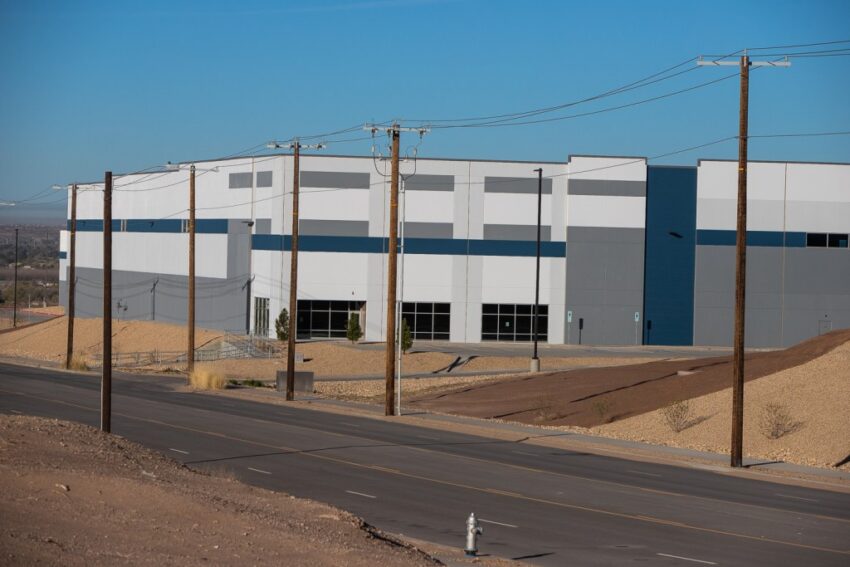

As El Paso local governments discuss whether they can restrict immigration detention centers within their jurisdictional limits, a planned mega facility in far East El Paso County is already underscoring the limits of local control.
The planned Immigration and Customs Enforcement facility within the Socorro city limits is part of the Trump administration’s new $38.8 billion detention center model that calls for expanding detention capacity to nearly 93,000 beds. To do so, the Department of Homeland Security is looking to convert existing warehouses into 16 regional processing centers for up to 1,500 detainees each, with another eight “mega” centers with capacity of up to 10,000 detainees.
El Paso’s is slated to be one of the mega centers, with a reported capacity of 8,500.
The city, county and Socorro city governments have adopted resolutions formally opposing the planned mega detention center – but have had little success finding legal and regulatory ways to block it or future facilities.
On Monday, the El Paso City Council voted unanimously to direct the city attorney and city manager to continue evaluating city zoning language it hopes could block or slow new ICE detention operations. The El Paso County Commissioners Court on April 6 filed a lawsuit against ICE for allegedly failing to respond to a Freedom of Information Act request related to plans to build the detention facility, including whether the federal government conducted a required environmental study.
DHS didn’t respond to El Paso Matters’ request for comment. But with recent leadership change at DHS, some plans may be on hold.
Homeland Security Secretary Markwayne Mullin, sworn in to replace Kristi Noem on March 24, is reviewing plans to transform warehouses into detention centers, pausing the purchase of new facilities and scrutinizing previously approved contracts.
During his confirmation hearings last month, Mullin noted that most municipalities don’t have the capacity in their infrastructure for waste and water. “So, it’s important that we’re talking to the communities and if we’re having additional needs, we can work with the cities,” he said at the hearing.
Here’s what to know about what municipalities can do about detention centers:
Cities generally can’t block federal detention centers
Under the Supremacy Clause of the U.S. Constitution, federal agencies such as ICE and the Department of Homeland Security are typically not bound by local zoning or permitting rules when operating on federally owned land.
In El Paso, DHS purchased three warehouses for $123 million, so it owns the property outright.
Private contractors or landlords leasing space to the federal government are typically subject to local code requirements and inspections unless a specific federal exemption applies.
Local governments still have some leverage
Even with those limits, cities and counties aren’t powerless.
Federal law requires agencies to consult with local officials and consider local regulations “to the maximum extent feasible.” It does not require, however, that the federal government follow local recommendations.
Detention centers rely on local infrastructure — including water, sewer, electricity and emergency services — giving local governments some influence over whether projects can realistically operate.

Far East El Paso center may hinge on infrastructure
The proposed facility in far East El Paso County is already facing questions about whether the area has enough water and infrastructure to support a large detention center.
The site of the planned detention center is serviced by the Lower Valley Water District, which contracts with El Paso Water.
While neither entity can deny the federal government service, they can charge the cost of infrastructure to them. Officials with the LVWD have said they anticipate having to place a large water tank on the detention center property to store water, which would have to be paid for by the federal government.
Other cities where detention centers are planned have also raised concerns about water supply, sewage capacity and emergency services.
Location matters
While El Paso City Council and Commissioners Court are investigating potential restrictions, the mega detention center isn’t planned within the jurisdiction of either.
The new planned center off Gateway Boulevard East near Clint is within the Socorro city limits in what is now an industrial zone.
In this case, there would be little the city or county of El Paso could do in terms of zoning or other regulations. Instead, those two governments are focused on blocking any future immigration detention centers within their jurisdictional boundaries.
Communities nationwide are testing ways to push back
Throughout the country, including in Texas, local governments are trying a range of strategies to resist new ICE facilities:
- Passing moratoriums on new private detention centers
- Enforcing zoning and code rules on privately owned properties leased to ICE
- Filing environmental lawsuits over water and infrastructure impacts
- Restricting how federal agents can use city-owned land
Other entities have sued the federal government to try to halt similar projects, including in Maryland and New Jersey.
In Maryland, a federal judge issued a restraining order against DHS that was later extended, pausing construction over concerns of environmental damages. The government promised it would conduct an environmental analysis. The New Jersey lawsuit argues the proposed detention center site is unsuitable, citing inadequate water and sewage infrastructure. It also argues the government failed to conduct environmental reviews.
Some efforts have delayed or reshaped projects, but many are expected to face legal challenges — and courts are still deciding how far local authority can go.
In February, several lawmakers introduced in the House and Senate the Respect for Local Communities Act to require local consent for new ICE detention centers.

ICE detention centers in El Paso
El Paso is no stranger to immigrant detention facilities.
The federal government runs a tent facility in far Northeast El Paso opened in January 2023 as a processing center for Border Patrol to help with the influx of migrants arriving at the border at that time. The facility was transferred to ICE to use for detention decompression and staging area for deportation flights in March 2025.
The East Montana Detention Facility, known as Camp East Montana, opened on Fort Bliss land in August 2025 and is expected to hold up to 5,000 detainees. ICE recently replaced the center’s operators after several reports of human rights violations and violation of detention standards.
The ICE El Paso Processing Center, 8915 Montana Ave., near El Paso International Airport, opened in 2007 and serves as a long-term detention site and holds immigration court processing and removal proceedings. The processing center has also been scrutinized for human rights violations.
Additionally, the Department of Health and Human Services operated emergency shelters for migrant children, including the controversial “tent city” for unaccompanied minors in Tornillo in the easternmost edges of El Paso County from 2018 to 2019 and another child migrant facility at Fort Bliss from 2021 to 2022.
Other El Paso City Council action
Here’s a recap of other immigration-related issues discussed at Monday’s El Paso City Council meeting:
- El Paso Police Chief Peter Pacillas reiterated that the Police Department doesn’t enforce immigration laws – or stop, detain or arrest people solely on immigration status. But he clarified that immigration authorities are notified if during an investigation it is found or revealed that a detainee is an undocumented immigrant.
- The council didn’t take any action to outright prohibit federal agents from using municipal property for enforcement operations, but unanimously approved implementing protocols on notifying department heads and the City Attorney’s Office when federal agents are taking enforcement actions on city property.
- Staff from the city’s grant administration office told the council that stricter language and enforcement of federal grants under the Trump administration could put those funds at risk. That’s because grant language requires that applicants not conceal, harbor or shield undocumented immigrants from federal law enforcement and that they do not impede federal officers from exercising their authority. The council voted unanimously to continue to comply with the required grant assurances.
The post El Paso leaders want to limit ICE detention centers. Here are 6 things to know appeared first on El Paso Matters.
Read: Read More