




The last time Paul Enriquez was arrested in El Paso for driving while intoxicated was in 2017. It wasn’t his first time drinking and driving, but he had planned to make it his last.
Enriquez, who said he battled depression from childhood trauma most of his life, had the intention to kill himself that day while behind the wheel. Instead, a police officer arrested him, the state suspended his license, and the following year an El Paso County judge sentenced him to 10 years of probation.
At first, his habits followed him during probation and he made up excuses to skirt court-ordered drug testing. Alcohol was what got him in trouble, legally, but drugs, particularly methamphetamine, consumed his life, Enriquez said.
Then in 2020, Enriquez surrendered himself to county jail for court-ordered rehabilitation and detoxification. What was supposed to be a two-week stint stretched to four months alone in a cell during the pandemic lockdown because his rehab treatment center was operating at limited occupancy. Rehab led his judge to recommend him for the DWI Drug Court, an 18-month program under Judge Robert Anchondo to treat the underlying causes of an offender’s behavior and reduce future DWIs.
“That program saved my life, I can say that,” Enriquez said.
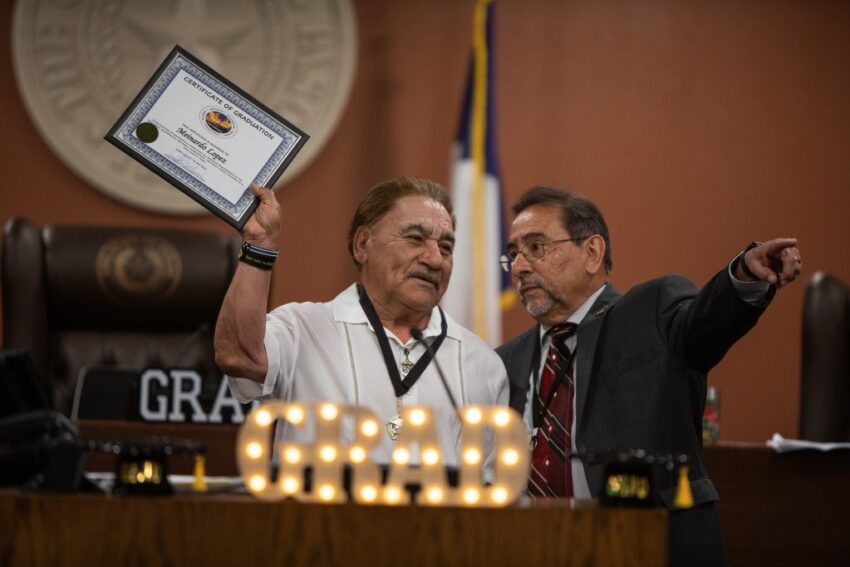
Enriquez is among more than 750 people who have graduated from the DWI Court Treatment Program since it began in November 2004. The intervention program was the first of its kind in Texas, according to the Texas Association of Drug Court Professionals.

The program has a recidivism rate of about 1% of participants who are rearrested on suspicion of DWI within three years of completing the program, and 15% recidivism rate overall, according to data provided by El Paso County.
This is lower than the state’s recidivism rate of about 31% for DWI arrests in 2024, according to the Texas Department of Public Safety.
In May, the county celebrated several more graduates in a public ceremony. The ceremony came days after the city and county of El Paso held a news conference with local elected officials, law enforcement leaders and victim advocates to speak out against DWIs.
The El Paso County Sheriff’s Office led a DWI Task Force over one recent weekend in May, arresting nearly 50 people mostly for DWI offenses, said El Paso County Sheriff Oscar Ugarte. The task force, which also includes the El Paso Police Department, El Paso County constables and Texas DPS, made more than 40 DWI arrests, including several minors, over Memorial Day weekend.
In 2024, El Paso recorded more than 1,300 arrests for DWIs and more than 180 of the people arrested had multiple DWIs on their record, said El Paso Police Chief Peter Pacillas at the May 19 conference.
DWIs are a concern law enforcement agencies face among their own officers, too. Earlier this month, an El Paso police lieutenant was charged with a DWI after crashing into cars and allegedly trying to bribe witnesses. In 2016, a former El Paso County Sheriff’s deputy was convicted of intoxicated manslaughter after striking and killing 26-year-old Richard Lopez in a drunken driving wreck four years prior.
But law enforcement is just one component to addressing public safety, Anchondo said. When a person is arrested for drinking and driving, it’s usually not their first time doing it, just the first time they got caught, he said.

The DWI Court Treatment Program aims to address what Anchondo thinks is oftentimes the root cause for repeat offenders – substance use disorder. Based on national research, anywhere from a third to half of people arrested in El Paso for impaired driving could also have a co-occurring mental health issue, Anchondo estimated.
This is why the court has clinicians who screen potential candidates for the intervention program, Anchondo said. Many participants have had a traumatic life or relationship, and they mask the issue with drinking, he said. Substance use disorder, also known as addiction, is a brain disorder, according to the National Institute on Drug Abuse. It can go undiagnosed prior to a DWI arrest, Anchondo said.
“You can’t just put them in jail and hope they’ll stop,” Anchondo said. “Alcoholism is a very serious illness. If we can address issues of alcoholism quicker, we’ll have better success. We don’t need to wait for someone to be arrested with a DWI to identify they have a problem.”
Enriquez said he’s part of the population the public might prefer to villainize and criminalize. He sees the mugshots and impaired driving videos posted on social media, including the popular Instagram account @therealfitfamelpaso. He reads the comments, where people have called for harsher punishments for drunken drivers. Some have called for DWI checkpoints in El Paso, which are illegal in Texas.
“It’s a lot more complicated than, ‘Why didn’t you just get an Uber?’” Enriquez said. “Someone who drinks to get that drunk is clearly going through something. Not always, but mental health in El Paso is something not really considered when it comes to substance use, to drinking … Addiction is a very pernicious disease. There’s no reasoning when it comes to addiction. There’s no logic to what someone will do in their addiction.”
Enriquez said he’s relieved he never caused a fatality while driving impaired – a pain that follows families for the rest of their lives.

“It’s hard when people lose someone to a DWI,” Anchondo said. “There’s no words to say that will bring back that person. What I will tell them (families of victims) is: We understand. And I want to make sure I do my effort with the help of a team to make sure they don’t reoffend.”
The Texas Department of Transportation recorded 26 fatalities from 625 alcohol-impaired crashes in El Paso County last year.
El Paso mother Lupe Lucero lost her son Steven Hernandez to a DWI crash in 2023. Afterward, she co-founded the SoberStreets Movement, an organization that raises awareness about drunken driving, advocating for stricter laws and stronger punishments.
“We have turned our pain into action and our grief into a call for change,” Lucero said at the city’s May 19 news conference. “In the heart of El Paso, we stand united. Not just for our children, but for every family still at risk, for every life that can still be saved.”
“We cannot keep allowing repeat drunk drivers to walk free while innocent lives are buried,” she continued. “When is enough going to be enough?… Our loved ones are not just another case number.”
For Enriquez, completion of the DWI Court Treatment Program did not reduce his 10-year sentence. He still has three years left on his probation.
Enriquez, now 33, works as a certified recovery coach for Punto de Partida, a nonprofit that supports people with substance use disorders. He continues to see a sponsor for Narcotics Anonymous.
To be eligible for the DWI Court Treatment Program, participants must live in El Paso County, be 17 years of age or older and have a misdemeanor, felony or federal DWI offense. Along with paying any fine associated with their DWI, participants must pay a $500 program fee.
Enriquez described the 18-month program as intense – it is only successful for participants who want the program to work, he said. The days are filled with individual counseling, group recovery support sessions, court hearings, meetings with probation officers, urine analysis testing and community service. Participants have a curfew and must be home during those hours for unannounced visits, according to a brochure of program requirements.
His schedule revolved around the program, Enriquez said. He had a job on the weekends, relied on his parents to drive him to appointments when his license was suspended and had some money saved from pandemic-era relief checks. He imagines the program is even harder for participants who had more barriers, such as lack of childcare.
Since 2004, about 75 participants have opted to be revoked from the program, DWI Drug Court coordinator Leticia Medina said in an email.
“It’s not easy by any means,” Enriquez said. “If I’m being very honest, I’ve heard people voice concerns about the program. They say it feels like they want you to fail … It will really push you to your limits. If you don’t want change, this is not the program for you.”
This comment is heard from many participants who’ve gone through the program, but the court also receives feedback that the program has helped participants gain structure in their lives, united their families and improved their health, Medina said.

After completing the program, participants can continue reporting to the DWI Drug Treatment Court for two to three years, which usually increases their success, Anchondo said.
Anchondo said a lack of funding is one of the biggest challenges the DWI Court Treatment Program faces, and what prevents the program from taking on more participants.
The DWI Court Treatment Program is funded entirely by state and federal grants, and receives no funding from El Paso County taxes, Medina said. For fiscal year 2025, the program received $140,000 for salaries, drug testing and family counseling. Some personnel, such as public defenders, are paid by their respective employers.
Other expenses over the years include equipment, from alcohol monitoring devices to a vehicle for house visits, according to past grant applicants submitted to the El Paso County Commissioners Court.
“We can’t take everybody,” Anchondo said. “I wish I could tell you we have a lot of resources, but courts of this nature need a lot. I always need a lot of people to work with this population. But I will always tell folks, the balance is this – now the person who has gone through the criminal justice system won’t come back.”
The post El Paso police made more than 1,300 DWI arrests in 2024. The DWI Drug Court aims to stop repeat offenses. appeared first on El Paso Matters.
Read: Read More