



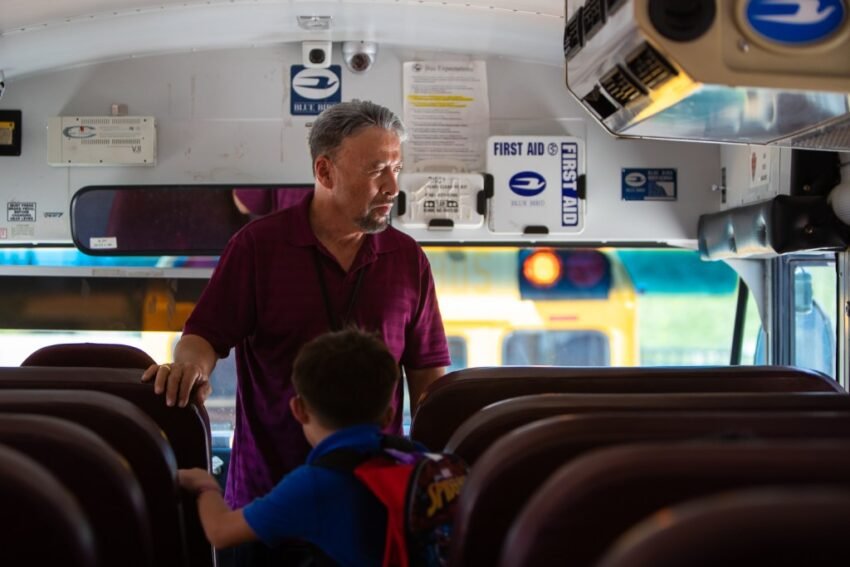

Safety is top of mind for Eddy Harris every morning as the sun rises over the horizon and he inspects the yellow school bus that will transport dozens of students to and from school that day.
“You go in, and you check your tires, you check your oil, you check your transmission fluid. You know you have to do these checks daily to make sure when your bus get out there, it doesn’t break down,” said Harris, an Ysleta Independent School District bus driver and Gulf War veteran.
Harris and his fellow drivers have to traverse unpredictable traffic, adapt to changing weather conditions and adhere to the rules of the road while monitoring a bus full of occasionally rowdy students.
“You have to have a lot of patience,” YISD bus driver Henry Vasquez said calmly as he sat at the district’s transportation hub in the Lower Valley.
“It’s a big responsibility, but it’s very rewarding getting the kids to school and home safely,” added YISD bus driver Jaime Urenda.
YISD and school districts across the state are working to make school buses safer under a new Texas law that requires they be equipped with three-point seat belts that go over a passenger’s chest and lap by Sept. 1, 2029.
Currently, school buses only need two-point seat belts, which go over a passenger’s lap, if they were made on or after 2018.
Senate Bill 546 requires school districts to estimate the costs of installing three-point seat belts, present a report to the board, and send information to the Texas Education Agency on any potential budget limitations before June 2027.
The bill, which was passed during the 2025 state Legislature, was introduced in response to the 2024 school bus crash in Bastrop County that led to the deaths of a pre-kindergarten student and the passenger of another vehicle.
With no state dollars attached to the legislation, many El Paso school district officials worry it will create financial strain on their already tight budgets if Texas lawmakers don’t provide funding before the deadline.
For a large school bus fleet, the cost of complying with the new seat belt requirements can become significant, particularly when combined with the need to replace aging buses and maintain the existing fleet,” YISD Director of Transportation Rosario Fernandez said.
“Without dedicated state funding, these expenditures would have to compete with other district priorities and the cost of complying with the new seat belt requirements would have to be considered within the district’s existing financial resources,” Fernandez added.

The El Paso Independent School District, the largest in the region, plans to install three-point seat belts into 140 of its buses, which will cost an estimated $7.15 million and be split into two phases
Socorro and Ysleta school district officials say they plan to replace buses that don’t have the proper restraints rather than retrofitting them, partially because the upgrades could void their warranties.
The Socorro Independent School District plans to start by entering an agreement, which was approved in June as part of its budget, with Highland Fleet — a Massachusetts-based company that specializes in providing electric buses to schools — to add 25 buses to its electric vehicle fleet. The Ysleta district plans to purchase 75 school buses using maintenance tax notes, which serve as long-term loans.
An estimated 27,300 students enrolled in El Paso’s three largest school districts ride the bus every day. About 8,000 of them attend EPISD, 7,000 attend SISD and 12,300 attend YISD.
Most El Paso schools provide transportation to students who live outside a campus’ two-mile radius or those who would have to cross dangerous roads to walk to school. The state gives school districts additional funding to offer transportation to these students, as well as special education and homeless students.
In 2025, EPISD split its district into four transportation zones and began allowing students to take the bus to any school within their zone. This was a part of the district’s plan to close several underutilized schools due to declining enrollment, which left some students further away from their neighborhood campuses.
School districts also rely on their buses to take students on field trips, for certain extracurricular activities and for competitions that require travel.
Safety concerns have kept some parents, such as Angela Dickson, whose 11-year-old daughter attends Don Haskins PK-8 School, from using the bus to get their children to and from school.
“She’s only been on them during school field trips. The seat belts is just another reason it makes me uneasy for them to travel on the bus daily,” Dickson said.

For Genevieve Medrano, the school bus has been the most reliable way to ensure her daughter Naeli, 10, gets to Pebble Hills Elementary School. Medrano, who shares a car with her husband, said she doesn’t always have transportation available to take their daughter to school and welcomes the new seat belt requirements.
“It’s good because you never know if there’s going to be an accident and something can happen, and it’s better to be safe,” Medrano said.
Despite some parents’ concerns, school buses are safer than walking or riding in a car, according to the National Safety Council. The council supports the use of lap-and-shoulder seatbelts to make school buses safer, but did not
On average, there have been 108 school-bus-related fatalities a year in the U.S. between 2015 and 2024, only about 6% of which were school bus passengers. That is out of the 42,000 vehicle fatalities that happen every year.
New school buses
As the deadline to submit the TEA transportation reports neared, El Paso’s three largest school districts in May presented an update to their boards on what it would take to comply with SB 546.
SISD has 275 buses in its fleet, 129 of which already have three-point seat belts. The district estimated it will cost $3.3 million to retrofit the remainder of its buses with the required restraints and $22.9 million to replace them completely.
Only 30 of YISD’s 226 buses have the required seat belts. Officials estimate it will cost $4.8 million to retrofit nearly 200 buses and $31.7 million to replace them.
EPISD has about 260 buses, and less than half have three-point seat belts. District officials did not say how much it would cost to replace their buses during the meeting, but have said they plan to auction off older buses and potentially use bond funding to pay to install seat belts. The district plans to ask voters in May 2027 to approve a nearly half-a-billion-dollar bond proposal to upgrade air conditioners and make improvements throughout its campuses.
YISD and SISD have already started work on acquiring new school buses, in part to meet SB 546’s requirements.
The YISD school board voted Aug. 12 to authorize the issuance of $65 million in maintenance tax notes for facility improvements and to purchase 75 school buses. YISD officials said the cost of the new buses will range from $160,000 to $180,000 each depending on the size.
This comes as the district is trying to slash expenses to avoid layoffs after adopting a budget that nearly depleted its reserves.
Fernandez, Ysleta’s transportation director, said some of the district’s buses are over 30 years old and use parts that are difficult to find or need to be custom made.
“It’s really not about just retrofitting older buses, but it’s actually moving in the direction of making sure that these new buses that we get are equipped and that they meet all safety requirements, and I think at the end it’s something that’ll be good for the district,” Fernandez said.
YISD bus driver Ray Morales said the district’s buses haven’t had any major issues, but have been affected by regular wear and tear.
“There’s nothing really wrong with them. It’s just, they’re outdated,” Morales said. “We use these buses every day, anywhere from six to eight hours a day. Things are bound to happen. There’s going to be leaks, there’s going to be flats because we don’t give them the rest.”

SISD, the first in the region to transition to a renewable energy source for transportation, plans to lease 25 electric school buses to add to its fleet.
The district began using 25 electric buses in 2024 after receiving over $9.8 million from the U.S. Environmental Protection Agency’s Clean School Bus Funding program to build charging stations and purchase the vehicles.
Instead of purchasing new buses, SISD will contract with Highland Fleet to lease its buses at a rate of $18,000 a year for each vehicle.
Under the contract, Highland Fleet will install the charging stations and reimburse the district for any parts or repairs that are needed. This will save SISD nearly $5 million over the next 10 years compared to operating traditional diesel buses, according to the presentation given by the company in May.
SISD’s Assistant Superintendent of Administrative Services Enrique Herrera said 20 of the new electric buses will be used by special education students, who have their own dedicated routes and vehicles.
“We’ve gotten a lot of great feedback from not only the bus drivers but the students,” Herrera said.
“Part of that idea is to accommodate the sensitivity of our special needs students. (The buses) make no noise, and they provide a better experience for our students as well,” he added.
Fernandez said YISD isn’t looking into buying electric buses because of the time it takes to charge them and the additional investment needed to build charging stations. But officials said they may consider other energy efficient options, such as natural gas or propane.
“It’s just the infrastructure, the charging stations, the whole layout. I think it’s just a little bit more than just buying the bus,” Fernandez said.

No matter what kind of vehicle they will be driving, YISD’s bus drivers said getting students to school, making connections with their young passengers and contributing to their education makes the job worthwhile.
“I love to be a bus driver because every morning when you receive all the students, they have some big smiles,” YISD bus driver Gabriela Rojas said.
The post El Paso school districts to retrofit, purchase buses to meet state’s new seat belt law appeared first on El Paso Matters.
Read: Read More