



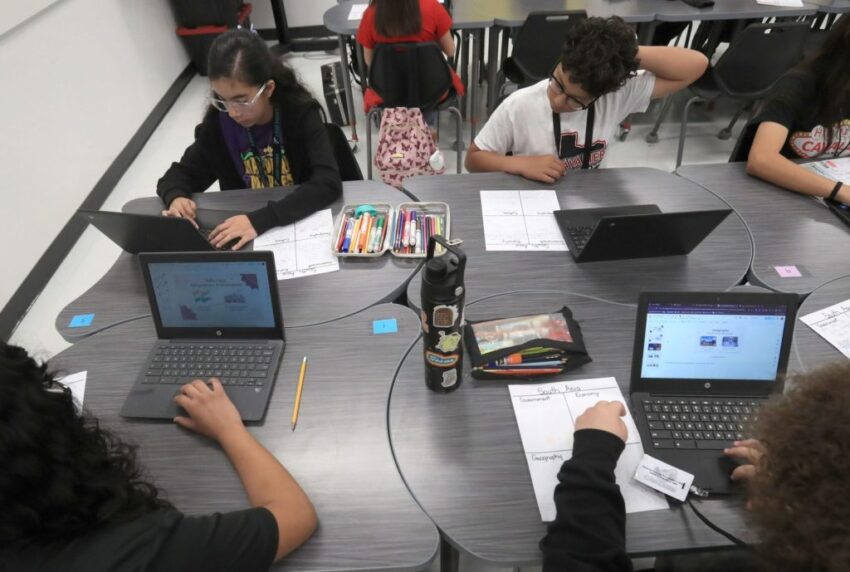

Hanks Middle School students in Kim Vandagriff’s sixth-grade social studies class typed their handwritten notes onto their computers, scrolled to the bottom of the screen and prompted an artificial intelligence program to generate a slide for a presentation.
“They’re going to create a video that they can go back and share with their friends,” Vandagriff told El Paso Matters. “We don’t want this to be a replacement for their thinking. We want this as a tool to share information.”
El Dorado High School senior Azul Larson said her teachers have varying approaches to using AI.
Her dual-credit English teacher is completely against the technology and will fail anyone whose essays are deemed to be over 15% AI by software designed to spot computer generated writing. Meanwhile, her precalculus teacher sometimes uses AI in class when he doesn’t know how to solve an equation, she said.
“I’ve also had a few teachers who don’t recommend directly copying from AI, but rather using it for inspiration or to sort of guide you in an assignment,” Larson told El Paso Matters.
Students and teachers across El Paso are utilizing AI in similar ways, using programs that range from generative chat bots — such as ChatGPT — that can respond to users to specialized software with tools designed with education in mind.
Now many are finding ways to implement lessons to teach students how AI works, how it can be used and how to use it ethically and responsibly — a concept known as AI literacy.
Many, including the Socorro and Ysleta independent school districts, are also developing guidelines for employees and students that outline how they are allowed to use AI.

Next school year, YISD plans to have students take a monthly digital citizenship course, which will show students how to responsibly use technology and how to safely navigate the online world, including AI use.
Harmony Public Schools, the second-largest charter school system in the county, plans to start offering a class next school year on AI to all its eighth-grade students.
El Paso Independent School District officials said in a statement that the district has integrated AI into its instruction and uses AI programs that give students feedback on their writing, but did not give details on how they work.
While many of these changes are years in the making, they are gaining urgency as the use of AI in schools grows. The President Donald Trump administration has also pushed for AI in education, after signing an executive order last year encouraging schools to teach AI literacy starting in kindergarten. The order also established the Artificial Intelligence Education Task Force to identify federal funding sources for schools that could be used for AI education.
AI use in schools is quickly increasing, though training and policies are falling behind as technology rapidly advances, according to a national survey conducted by RAND, a nonprofit, nonpartisan research organization. The survey found 54% of students and 53% of core subject teachers indicated that they used AI for school in 2025 — an increase of 15 percentage points compared with the previous two years. The survey also found that over 80% of students have not had lessons on how to use AI for schoolwork, and only 45% of principals reported having policies or guidance in place on how to use it.
Texas is one of 16 states that don’t have official guidelines on the use of AI in public schools, and does not have curriculum standards on AI literacy.
With no direction from the state, El Paso schools are left to figure out how to teach and utilize the technology.
Most area school districts are still working out how to use AI in a way that will improve learning outcomes, said Clifton Tanabe, the dean of the University of Texas at El Paso College of Education.
“Some districts are further along in ‘here’s the dos and don’ts. Here are some tools that we believe work. Here are some things that we want you to be careful of.’ And then other districts are just at the very beginning of trying to figure that out,” Tanabe told El Paso Matters.

Tanabe said this is why UTEP is hosting the Region-Wide K-12 AI Learning Incubator, a series of workshops for district leaders to discuss AI literacy, ethics, data security and the different types of AI models.
The series kicked off March 25 and included a discussion with districts about their AI policies.
“They were asking each other questions and then sharing insights about where they were at, focused on policy development. We talked about what’s going on, what you do with AI, and can you share that with each other?” Tanabe said.
Next, UTEP plans to bring experts and visit national conferences to discuss how AI has been used in schools outside El Paso.
Tanabe said the incubator will culminate in a large summit in August where education leaders will talk about the next steps for AI in education in the region and celebrate the work that has been done so far.
AI in schools
Many schools started using AI programs years ago, though they went by a different name, said Miguel Moreno, SISD’s instructional technology coordinator.
“They would call it software that is adapted to student needs, or is tailoring instruction to students’ levels,” Moreno said.
What’s new are the large language models that analyze data to generate human-like responses, such as ChatGPT, Claud, Copilot and Gemini, said Veronica Alvarez, YISD’s director of innovative learning.
“These AI agents build and leverage those (large language models) as the brain, and then they program them and build them for a specific task,” Alvarez said.
SISD, YISD and Harmony all use Magicschool, a program with dozens of education-based tools, including some that can generate feedback on lectures, write emails to parents and translate text.
The program can be customized to fit a school’s policies, and ensure it’s being used for its desired intent, said Burak Yilmaz, Harmony’s director of instruction.
“We don’t want teachers, for example, to ask AI to create a new lesson plan from scratch,” Yilmaz said.
Instead, Harmony teachers can use Magicschool to help prepare for a lesson by creating checklists and giving feedback, Yilmaz said.

Vandagriff said she has used Gemini, which is integrated into all Google programs, to translate documents for her student, who recently moved to the U.S. and does not speak English. She’s also used it to adjust the reading difficulty of an article based on a student’s skills.
Eastwood High School junior Sophia Gutierrez said she used AI to generate flash cards and got answers to questions faster than she normally would without the technology.
“In the classroom, some teachers do use AI for assignment making and encourage us to explore apps, like Quizlet, that create study plans or a bot that we can ask questions to,” Gutierrez said.
YISD blocked students from using ChatGPT on school computers and redirects them to the Securely AI chatbot, which can be accessed by their school.
Gutierrez said it’s unclear how students are allowed to use it and thinks the district should have an AI policy centered on improving learning.
“I would like our administration to do a better job at addressing AI in schools because it was never explicitly mentioned that it wasn’t allowed, making it easier for students to rely on it rather than help them learn,” Gutierrez said.
“Because it isn’t black or white if it’s a good thing or a bad thing,” she added.
SISD is one of the only districts in the region that has policies on how students and employees are allowed to use AI.
The policy, which was adopted November 2025, states students can only use AI in school with a teacher’s permission, must do their own work and properly credit sources, including AI tools.
Now the district is creating a handbook for teachers and students with basic information on AI and guidance on how to adhere to the district’s policy.
The SISD school board is expected to vote on the handbook at a board meeting later this month.
YISD is creating a similar “framework” that outlines responsible use of AI for teachers and students, and a curriculum that offers more direct instruction for students.
“It really just outlines this set of guidelines that teachers can leverage and use in the classroom when they are teaching students about or when they’re going to get ready to use software that may have AI infused within it,” Alvarez said.
Though YISD’s guidelines have not been shared publicly, Vandagriff said she’s already received training on AI use.
The YISD school board will get a presentation and vote on the framework in the coming months.
AI literacy
Over the last two years, Alvarez said, YISD has incorporated instruction on AI into its digital citizenship courses, which students take online at the start of the school year.
The classes are taught to students in all grade levels and designed to be age-appropriate.
“They’re being taught the basics about AI, how to recognize it, responsible use and things to be aware of, depending on what level they’re at. So it’s a very foundational understanding of AI,” Alvarez said.
The courses also teach about online safety and privacy protection, cyberbullying prevention and media literacy — distinguishing fact from opinion and recognizing misinformation and bias.
At SISD, Moreno said students learn about AI as they encounter it.
“We look at AI literacy as part of overall digital literacy. It’s a technology tool,” Moreno told El Paso Matters. “Every time that students are using a technology tool, including AI, there’s always a conversation about appropriate use and ways to use it.”
Moreno said teachers at the beginning of the year establish routines and rules with their students around technology and AI use, and reinforce them as the year progresses.
Harmony Public Schools currently takes a similar approach, teaching students about AI whenever they encounter it, Yilmaz said.

Starting in August, Harmony eighth graders will also have to take a class dedicated to AI literacy, where they will learn about how to use AI responsibly and how it can be harmful if used incorrectly.
“We don’t want our students to fall into a trap of using AI as a shortcut to get answers or cheat because they can easily get spiraled into that habit of not doing any thinking,” Yilmaz said.
“What we want to do instead is keep students as the primary thinkers in their lessons as they engage with AI, whether it’s in school or out of school,” he added.
Vandagriff said lessons on AI are necessary as more students gain access to it.
“They’re going to figure out how to use it anyway. So either we can teach them how to be part of the solution, or we let them grow up and be part of the problem. And I would rather that they learn how to use it as a responsible citizen,” Vandagriff said.
The post El Paso schools work to adapt to rise of AI in education: policies, programs and literacy lessons appeared first on El Paso Matters.
Read: Read More