



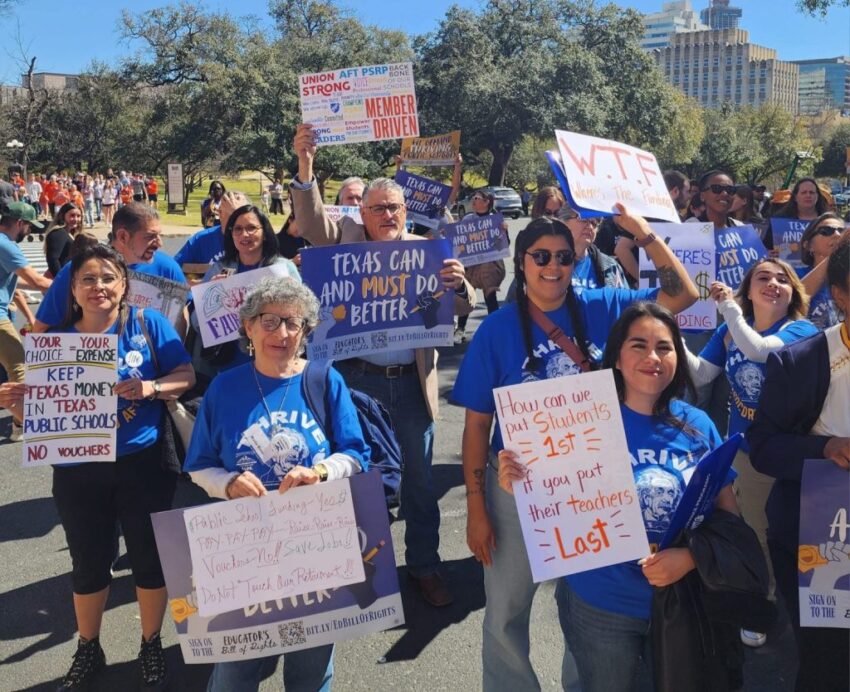

Public school funding, teacher raises and a controversial educational savings account program that would give families up to $11,500 to enroll their child in private school — known as vouchers — have become some of the top education priorities for state lawmakers during the 89th session of the Texas Legislature.
El Paso lawmakers have promised to support increasing the basic allotment for public schools — which has been set at $6,160 per student since 2019 — as well as changing the basis of the school funding formula. They’ve also promised to oppose vouchers.
Almost two months into the biennial session, some El Paso teachers and education advocates used their spring break to head to the state Capitol to advocate for school funding and other issues affecting educators.
About 40 members of the Socorro American Federation of Teachers and three members of the West Texas Alliance went to Austin in early March hoping to talk to lawmakers and show their support for public education.
The West Texas Alliance is a local public education association serving employees in the Socorro, Clint and Ysleta school districts.
After signing up to speak and waiting roughly 14 hours at the state Capitol, president of the West Texas Alliance, Rosie Perez, said she and her nephew, Oliver, a sixth-grader from the Socorro Independent School District, ran out of time and had to head back home.
Oliver hoped to tell lawmakers not to vote for vouchers and to increase funding for public schools after Socorro ISD announced it would get rid of the program at the elementary school level to save money.
Instead, they recorded a video and submitted it to the House, hoping it would be heard.
“It saddens me that kids in the future won’t be able to experience the same fine arts classes I experienced,” Oliver said in the video. “But, at the same time, the state wants to give out $10,000 vouchers to kids to attend private schools. That doesn’t make sense to me.”

Still, Perez said their visit went well.
“It was productive. There were some very good conversations about funding, some of our ideas and some of what we’re seeing, and how to move forward with the challenges that have come,” Perez said.
While lawmakers continue to debate school funding in Austin, El Paso school districts are preparing their budgets for the coming school year. Many are expecting to approve a deficit as they face declining enrollment and other financial challenges.
Ysleta ISD may need to take out a loan to cover payroll and make it through gaps in the state’s payment schedule.
In February, the Socorro ISD board voted to lay off 300 employees and cut its elementary fine arts program to try to cut the budget for the coming school year by $38 million. This comes after years of overspending and operating under a budget deficit, draining the district’s reserves.
The Canutillo ISD board also voted to lay off employees Tuesday to cut its projected budget deficit for the coming school year from $5.8 million to $2.3 million. The district has not said how many employees could be affected.
Raising the student allotment
As part of the House’s omnibus school finance proposal, House Bill 2, lawmakers are looking to raise the basic per-student allotment from $6,160 to $6,380.
The bill would also require school districts to use 40% of the new funds they receive on pay for teachers, district employees, librarians and counselors. The Texas Education Code currently requires districts to use 30% of any increase in the basic allotment on salary increases. The remainder can be used for general operating expenses or can be allocated to the reserve fund.
If the bill passes, Ysleta ISD — which has over 33,900 students — estimates it will receive an additional $6.8 million from the state, $2.7 million of which would go toward employee salaries, chief financial and operations officer Lynly Leeper said during a board presentation March 19.
El Paso ISD, the largest school district in El Paso County with over 48,000 students, estimates it will bring in $14 million in new revenue, chief financial officer Martha Aguirre said during a board workshop Monday.
Socorro ISD, the second-largest school district in the county with about 46,600 students, estimates it will get $13 million, chief financial officer James Vasquez said during a board meeting Wednesday.
Perez, Socorro AFT president Veronica Hernandez and some El Paso lawmakers agreed the $220 increase was not enough to keep up with inflation.
“Research shows that that does not keep up with inflation. So while we’re happy that we are putting more money into public schools, we do want to address the inflationary factor, and that’s something we’re still going to be advocating,” state Rep. Mary González, D-El Paso, told El Paso Matters during an interview.
Hernandez said the proposal falls short.
“They’re proposing a raise in the basic allotment, of which we are very appreciative because in six years they have not done this. But it’s an arbitrary allotment increase of only $220 that will not make our public schools whole again. It’s falling really short,” Hernandez said.

Hernandez said lawmakers need to raise the basic allotment to about $1,400, while Perez said $1,500.
Sen. César Blanco,D-El Paso, told El Paso Matters via email that school districts need at least $1,000 more per student than what the current basic allotment provides to keep up with inflation.
He co-authored Senate Bill 597, which would raise the basic allotment to $7,564 per student.
El Paso lawmakers, including Gonzalez and Blanco, said they also support legislation that would change the school funding formula from being based on average daily attendance to enrollment.
Senate Bill 233, co-authored by Blanco, and House Bills 1157 and 1703 would establish those changes into law.
All four bills were referred to their respective Senate and House education K-16 committees. None have been scheduled for a hearing.
Teacher salaries
The Senate’s school finance proposal, Senate Bill 26, primarily focuses on establishing a teacher retention allotment to provide yearly salary increases for Texas public school teachers.
When adjusted for inflation, the average Texas teacher salary has declined by over 9% between 2009-10 and 2023-24 school years, according to a report created by the Texas AFT and Every Texan, a nonprofit focusing on policy research.
The report found that when adjusted for inflation, salaries for El Paso ISD teachers decreased by 15% and by 9% for Ysleta ISD teachers during that time frame.
Socorro ISD teachers saw their salaries increase by 25% when adjusted for inflation after the district gave employees pay raises for the 2022-23 and 2023-24 school years.
SB 26 would give Texas teachers $5,000 if they have at least three years of experience and are working in districts with less than 5,000 students, and $10,000 for those with at least five years of experience.
In districts with over 5,000 students, teachers with at least three years of experience would receive a $2,500 raise, and those with five or more years would receive $5,500.
SB 26 would also eliminate the statute requiring school districts to direct 30% of any basic allotment increases to pay for teachers, district employees, librarians, and counselors.
Blanco, who voted in favor of the bill, said it would provide smaller districts more opportunities to address teacher shortages and “reduce financial burdens, giving school districts the flexibility to address other needs.”
SB 26 would also expand the state’s Teacher Incentive Allotment program, which gives bonuses to teachers in eligible school districts based on their student’s academic performance, and create a new designation of teachers who can qualify for the incentive.
Some El Paso school districts, including Clint, San Elizario and Canutillo, have already implemented the program.
Critics of the allotment, including Hernandez, say it is too limited and would only benefit a few teachers with high standardized test scores.
“That is going to exclude the majority of our workforce, our teachers. Only a few that are going to get this,” Hernandez said.

About 25,000, or less than 7% of the state’s over 384,000 teachers took part in the program last school year, according to Texas Education Agency data.
The application process for districts to take part in the program may also be limiting for districts looking for immediate financial incentives for their teachers.
It can take one to three years before a district gets approved for the program, YISD’s Leeper said during a March 19 school board meeting.
Perez said the program is still a good opportunity for teachers who can qualify for it.
“Teachers can decide, ‘I want to try to make this much extra, or this much extra.’ There is a very clear set of requirements that need to be met in order to get that compensation. If they’re willing to do it, then I think that that should be something that they bring to the districts to take advantage of,” Perez said.
Vouchers in the Legislature
Gov. Greg Abbott has made it a top priority to adopt an educational savings account program in Texas.
While he pushed for lawmakers to pass vouchers during the 2023 Legislature, his efforts were thwarted by Democrats and rural Republicans in the House who opposed the program.
The newest iteration of voucher legislation — Senate Bill 2 — advanced in the Senate last month and is headed to the House, where Abbott said he has enough votes to pass the “school choice” bill.
SB 2 would give families $10,000 per student, per year to send their child to private school, and $11,500 for students with disabilities. It would also give up to $2,000 for homeschool students.
The bill prioritizes vouchers for children in households with an annual income up to 500% of the federal poverty level, or roughly $156,000 for a four-person household.
González said she and other members of the El Paso delegation have opposed vouchers because they would interrupt their work toward educational equity.

“I think the myth is that private schools are better than public schools. Researchers have demonstrated that we have wonderful public schools that have just been out-resourced. So we need to continue to support our public schools and give them the resources they need to be successful,” González said.
González said it’s still too early to know if educational savings accounts will become a reality, but noted there will be efforts to implement regulations on private schools that take vouchers.
“Let’s say a student does take the voucher, goes to private school, gets kicked out or gets removed, then the private school should have to refund the money. That type of guardrail is not in the current piece of legislation. I know both Republicans and Democrats would like to see some guardrails,” González said.
Critics of voucher programs argue they siphon tax dollars away from public schools by incentivizing students to enroll in private schools and will only benefit high-income families who already have children in private schools.
El Paso currently has over 30, primarily religious, private schools, many of which only had a few dozen students during the 2020-21 school year, the most recent data provided by the National Center for Education Statistics.
El Paso’s largest private school, Loretto Academy, had fewer than 600 students that year.
In 2021, over 197,000 school-aged children between the ages of 5 to 19 lived in El Paso County, according to U.S. Census data.
While there currently aren’t many private school seats open in El Paso, lawmakers and education advocates are concerned it will incentivize new ones to open.
“Several of the kids who are already going to private schools, their parents can already afford that. But if vouchers pass, then there’s going to be plenty more private schools and the charter schools popping up, I can assure you that,” Hernandez said.
Perez said the $1 billion being allocated for educational savings accounts under the bill would be better spent on public schools, and worries the amount used to fund the program may grow over time.
“It is projected to look at $4 billion in the next legislative session, and then $7 billion after that, so it’s not going to stop,” Perez said. “How much more could that do for our public ISDs?”
The post El Paso teachers’ unions advocate increased school funding, decry vouchers at Texas legislature appeared first on El Paso Matters.
Read: Read More