




The Trump administration’s decision to freeze hundreds of millions of dollars for a 60-year-old program designed to help students get a college education has created uncertainty among many institutions of higher education in recent weeks.
That is not the case at El Paso Community College, which announced Wednesday that the Department of Education had awarded it a five-year, $3.7 million grant to continue its TRIO Student Support Services program. A collection of eight federal programs created to help low-income, first-generation students and students with disabilities to access college, TRIO got its name because it started with three programs: Upward Bound, Talent Search and SSS.
EPCC officials said the college will use the money to enhance college retention and graduation rates for students in the SSS program.
This is the latest competitive TRIO SSS grant that EPCC has earned since 1985. The exact amount of the award is $3,679,765. Previous iterations have benefitted more than 24,000 students in many aspects of academic life such as mentorship, tutoring, financial aid, scholarship advice and early course registration.
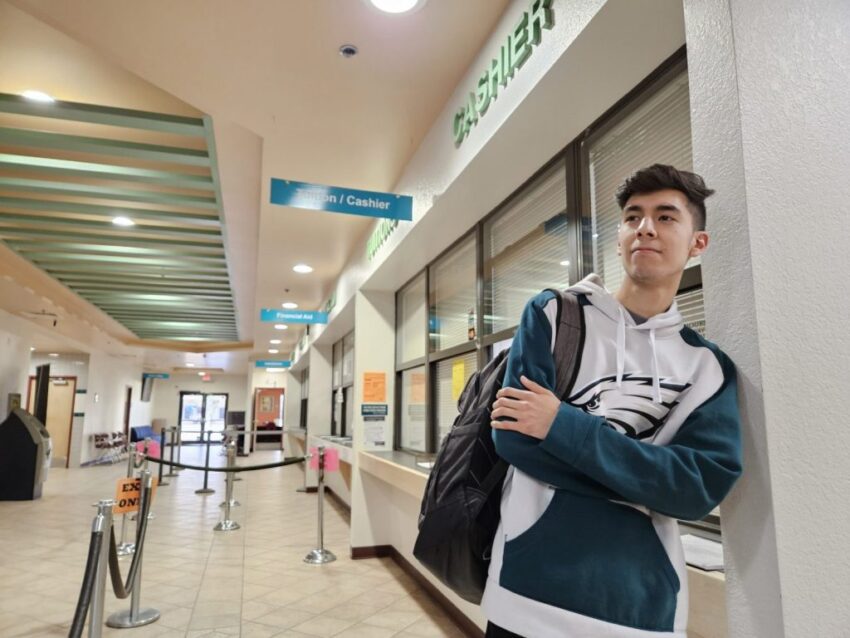
Jesus Flores, a first-generation college student with a minor learning disability, said that he was having problems with his EPCC courses before he joined the program in spring 2024 at the Mission del Paso Campus. There, he found tutors who helped him with math, English and several natural science courses.
Flores, a 2023 graduate of El Dorado High School, is a multidisciplinary studies major. He expects to graduate in December and start the spring 2026 semester as a history major at the University of Texas at El Paso.
“I’m very grateful to have been part of this program,” the 21-year-old said during a phone interview from the Mission SSS offices. “I was nervous at first and then I got used to it. (The tutors) helped me so much. They pushed me to be better in school. If not for this program, I’m not sure I’d be graduating.”
RELATED: UTEP, EPCC and Texas Tech Health weigh impact of HSI grant cuts
Lucia Rodriguez, director of the EPCC Office of Student Success, was unavailable for an interview, but said in a college news release that the grant puts students in an environment where they can learn the tools and gain the confidence that will ensure their success personally and academically regardless of background.
Before this week, the college was anxious about its TRIO grant. The funds were supposed to have been awarded as early as Sept. 1. An EPCC official said the college was monitoring the TRIO grant – and all federal grants – closely.
For some institutions across the country, the delay or freeze of about $660 million in TRIO funding led to staff layoffs and, in some cases, an end or scaling back of program operations. This affected more than 2,000 programs and tens of thousands of students.
UTEP leaders of a pair of TRIO programs – Student Support Services and Upward Bound – did not respond to a request for comment. However, an SSS program advisor said the office did receive its TRIO funds, but did not give additional details. The Department of Education Student Support Services Program website showed that the government awarded UTEP’s program $360,957 for 200 participants for fiscal years 2021 through 2024, the last data available.
Texas Tech Health El Paso did not respond to a request for comment. There was no TTHEP data on the education department’s SSSP website.

Victoria Regil, a junior graphic design major at UTEP, joined the university’s Student Support Services program in spring 2024. She said that she gets help from the program’s math and science tutors to help with her computer science minor, while other staff have offered tips on how to prepare a resume or how to write essays.
Regil, 19, said she learned about the program during an introductory university course. The first-generation college student said another advantage is that the program gives her a priority to register for classes.
SEE ALSO: UTEP expands esports program; EPCC launches its own
The Ciudad Juárez resident talked about her SSS experiences after a Wednesday workshop to help with job interviews at the program offices on the first floor of UTEP’s Union Building West.
“It’s been good for me,” Regil said. “(SSS has) been a helpful resource. They are flexible and will help with whatever I ask for. I’m glad I did it.”
In a Sept. 12 Inside Higher Ed story, the Council for Opportunity in Education estimated that 650,000 college students and high school seniors would not get the academic advising, financial guidance and assistance with college applications if the TRIO grant freeze persists.
The COE, a nonprofit advocacy group that supports TRIO programs, said about 1,300 grants for certain TRIO programs such as Student Support Services, Upward Bound Math-Science and general Upward Bound programs would be awarded, but they were only 43% of the TRIO programs.
Instead of getting their funds, some program officers received “no cost extension” notices that meant their programs could continue until the end of the month, but would not receive any additional grant money.
The hold up generated concerns in Congress. Both houses sent letters earlier this month to President Donald Trump and Secretary of Education Linda McMahon that urged the immediate release of the TRIO funds.
A spokeswoman for U.S. Rep. Veronica Escobar, D-El Paso, said those TRIO funds support the most vulnerable students who often need the resources to be successful. She said Escobar, who was out of the country and unavailable for comment, continues to support TRIO grants because they ensure students have access to those opportunities.
Escobar’s name was not on the House letter to Trump, McMahon and Russell Vought, director of the Office of Management and Budget, and her office did not say why it was not included. The spokeswoman said the representative will continue to use her position on the Appropriations Committee to advocate for the funds, programs and infrastructure that students and educators need to thrive.
The House continues to discuss the amount of funding for TRIO programs as part of the congressional appropriations process for fiscal year 2026. Both sides will negotiate the final amount by Nov. 21.
Congress allocated $1.19 billion for TRIO during the 2025 fiscal year. The Trump administration proposed in May the removal of all federal funding for TRIO programs. On July 31, the Senate Appropriations Committee passed the FY 2026 Labor, Health and Human Services and Education Appropriations Bill that will maintain TRIO funding at $1.2 billion for the 2026-27 program year.
Trump has called TRIO programs “relics of the past.” TRIO was launched in 1965 as part of President Lyndon Johnson’s “Great Society” portfolio of social reforms.
Trump has said that there is no longer a need for the federal government to provide such incentives to motivate people to enroll in college. Additionally, he has said that the institutions should pay for such programs. Other recent statements from his administration have included claims that the program promotes “woke ideology.”
In the Sept. 12 IHE story, Ellen Keast, Department of Education deputy press secretary, said the government planned to issue some TRIO continuation awards by late September.
“The Trump administration is no longer allowing taxpayer dollars to go out the door on autopilot — we are evaluating every federal grant to ensure they are in line with the administration’s policy of prioritizing merit, fairness, and excellence in education,” Keast said.
The post EPCC receives $3.7 million TRIO grant as federal freeze disrupts student support nationwide appeared first on El Paso Matters.
Read: Read More