




Although it has made some strides, the El Paso Independent School District still has work to do on addressing disparities and inconsistencies throughout its campuses and improving school climate for certain groups of students, according to an Equity Assessment Audit meant to identify potential barriers to student success.
The EPISD Board of Trustees last week heard a presentation on the audit, which was conducted by the Mid-Atlantic Equity Consortium, a nonprofit funded by the U.S. Department of Education.
Board President Leah Hanany said the board historically has not done a good job of ensuring the funds it is spending are going toward positive student outcomes.
“And, so, for me, from that sense, it becomes sort of an honest reckoning with the disparities that have shaped the outcomes of students across the district historically,” Hanany said during the June 18 meeting.
The audit was conducted under a settlement agreement between EPISD and Familias Unidas del Chamizal por la Educación, who sued the district in 2020 alleging it had discriminated against poor, Hispanic and Mexican American families when it closed Alta Vista, Beall and Burleson elementary schools in South Central El Paso. Familias Unidas is a grassroots parental advocacy group based in Segundo Barrio.
Once completed, the consortium will develop an improvement plan that offers recommendations on how EPISD can address equity gaps.
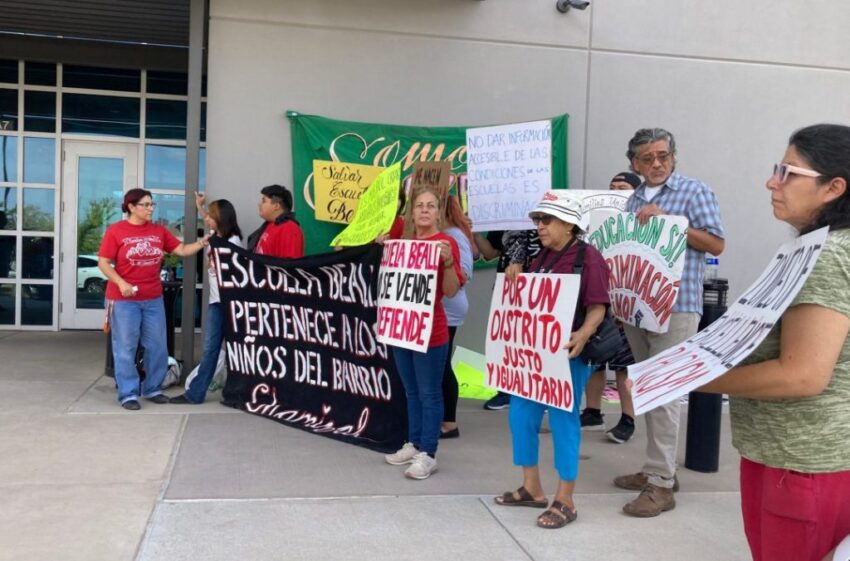
Ahead of the June 18 meeting, members of Familias Unidas gathered outside the EPISD administrative building to denounce the report, claiming MAEC failed to thoroughly examine some of the issues in the district and that district officials, under the leadership of former Superintendent Diana Sayavedra, interfered with the audit.
“Even if they provided outcomes that are supportive of our claims, the fact that they interfered so much really questions the fidelity of this product,” Familias Unidas organizer Hilda Villegas told El Paso Matters. “Obviously, if you do have some issue with equity, it’s going to be hard to hide all of it. So, it is going to produce some type of issue that it’s favorable to our position, but it’s not as strong as it should be.”
The group denounced the audit for breaking down its findings by EPISD’s Zones of Excellence, which divided the district into four sections under Sayavedra’s plan to close elementary schools and improve the ones that remain open, dubbed Destination District Redesign.
Familias Unidas has been critical of the zones for lumping together the Bowier High feeder pattern, which has some of the lowest-income households in the city, with the El Paso High feeder pattern, which has some of the wealthiest, a sentiment Hanany echoed during the meeting.
“I think there might be a better way to think about how we look at equity when we’re creating groups, maybe four quadrants doesn’t serve. I can see where some of our families have taken some issues with that,” Hanany said.
As part of the audit, which was started in March 2024, MAEC reviewed public data on the district and nearly 50 documents provided by EPISD, including the student code of conduct, curriculum information and the district’s discrimination policies.
The organization also surveyed nearly 21,900 students, 4,100 family members and 2,200 staff. It also conducted focus groups made of staff, parents, students and district partners, including one for the Bowie feeder pattern.
Between now and December, MAEC plans to present an action plan that addresses the audit’s findings.
Mixed findings
The audit found that EPISD has made some notable advancements in equity, but still has areas that need improvement.
Participants who were surveyed shared generally positive views of EPISD’s school climate, but in focus groups some felt students with disabilities, LGBTQIA+ youth, Black students and immigrant families experienced discrimination and unequal treatment based on their identities, according to the audit.
“Across focus groups, parents reported isolation, racist comments, and casual use of slurs like the N-word, with inconsistent school responses,” the report stated.
Notably, Bowie High School students who were surveyed shared a significantly lower perception of their school’s climate than every other high school in the district.
“There seems to be a disconnect between the quantitative data that is being provided and the qualitative experience of our students, when we think about what their actual learning experiences are at schools,” Hanany said. “At some point, we want to be able to split the difference and meet somewhere closer to the middle, so that the qualitative data that we get from families matches the information the district is providing to the public.”
The audit also broke down how funding was distributed throughout EPISD’s schools and found that on average, schools with the highest levels of economically disadvantaged students receive the most dollars per student.
But, Kasia Razynska, a MAEC research alliance coordinator, noted 19% of that funding comes from federal sources designated for high-needs students, such as those who are homeless or disabled, whereas schools with the lowest levels of economically disadvantaged students only got 14% of their funding from federal sources.
Razynska also noted that the district is developing an equity-based funding model to allocate resources based on schools’ specific needs, but it has not been implemented yet.
EPISD has 18 high-needs schools, which have a student population that is at least 94% economically disadvantaged, nine of which are in the South Central zone of excellence, according to the audit report.
Students and community members surveyed as part of the audit felt there were disparities in access to up-to-date equipment and career and technical programs in high-need campuses such as Bowie.
Some participants noted there are inconsistencies in how principals lead and spend money, resulting in unequal school experiences, and that schools in higher-income areas often get more parent funding and volunteers, widening gaps with lower-income schools.
The report says that the district has made improvements in providing access to advanced and dual-language classes. It praised initiatives such as automatically enrolling students into Algebra I in eighth grade — which is normally done in ninth grade — and dual credit options, but noted that staffing shortages, uneven access, and a lack of culturally and linguistically responsive outreach limited equitable participation in these programs.
EPISD leadership’s “commitment to transparency and inclusive engagement represents a bright spot,” according to the report, but mentions that those efforts aren’t always realized by the community.
An inadequate audit
Familias Unidas protesters said the audit did not do enough to ensure its assessment of EPISD was accurate, including visiting campuses to see how programs were implemented, and questioned why a large portion was based on participants’ perceptions.
Villeagas said the group was also concerned that MAEC was not able to verify the accuracy of the information in the documents provided by EPISD and that additional documents may exist but were not made available, which was noted in the audit report.
“We call it a breach of contract. Whatever they’re presenting is not an assessment. Everything they did was gather documents that EPISD chose for them to examine, and then they went and asked regular people like us, to give our input,” Villegas said.
Familias Unidas has been critical of EPISD’s leadership under Sayavedra, who agreed to retire earlier this month under pressure from the new board that took office after the May 3 election.
Despite the organization’s issues with the audit, Villegas said she hopes the new board will be more willing to work with Familias Unidas and listen to the needs of students in South Central El Paso.
“For the first time in history, at least since we started back in 2015 we have a representative that has looked our way … which is Leah,” Villegas said. “I know that she’s had a lot of pushback from a large group of people who are also very supportive of Diana Sayavedra, and we’re here to say that we have a different story to tell, and that right now our biggest concern should be addressing the inequity issues in the barrio.”
“We hope that this new board has enough background and experience in education and understanding to be able to really look at what’s happening in the barrio and not be influenced by these other people,” Villegas added.
The post Equity audit finds EPISD has work to do on disparities despite strides, Familias Unidas questions report’s ‘fidelity’ appeared first on El Paso Matters.
Read: Read More