



“Dangerous” and “heart-wrenching” is how current and former Jungle Reef employees describe the conditions of fish and animals at the indoor interactive touch aquarium and petting barn inside the Shoppes at Solana in West El Paso.
Jungle Reef, owned by Jon Hepworth and his brothers Taylor, Cy, Jordan and Thane, opened on the first floor of the former Sunland Park Mall in February. The business touted a 26,000-square-foot interactive aquarium where patrons could physically interact with various marine life. The aquarium also had bumper cars when it opened, but after the cars broke down, they were replaced with a petting barn in April.
On Aug. 15, a child was scratched in the face by Jupiter, a wallaby. Jupiter died the same day after being caught in the barn’s entrance doors.
Hepworth said although he’s made improvements to the attraction, complaints about animals in captivity are not uncommon.
“Being in the animal world is very fickle. You’re going to have people that hate you no matter what you do,” Jon Hepworth told El Paso Matters during a tour Aug. 23. “It doesn’t matter how good I get. I am always learning and, every year, I always get better. It doesn’t matter how good I get, you’re going to get reviews. You’re going to get people that don’t want to see these animals in captivity – that’s just the truth of it.”
But the aquarium has had multiple non-compliance findings by the U.S. Department of Agriculture Animal and Plant Health Inspection Service, the agency that issued Jungle Reef’s exhibitor license. The People for the Ethical Treatment of Animals, or PETA, has received at least six complaints. The city’s 311 call center has received two complaints regarding the business since it opened.
Jon Hepworth, manager of the Jungle Reef Aquarium, checks on parakeets in the Bird Enclosure, Aug. 23, 2024. (Luis Torres/El Paso Matters)
Hepworth was also CEO of the interactive aquarium Blue Zoo in Spokane, Washington, where similar concerns were brought up.
“They opened with a very successful grand opening and it was very well publicized and had a very positive reception when they opened,” said Shoppes at Solana owner Enoch Kimmelman. “It’s the only venue like it anywhere in the region. So, they’ve been very, very successful and very, very popular.”
Kimmelman said he has visited Jungle Reef several times and engaged with Hepworth and has never seen any indication that they are not properly caring for the animals.
“They have a very vested interest to make sure that the animals are taken care of and that they are treated in a way that will preserve them and make sure that they’re healthy,” Kimmelman said.
‘Fun idea quickly turned dark’
One former employee said the initial excitement about being able to work with animals diminished soon after opening.
“During opening weekend, Jungle Reef started with a touch tank full of starfish, various crabs, urchins, a school of black mollies, a few clown fish, and a tang,” the former employee said. “What seemed like a fun idea quickly turned dark as I witnessed people (customers) ripping off the starfish’s legs.”
The employees and former employees who spoke with El Paso Matters signed non-disclosure agreements upon being hired at Jungle Reef and asked that their names not be used for fear of retaliation. One current employee and several former employees talked with El Paso Matters about their concerns.
Hepworth said he realized the touch tank was not going to work. The marine life was removed from the exhibit in May and changed into a treasure hunt where children can search for coins in the water and sand.
“Close to the grand opening, we didn’t expect as many people to come out as they did. I knew we’d be busy, but it was – everybody rushed in at once, and so that’s hard to monitor,” Hepworth said. “Some parents don’t watch their kids, so I thought – this isn’t working.”
Koi swim in a pond at Jungle Reef Touch Aquarium, Aug. 23, 2024. (Luis Torres/El Paso Matters)
Multiple employees said the business was woefully understaffed to handle the hundreds of patrons who came through the doors during the opening weeks – and that the staffing issue hasn’t changed since.
“During my orientation, the owners expressed that all the employees they have hired are replaceable and that they will not hesitate to replace anyone – they also expressed that they do not care how much anyone knows about the animals,” the employee said.
Hepworth said that his approach may have been tactless, but he wanted employees to understand the way he operates.
“Let’s say, I’m feeding my dogs kibble, and I need you to be OK with that and, if you’re not, let’s talk about it. But, if you morally can’t get behind it, that’s fine – just don’t work here. That’s all it is,” Hepworth said of orientations. “These are the ways I do things. I love and care about my animals (and) either you get behind them or you don’t. If you don’t, that’s OK. I just don’t want you working here.”
Employees also had to sign non-disclosure agreements, which some said felt like a threat to prevent them from speaking out against the business.
Hepworth said non-disclosure agreements are not uncommon in the aquarium business and are necessary to protect intellectual property such as water filtration systems, diets for the animals and animal care regimens.
Employees said countless fish have died because of lack of proper care and transport, illness and patrons physically grabbing and being allowed to put their hands in the tanks where they are housed.
“Touch tanks are popular things, but you’ve got people putting their hands into water with marine animals (and) people’s hands have bacteria on them – they have chemicals on them that then are transferred into the water,” said Willow Hecht, who works in the captive animal law enforcement division of PETA.
Hecht said PETA has received six complaints against Jungle Reef since the aquarium opened its doors.
“Marine animals are extremely sensitive. Their water has to be a certain pH, it has to be a certain temperature – it’s hard to believe that they have all this variety of wild marine animals and people are sticking their hands in and there’s not going to be issues with animals getting sick,” Hecht said.
One employee said it was clear early on that Jungle Reef did not know how to properly test the water and that dozens died and continue to die as a result.
The employees said whenever concerns about the water quality or suggestions were brought up on how to make improvements, management dismissed them, or said they would “get to it.”
Hepworth was adamant tanks are being properly tested.
Iguanas form a pile in their enclosure at Jungle Reef Aquarium, Aug. 23, 2024. (Luis Torres/El Paso Matters)
A Komodo dragon sits beneath a heat lamp in its enclosure at Jungle Reef Aquarium, Aug. 23, 2024. (Luis Torres/El Paso Matters)
Concerns about how reptiles were being housed also became a concern for the former employees. One employee said multiple species of lizards and reptiles were not kept in the appropriately sized enclosures, including two uromastyx lizards kept in a 40-gallon enclosure to encourage mating. The spiny-tailed lizards can grow up to 2 feet long.
The employee’s concerns were that a single lizard of that type should not be permanently housed in an enclosure that size, let alone two.
“There was also a Savannah monitor in another 40-gallon,” the employee said about another type of lizard that can grow up to 4 feet long. “These monitors are smart, they’re big as well. A Savannah monitor should be housed in an enclosure around 250 times that size. It is heartbreaking to see an animal in an enclosure that it cannot even turn around in.”
Hepworth said the lizards and snakes are taken out of their enclosures periodically to move around or interact with the public.
From bumper cars to a petting barn
Jungle Reef’s petting barn had two white pygmy goats and one male wallaby when El Paso Matters toured the facility Aug. 23 with Hepworth.
A wallaby eats vegetables in its enclosure at Jungle Reef Aquarium, Aug. 23, 2024. (Luis Torres/El Paso Matters)
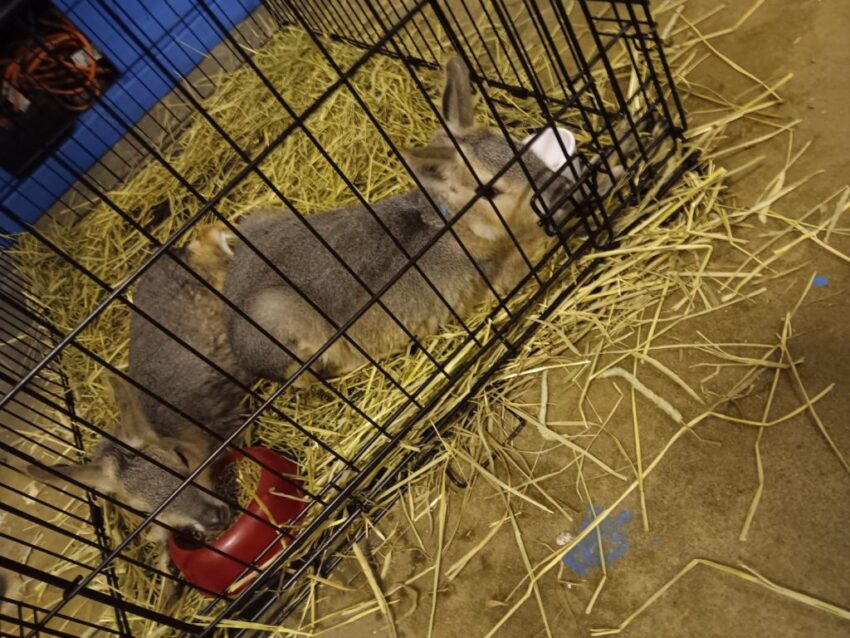
Two Patagonian cavies – which are large relatives of guinea pigs generally found in South America – were not in the petting barn. The cavies were being kept together in a crate in the hospital room used for treating sick reptiles, fish and animals at the aquarium because one had wet-tail, a form of diarrhea, and was being treated with antibiotics. Hepworth said he wanted to keep them together during the recovery.
But former employees said there is constant change in the barn area and there have been issues with too many animals and overcrowding with adults and children in the past.
The week before the tour, the barn had the two pygmy goats, the two cavies, a tortoise and two wallabies.
In prior iterations, mammals such as rabbits, tortoises, a baby duck and an African crested porcupine were kept in wooden crates in the zone where reptiles are housed before being placed in the barn area together.
Buster the porcupine scampers around its enclosure at Jungle Reef Aquarium, Aug. 23, 2024. (Luis Torres/El Paso Matters)
Buster, an African crested porcupine, was kept in the barn interacting with the other animals and public until he drew blood after poking one of the pygmy goats. Buster is now housed in a small enclosure by himself.
“There’s so much going on, and it’s chaotic and it’s been heart-wrenching as well, because there’s so much going on with the animals that I’m seeing on a regular basis,” a current employee said. “A lot of the creatures are unhappy.”
The current employee described her concerns about Jupiter, the female wallaby.
“There is a wallaby there who they’ve had since she was a baby – and there’s a total of two wallabies. One of them (Wally) is happy being there. He’s fine. But the sister (the female), on the other hand, is starting to bite people and she is jumping on people, which is a sign she’s stressed,” the employee said. “Obviously, she shouldn’t be biting people (and) she’s doing it for a reason, and they’re not really doing anything about it.”
An employee cleans the wallaby enclosure at Jungle Reef Aquarium, Aug. 23, 2024. (Luis Torres/El Paso Matters)
Jupiter scratched a child’s face then died a week after the employee spoke with El Paso Matters.
“Animals don’t want to be handled and harassed,” Hecht said. “Imagine you’re in your house, and somebody comes in and they’re picking you up and they’re touching you, and they won’t go away. They really don’t have anywhere to hide … so, they react out of fear and defend themselves by biting or scratching.”
Hepworth said Jupiter was happy and energetic and did not scratch the child out of anger, but rather, “playfulness.” He also said the employee watching the barn at the time was not doing her job to ensure that didn’t happen.
When asked of Jupiter’s death, Hepworth said, “We had a former employee, who is no longer with us, not watch, she opened up the door and it crushed her. It was awful. It was the saddest thing.”
Hepworth said he and staff are still recovering from the trauma of Jupiter’s death, but are considering acquiring another wallaby as a companion for Wally.
Tortoises bask beneath a heat lamp in their enclosure at Jungle Reef Aquarium, Aug. 23, 2024. (Luis Torres/El Paso Matters)
Hecht from PETA said Jungle Reef’s business model creates risk for animals.
“Anytime the business model is direct contact between the public and animals, that’s when you’re going to get bites and animals getting stepped on and animals getting kicked and pushed and children getting bitten and then infected,” Hecht said. “It’s just a recipe for disaster anytime you have these encounters.”
USDA regulations lacking, animal advocates say
Though Hepworth maintains he is constantly making improvements, animal rights organizations say businesses such as mall aquariums, which are popping up around the country with similar issues, do not have sufficient regulations.
“The USDA can impose penalties that can suspend and revoke an exhibitor license, but too commonly, instead it issues warnings and then takes no further action,” said James Erselius, an attorney with the Animal Legal Defense Fund, a national animal law advocacy organization.
Erselius said his organization steps in to help strengthen animal enforcement laws where possible, but discourages parents from taking their children to such establishments.
“(These businesses) teach children all the wrong lessons,” Erselius said. “They teach children that animals are play things and it’s OK to handle them against their will – animals and (fish in) tanks being touched and handled – is not fun. It’s stressful.”
The USDA declined an interview request for this story, but spokesman R. Andre Bell provided responses to questions in an email.
“Our investigative process for individuals and/or businesses found out of compliance with the AWA (Animal Welfare Act) may lead to an enforcement action such as letters of warning, monetary penalties, license suspensions and revocations,” Bell said.
An employee of Jungle Reef Aquarium walks a wallaby around the facility with a harness, Aug. 23, 2024. (Luis Torres/El Paso Matters)
Jungle Reef has been inspected four times, according to the USDA Animal and Plant Health Inspection Service website. The inspections were conducted prior to the aquarium opening and again in May following a complaint by PETA over the aquarium’s treatment of a lemur.
During the May inspections, 10 violations by Jungle Reef were found, including improperly housing the female lemur Zabu, matted hair on rabbits, improperly tracking animals such as chickens, rabbits and the lemur, improper storage of food, and improper environments for chickens and ducks.
“In the petting barn area, there are six adult rabbits housed together with two goats, three giant tortoises, two chickens and one duck. Rabbits should not be housed together with other species for health, safety and behavioral reasons. The facility must ensure that rabbits are not housed in the same primary enclosure with any other species of animals unless required for scientific reasons,” the May 30 inspection report states.
The former employees that came forward shared photos of various animals in distress, including a rabbit that drowned in a water bowl in the barn. (El Paso Matters is not publishing that photo.)
Zabu, which the USDA determined was being improperly housed and was showing signs of distress by constant pacing and not receiving cognitive enrichment or a place to hide in its enclosure, was ultimately removed from the aquarium.
Hepworth said they had been in the process of acquiring a second lemur to accompany Zabu before the inspection, but ultimately decided to rehome the lemur and not get another one. The rabbits, ducks and chickens were also removed from the aquarium. Information about where Zabu currently resides wasn’t available.
Bell said when they find issues that bring facilities out of compliance with the AWA regulations, they work hard to bring them back into compliance as quickly as possible.
Hepworth said he has complied with all of the USDA recommendations.
But Erselius said mall aquariums like Jungle Reef can’t properly provide for animals.
“Mall aquariums exist to make a profit from the exploitation of animals, not to provide the adequate care that animals need,” Erselius said. “So, animals suffer in environments where they’re subjected to touching and handling by the public … and it’s not surprising that there are documented violations.”
The facility has not been inspected since the end of May.
Two complaints were filed through the city’s 311 complaint call center, one for alleged non-compliance with the Americans with Disabilities Act and another for unlicensed animals being moved in and out of the aquarium on weekends.
Hepworth’s brothers are opening another interactive aquarium at the Chapel Hills Mall in Colorado Springs, Colorado.
The post ‘Heartbreaking’: Concerns rise over Jungle Reef mall aquarium conditions, compliance issues appeared first on El Paso Matters.
Read: Read More