



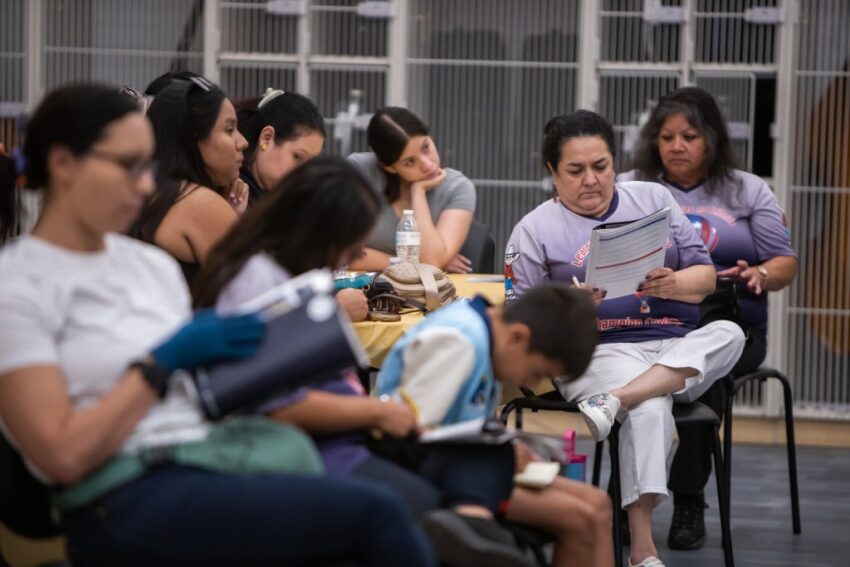
About half of the El Paso Independent School District’s elementary schools did not meet the scoring criteria to be labeled a “destination school” — a campus that attracts students, teachers and parents for its facilities, programs and resources — as the district considers which campuses to close or consolidate by the 2025-26 school year.
As part of the process EPISD calls “Destination District Redesign,” administrators gave elementary schools a “seat score” based on student attendance, the number of extracurricular activities it offers, teacher vacancies and other factors.
District leaders have not said which schools, or how many, will be affected and stress that a destination school designation alone won’t dictate whether a campus closes.
“We don’t have a definitive number at this point,” EPISD Superintendent Diana Sayavedra told El Paso Matters. “I would share that almost every area of the district will be impacted by at least one, if not two, school closures.”
Administrators plan to present their recommendations to the school board Oct. 15 and will hold a final phase of community meetings to discuss them. The second round of meetings was originally scheduled to conclude Monday at Franklin High School. However, in the wake of the death of a student in a traffic accident over the weekend, the district announced on social media that the meeting at Franklin was postponed. The final decision will be brought to a vote Nov. 21 during the district’s regular board meeting.
Enrollment declines as birth rates fall
The anticipated closures come as the district expects enrollment to continue to decline in the coming years due to falling birth rates, leaving many campuses with empty classrooms.
Out of EPISD’s 48 elementary and PK-8 schools, 20 are at 60% capacity or below. Some schools, such as Lamar Elementary School, have a capacity as low as 30%.
For schools to reach a goal of 80% capacity with its present enrollment, the district would need to operate only 33 elementary schools, Sayavedra said.
El Paso ISD Superintendent Diana Sayavedra speaks to district families and employees at Andress High School about the redesign and “rightsize” plans, Sept. 4, 2024. (Corrie Boudreaux/El Paso Matters)
“I’m not standing in front of you telling you that in one fell swoop, we’re gonna close that many schools because that’s not what we’re doing,” Sayavedra said during a Sept. 9 community meeting at Bowie High School.
“It’s important for us to understand the current reality of where we are as a school district in terms of the number of pre-K through fifth-grade children that we serve and the number of schools that we currently operate as a school district alongside the number that we actually need,” she said.
See also: EPISD plans school closures, consolidations amid sharply declining enrollment
Teachers and staff will still keep their jobs at a new campus if theirs closes, and students will be moved to a nearby school, presenters said throughout a series of community meetings held over the last three weeks.
The district is also considering asking voters to approve a bond proposal to upgrade air conditioning, improve safety and security, and invest in more educational programs at the schools that will remain open.
El Paso ISD Destination District Redesign
• This map depicts elementary schools and Pre-K through eighth-grade schools in the El Paso Independent School District along with the data points unique to each campus that are being utilized by the district to establish quality-seat criteria scores.
• Schools with a seat score of 72 or above meet several metrics and are considered “destination schools.” Of the district’s 48 elementary and PK-8 schools, 27 did not meet that criteria. Schools with seat scores above 72 may still be at risk of closing based on other factors such as enrollment.
• To see your school’s score, click on the sidebar tab on the top left of the map below:
How will EPISD decide what schools to close?
Sayavedra said schools with a seat score of 72 or above meet several metrics and are considered “destination schools.”
Of the district’s 48 elementary and PK-8 schools, 27 did not meet that criteria.
The elementary schools with the lowest seat scores include Travis (54), Newman (60), Stanton (62), Moye (64), Park (64), Rusk (64), Douglas (65), Rivera (65), and Hillside (67). Green, Putnam and Zavala elementary schools tied for the 10th lowest seat score with a 68.
Schools with seat scores above 72 may still be at risk of closing based on other factors such as enrollment.
“I wouldn’t say yes or no that simply because you have a 72 that we’re not going to look at your campus,” Sayavedra told El Paso Matters. “The chances of it being considered a closure are maybe less, but I’m not going to say that it’s completely impossible.”
Besides the seat score, district administrators said they will look at campuses that are in poor condition, have fewer than 400 students, are under 66% capacity and those with at least 35% of students living within its boundaries but attending school elsewhere.
Campuses that meet all these metrics include Newman, Travis, Putnam, Rusk, Zavala, Hawkins, Hillside and Stanton.
El Paso ISD Deputy Superintendent Vincent Sheffield speaks to district families and employees at Andress High School about the redesign and “rightsize” plans, Sept. 4, 2024. (Corrie Boudreaux/El Paso Matters)
The district will also see if a campus has a nearby “sister school” that can take more students.
“The biggest factor is we have to make sure that there’s what we’re calling a sister school that’s within that neighborhood, that has higher quality seats, a school that has a better facilities condition, and so on,” said Marivel Macias, the district’s chief organizational transformation and equity officer, during a Sept. 5 meeting at Austin High School.
Other factors the district will consider is if a school has had any recent or upcoming improvements or if there are any upcoming changes to the neighborhood, such as new housing.
EPISD plans to rebuild Bliss Elementary School, located on Fort Bliss, primarily using funds provided by the U.S. Department of Defense, and hopes to do the same with Milam Elementary School, which is also located on Fort Bliss.
The DOD will cover 80% of the costs to rebuild the school. The district will pay for the remaining 20%, “which we’ve already secured funding for,” Sayavedra told El Paso Matters.
The district does not have a timeline of when the school will be rebuilt.
EPISD also anticipates more students to enroll in schools near the Bowie High School feeder pattern in 2026 when the Ruben Salazar public housing complex is expected to reopen.
“We’re not going to make any rash decisions about the schools in that area without knowing what the potential enrollment might be,” Sayavedra told El Paso Matters.
Another factor that may play a role in deciding what schools to close is the price tag that comes with running a school.
It costs over $10,000 to educate one student at Newman, Zavala and Rusk elementary schools, and it costs over $11,000 at Rivera, Travis, Moye and Hawkins elementary schools.
Related: EPISD approves $18.5 million budget deficit, no employee pay raises
The district calculates this by taking the overall cost to operate a campus, divided by the number of students it enrolls.
Travis Elementary School, a Chapin High School feeder in Northeast El Paso, was rated as “Poor Low” in El Paso ISD’s Facility Condition Study. The study is part of the “Destination District Redesign Project,” which will determine whether campuses should be renovated or closed. (Luis Torres/El Paso Matters)
District leaders said schools with low enrollment tend to have higher operational costs per student because they still have a lot of the same expenses as other schools, such as utilities and administrative staff, but get less revenue based on enrollment.
On the low end, it costs the district less than $6,900 per student to run Tom Lea and Milam elementary schools and the Don Haskins, Coach Wally Hartley and Dr. Josefina Villamil Tinajero pre-k through eighth grade schools.
Concerns over equity, cost
The process has drawn mixed feelings from community members with some raising concerns over how the closures would affect some of EPISD’s most vulnerable students.
“A lot of the schools that they’re looking at are schools that are in working, middle-class or lower-class neighborhoods. Those are the students who will be highly affected by the decisions that they’re going to make,” Norma de La Rosa, president of the El Paso Teachers Association, told El Paso Matters.
Others said they felt the undertaking has improved compared with the last time EPISD closed schools four years ago.
“In 2020, there was really no process other than (close) the schools that have less than 400 kids. It was like a slasher movie,” Austin High School alumnus and district employee Ann Gallardo told El Paso Matters. “I have thought this has been very transparent.”
Some have also expressed concern over a potential bond election and how that would affect property taxes.
EPISD closed several schools and consolidated them into newly built campuses as part of its 2016 bond.
Parents El Paso Matters spoke to said they opposed building new schools.
“I just think that they should work with what we already have, because we do have bigger schools that can allocate a lot of students. I just think it’s a matter of relocating students to those schools, not building other ones and raising taxes,” said Jessica Navarro, a parent to an Andress High School junior and cafeteria worker for the district.
Sayavedra said a bond would not be used to build new schools and would focus on improving its current campuses.
Past school closures
Even though many community members said they understand why EPISD plans to close schools, some expressed skepticism after the controversial closure of three elementary schools near the Chamizal area in 2020 under previous leadership.
The closures led to a lawsuit filed by a local grassroots organization, Familias Unidas Por La Educación, which alleged EPISD had discriminated against poor, Hispanic and Mexican-American students by displacing them. The schools were in South-Central El Paso.
“School districts like to use school closures as a way to fix things, but you’re not actually fixing things, just moving students and creating problems for families. You’re breaking up communities,” Diana Ramirez, a member of the organization and mother of two EPISD students, told El Paso Matters.
The lawsuit was settled out of court in late 2022. Details of the settlement were not disclosed.
Zavala Elementary School, a Jefferson High School feeder in South Central El Paso, was rated as “Poor Low” in El Paso ISD’s Facility Condition Study. The study is part of the “Destination District Redesign Project,” which will determine whether campuses should be renovated or closed. (Luis Torres/El Paso Matters)
Now, parents and members of the organization are calling for the district to wait until it completes an ongoing equity audit, designed to help the district identify disparities in education, before deciding what schools to close.
“We haven’t finished the equity assessment, and the school district is already talking about closing more schools. So what are we doing? Are we not learning from the past? Are we not learning about the harms that were caused to other communities?” Ramirez said during a meeting Sept. 5 at Austin High School.
Sayavedra said waiting for the audit to be completed could set back the process up to a year.
“I don’t necessarily need to wait for an equity audit to come out to know that there are actions that I can take today that are going to serve to bridge some of those inequities,” Sayavedra told El Paso Matters. “Waiting would mean that we’re delaying actions that we could take now.”
The post How EPISD will decide which elementary schools to close, consolidate appeared first on El Paso Matters.
Read: Read More