



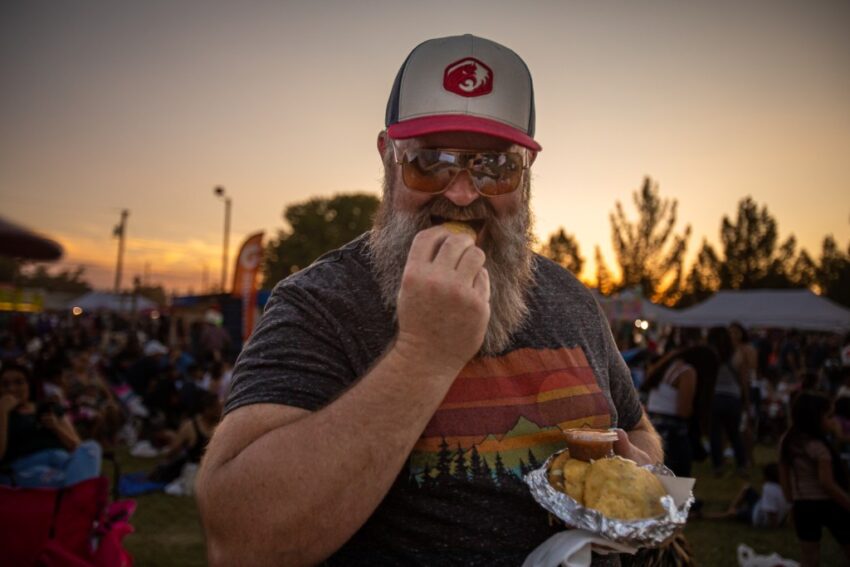
CLINT, Texas – On the final evening of the San Lorenzo Catholic Church kermés, families fill the church grounds as the golden hour casts its light on a vinyl sign hanging above the busiest booth at the bazaar.
The sign reads: “Gorditas – Heavenly Made.”
The line in front of the booth, which more than tripled in length that past hour, suggests visitors are willing to wait for a taste of heaven – deep fried patties made from corn masa, filled with seasoned ground beef plus shredded lettuce and diced tomato.
It’s kermés season in El Paso, a marathon of church bazaars from late July through mid-October, hosted mostly by the Catholic parishes.
Kermeses serve as the biggest fundraiser of the year for many churches, setting up carnival games, cake walks and raffles. Larger kermeses, such as the bazaars thrown by San Lorenzo in August and St. Anthony’s Seminary over Labor Day weekend, run for multiple days and attract thousands of visitors with live bands, dance performances and beer gardens.
Enchiladas and tasty antojitos compete for people’s appetites, but at a kermés, gorditas reign supreme.
In the gorditas assembly line inside San Lorenzo’s parish hall, volunteers slice an opening in the shell and stuff it with meat, beans, lettuce and other toppings as hundreds of festival-goers line up to place orders, Aug. 11, 2024. (Corrie Boudreaux/El Paso Matters)
Attendees can wait up to an hour at peak times for their order of gorditas, often served in threes with a side of jalapeño salsa and best eaten while the shell is still crispy on the outside.
But for El Pasoans, gorditas are more than fair food.
For Dayana Tena and Veronica Alvarado, they offer a way to give back to the church and feel a sense of belonging. Tena and her husband have volunteered for a few years while Alvarado has volunteered for more than two decades at the San Lorenzo kermés in the town of Clint in far east El Paso County.
For the Rios family, gorditas represent family bonds. Four generations of the family have volunteered to make gorditas at the St. John Paul II Catholic Church kermés in the Lower Valley. They became a part of the family’s livelihood after Martha Rios and her late husband, Hector, opened The Lunch Box restaurant in the Lower Valley in 1985, serving gorditas all year long.
Martha Rios (far left) next to her sister Bertha Delgado volunteer to make gorditas for Santa Lucia, now John Paul II, parish in 1985. She and her husband Hector opened The Lunch Box restaurant in El Paso that year. (Courtesy of Maria Olivas)
For Yvette Marquez-Sharpnack, they bring comfort to someone who’s long left El Paso. The cookbook author and food blogger lives in Colorado, but spent much of her childhood with her grandmother, who made gorditas until she was 90 years old for Our Lady of Mount Carmel Catholic Church, also known as the Ysleta Mission, the oldest operating parish in Texas.
Marquez-Sharpnack returned to El Paso in 2019 to attend the Ysleta Mission Fest, where her mother was volunteering at the gorditas booth.
“No cuts for me,” Marquez-Sharpnack recounted in a phone interview. “I had to go in the line and wait 45 minutes. That’s what makes it more special. You can’t wait to get your order. … I took my first bite and it took me back to being with my grandma and eating them with her. It’s such a nostalgic taste.”
When did gorditas become linked to kermeses?
Newspapers dating back to the early 1900s mentioned church bazaars and kermeses happening in Ciudad Juárez and El Paso, according to online archives. While El Pasoans associate the kermés of today almost exclusively with Catholic parishes, the kermés of the past functioned as fundraisers for a broader variety of organizations and causes.
By the 1950s, gorditas emerged as a popular way to feed crowds at these fundraisers.
In the gorditas assembly line inside San Lorenzo’s parish hall, volunteers slice an opening in the shell and stuff it with meat, beans, lettuce and other toppings as hundreds of festival-goers line up to place orders, Aug. 11, 2024. (Corrie Boudreaux/El Paso Matters)
The El Paso Herald-Post described gorditas as “spiced meat pies” and “little cornmeal cakes, piping hot, with toothsome meat patties in the center!”
In one of the earliest mentions of the kermés gordita, a 1952 El Paso Times article announced there would be gorditas at an annual bazaar held by the Knights of Columbus, a Catholic fraternity. Along with a “Mexican style supper,” the fundraiser would have booths for cockfights, dart shooting, lottery, cake sale and gorditas, the article lists.
Historically, food writers saw the origin of Texas as a “white man’s land” and forgot that Mexican cuisine has origins north of the Rio Grande, too, said food historian Adán Medrano, who produced and wrote the documentary “Truly Texas Mexican.”
Gorditas, like the tortilla, can trace their origin back to the domestication and nixtamalization of corn. Medrano argued against the theory that Mexican migrant workers in the Bracero Program, who were not used to the frontera’s flour tortillas, were the ones who popularized corn tortillas and gorditas in Texas.
Archaeological excavations in Texas and early Spanish writing show indigenous people were not only cooking corn, but offering Spanish explorers corn patties and tamales, Medrano said. The deep frying technique arrived in more recent history, after the Spaniards brought pigs over and people began frying food in pork fat.
Agustín Cano, a San Lorenzo parishioner, fries gorditas in hot oil as he and other volunteers prepare the dish for their church’s annual kermés, Aug. 11, 2024. (Corrie Boudreaux/El Paso Matters)
The gordita found at El Paso’s kermeses is just one of many regional varieties, from Mexico City’s gorditas stuffed with succulent chicharrón prensado and cooked on a comal to the Borderland’s gorditas de harina that resemble large, thick, flour tortilla pockets.
Masa from freshly ground corn spoils quickly. Out of convenience, many modern-day cooks make corn gorditas with masa harina, dried corn flour that only needs water added to become dough.
“Mexican gastronomy is ultimately an expression of indigenous cooking,” Medrano said. “The deep-fried gorditas of El Paso, a little bit south where people mix queso fresco in the masa, all these wonderful variations are indications of the people who live in different parts of Texas.”
Making kermés gorditas spans generations
It’s peak time after the sun sets and the temperature cools at San Lorenzo’s kermés.
As people order and pick up their gorditas, multiple orders stacked in white plastic bags, a flurry of people with hands in motion are moving on the other side of the window. Men are boiling ground beef seasoned with garlic, salt, black pepper and cumin. Others drop flat, round pucks of masa in the deep fryers. Once golden yellow, they make their way down an assembly line of mostly women in charge of slicing, stuffing and packaging.
In the gorditas assembly line inside San Lorenzo’s parish hall, volunteers slice an opening in the shell and stuff it with meat, beans, lettuce and other toppings as hundreds of festival-goers line up to place orders, Aug. 11, 2024. (Corrie Boudreaux/El Paso Matters)
Alvarado cuts each gordita open to form a pocket while Tena spreads the first filling of ground beef in each one. It’s a family affair for Tena – her husband, Mauro, and one of their sons are in another room pouring salsa into plastic condiment cups. Near them at the masa station another group is using an electric press to roll out the rounds of dough.
San Lorenzo goes through more than 2,800 pounds of masa for the kermés, Tena estimated.
Even smaller kermeses in El Paso have to keep up with high demand.
In July, St. John Paul II parish sold 730 orders in one day – totalling 2,190 gorditas, said Maria Olivas, a member of the Rios family who works at The Lunch Box and volunteers at the kermés. Several customers requested 10 or more orders at a time, which caught them off guard, Olivas said.
She and her mom and siblings gathered on a recent afternoon at The Lunch Box before closing. This year, more than 20 family members spanning four generations, as well as employees from The Lunch Box, volunteered at the kermés, Olivas said.
George Walsh, Lorenzo Olivas, Paula Tovar and Luis Rios (far right) of the Rios family and The Lunch Box restaurant helped make gorditas at the kermes for Santa Lucia, now John Paul II, parish in 2000. (Courtesy of Maria Olivas)
The annual tradition began with 84-year-old matriarch Martha Rios, who was born in Ciudad de Chihuahua and moved to El Paso in 1960. Rios said she never ate or cooked a gordita while living in Chihuahua. A parishioner taught her how to make her first gordita 55 years ago for the kermés at Santa Lucia Catholic Church. (Santa Lucia later merged with San Jose Catholic Church and was renamed St. John Paul II).
Santa Lucia is the patron saint of the blind and Rios began attending that church to pray for her sister who lost her sight. Rios promised to dedicate one year of service, but one year turned into 55 years.
Back then they cooked the masa for gorditas in wood-fired ollas before eventually getting a stove, and then a deep fryer, Rios said. They haven’t invested in a machine to crank out patties, so they still form the bolitas and pat the masa back and forth between their hands.
Her son, Martin Rios, who with his wife, Laura, runs Martita’s Lunch Box on Montana Avenue on the Eastside, said what they sell at the kermés is the same as what they sell at the restaurants – deep fried gorditas stuffed with a beef and potato picadillo, lettuce, tomato and shredded mozzarella. The salsa made in house has only four ingredients – jalapeños, salt, garlic and tomato paste.
Martin said he volunteers to serve God. But it’s also fun to show off, he added. His wife Laura pulled up photos on her cell phone from past kermeses that show Martin balancing a stack of unfilled gorditas on his arm.
“Oh, he loves shoving off,” Olivas exclaimed as she counted the number of gorditas in the photo.
“We can round it up, 25,” Martin said with confidence.
Marquez-Sharpnack said her grandmother Jesusita at Ysleta Mission used to add mashed Russet potatoes to the masa. The mixture made the gorditas more tender, giving them an almost creamy texture and pillowy soft center after deep frying, Marquez-Sharpnack said.
Before moving to El Paso, Jesusita made gorditas from scratch at a Mexican restaurant she owned in Shafter, Texas, a mining boomtown near the border that was abandoned after World War II.
Jesusita eventually settled with her daughter and grandchildren near Our Lady of Mount Carmel in the Ysleta del Sur Pueblo in the Lower Valley. After Jesusita died in 2004, Marquez-Sharpnack’s mother, Vangie, began volunteering to make gorditas at Our Lady of Mount Carmel.
Cookbook author and food blogger Yvette Marquez-Sharpnack (right) grew up in El Paso eating her grandmother’s home cooking. (Courtesy of Yvette Marquez-Sharpnack)
Marquez-Sharpnack, along with her older sister and mother, were inspired by the kermés gordita when they developed the recipe for her 2015 cookbook Muy Bueno Fiestas.
“Gorditas is like one of those dishes (my family) didn’t make very often at home,” Marquez-Sharpnack said. “It’s like a treat. When you have them, you have them out at the kermés.”
How the COVID-19 pandemic changed El Paso’s kermeses
The kermés may not be around for long at some of El Paso’s parishes.
When Marquez-Sharpnack brought a videographer to the Ysleta Mission Fest in 2019, she wanted to document her first time returning to her hometown kermés since moving away in the late 1990s.
She didn’t realize it may have been her last chance.
Volunteers assembled gorditas at the Ysleta Mission Festival in El Paso in July 2019. (Cristina Navarro/Muy Bueno Blog)
Diana Baeza, a bookkeeper at Ysleta Mission, said the parish stopped throwing its annual kermés at first because of the pandemic, and now because there aren’t enough volunteers. Parishioners and their children have moved out of their neighborhood. The community is elderly, so they can’t help with the manual labor as much as they used to, Baeza said.
The church used to purchase masa from La Tapatia restaurant and hold the Ysleta Mission Fest in the second weekend of July. The event was so well attended the parish had to run two gordita booths, plus an express booth for people requesting less than three orders, Baeza said. Now they have a gordita sale a few times a year to raise money for the church.
Martin Rios said St. John Paul II parish is also seeing an aging community. The kermés has shrunk in size over the years as young families move to newer developments, such as on the Far Eastside, he said. He thinks some people also got used to attending mass virtually during the pandemic and stopped returning in person.
Meanwhile, other kermeses have bounced back in full force since the pandemic. St. Anthony’s Seminary brought back its beloved lotería and planned three gordita booths for this year’s Labor Day weekend bash.
Hundreds of festival-goers line up at the San Lorenzo kermés to taste an order of the church’s famous gorditas, Aug. 11, 2024. (Corrie Boudreaux/El Paso Matters)
Outside San Lorenzo church, people could meander from the rows of food trucks to the stage where Norteño band Grupo Infiel crooned of love and pain. Matachines dressed in feathered headdresses and aprons beaded with the Mexican and American flags stepped in beat with the drums, performing rituals that blend Catholic and Indigenous storytelling.
Money raised by the gordita sales and other booths help fund upkeep of the church, said Chuy Dominguez, a longtime parishioner and former church chairman.
Adoberos built the church by hand in 1913 and behind the building’s white stucco walls are the original adobe bricks, Dominguez said. Adobe brickmaking and laying are a dying art so adoberos are hard to come by now if the church needs repairs, he said.
He knows people see kermeses as fun and entertainment, but there’s a religious aspect as well, he said. People travel from out of town to show their devotion and reflect on their faith in God at San Lorenzo, he said. Throughout the kermés, a steady stream of people passed through the church to pray. On the second night, a procession formed at 3 a.m. with people marching from San Elceario Catholic Church to San Lorenzo in celebration of the church’s patron saint.
The annual kermés at San Lorenzo Church in Clint brings thousands of visitors over a three-day period, Aug. 11, 2024. (Corrie Boudreaux/El Paso Matters)
Though the Ysleta Mission did not host a kermés this year, the parish held its Feast Day procession in July, accompanied by matachines.
Marquez-Sharpnack said she’s glad she took her son to experience her family’s kermés before the pandemic and hopes the historic parish will bring the bazaar back one day. Her mother Vangie still lives close to the Ysleta Mission and volunteers to make gorditas for its fundraiser drives.
“I took my son out there and it’s a forever memory he has with his grandma, just like the forever memories I have with my grandma,” Marquez-Sharpnack said. “That’s what El Paso’s all about. Those memories are my favorite.”
Volunteers assembled gorditas at the Ysleta Mission Festival in El Paso in July 2019. (Cristina Navarro/Muy Bueno Blog)
El Paso Kermes Season
Here are some upcoming church bazaars across the Borderland:
Sept. 6-8: Holy Spirit Catholic Church, 14600 Horizon Blvd. (Horizon City)
Sept. 6-8: San Juan Diego, 14520 Montana Ave.
Sept. 13-14: San Pedro Maldonado Catholic Church, 3000 Tim Foster St.
Sept. 13-15: Santa Rosa de Lima Parish, 620 E. 4th St. (Pecos, Texas)
Sept. 14-15: St. Patrick Catholic Church, 7065 2nd Ave. (Canutillo)
Sept. 21-22: San Judas Tadeo Catholic Church, 4006 Hidden Way
Sept. 20-22: Corpus Christi Catholic Church, 9205 N. Loop Drive
Sept. 21-22: Christ the Savior Catholic Church, 5301 Wadsworth Ave.
Sept. 21: Our Lady of Fatima Parish, 308 S. Almond St. (Van Horn, Texas)
Sept. 27-Sept. 29: La Purisima Mission, 328 S. Nevarez Road
Sept. 27-Sept. 28: St. Raphael Parish, 2301 Zanzibar Road
Sept. 28-29: Our Lady of Sorrows Catholic Church, 7712 S Rosedale St.
For a full schedule, see our list of 2024 kermeses throughout El Paso.
The post How kermés gorditas became a cherished El Paso tradition appeared first on El Paso Matters.
Read: Read More