



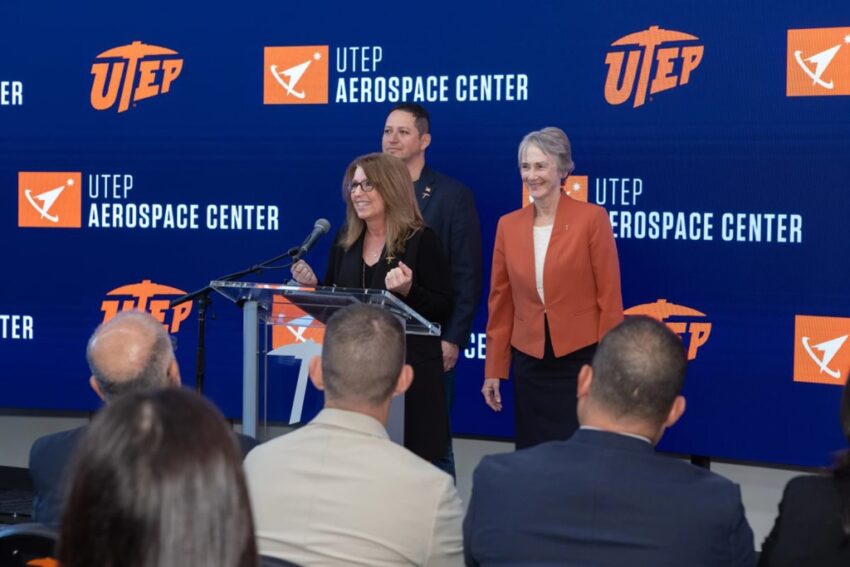

El Paso Matters produced this story as part of an initiative with ProPublica and The Texas Tribune to report on how power is wielded in Texas.
Two years ago, El Paso celebrated grants to coalitions led by the University of Texas at El Paso that could have brought up to $200 million to the region to develop a transformational manufacturing operation focused on defense and aerospace.
El Paso business owner Pablo Rodriguez, owner of PROD Design & Analysis, created a subsidiary, PROD Aerospace, in July 2022 to capitalize on anticipated growth in the defense and aerospace industry.
It never happened.
“We have had zero activities, zero employees, zero revenue. Zero. Zero. Zero,” Rodriguez said last year about his subsidiary, with more disappointment than bitterness. He closed the subsidiary’s bank account in September and shuttered his aerospace company in December. “Everything has been zero.”
El Paso leaders had spent years aiming to transform the area’s economy, banking on defense and aerospace manufacturing as a key driver for that change. Those plans, however, quickly unraveled in the spring of 2024, when UTEP President Heather Wilson, a former congresswoman and secretary of the Air Force during the first Trump Administration, and other university officials raised concerns with the National Science Foundation about an awarded grant application that could have generated as much as $160 million for the region.
The NSF suspended the grant on April 25, 2024, and the science foundation’s inspector general began an investigation. NSF killed the grant in August 2025, before the investigation was concluded.
Amid the grant’s suspension, Wilson demoted Ahsan Choudhuri, the engineering professor who provided the overall vision for developing the regional economy through aerospace manufacturing.
Within a year, another economic development grant meant to boost the aerospace manufacturing industry, this one from the Biden Administration’s Build Back Better initiative worth $40 million, was at risk as UTEP officials struggled to administer the plan. Choudhuri had been the principal investigator of both this and the NSF grant proposals.
El Paso Matters has reviewed dozens of emails and other records, and interviewed area officials and industry leaders, which together provide the most complete picture to date of how Wilson and other UTEP officials – amid deep divisions with two of the university’s leading researchers – took actions that eventually doomed funding aimed at remaking El Paso’s long-struggling economy.
The El Paso Matters investigation found:
- A key reason Wilson demoted Choudhuri is because she said an internal audit found that he incorrectly claimed in the National Science Foundation grant application that UTEP could use state-owned land in eastern El Paso County for test space. However, Wilson’s predecessor at UTEP, Diana Natalicio, had committed to allowing the land for aerospace testing in a 2017 interlocal agreement with the county government, the newsroom found. The university didn’t respond to questions about UTEP’s agreement to use the state-owned land as part of economic development plans with the county.
- UTEP’s internal audit said the grant proposal committed hangars at the Fabens Airport for the project, and that those hangars didn’t exist at the time. Choudhuri said the commitment for the hangars was made by the county, not UTEP, and he informed NSF and UTEP of construction delays before the grant was awarded.
- The university’s investigation of Choudhuri’s NSF grant application was not done in accordance with UTEP’s policy for investigating allegations of research misconduct, which spells out a deliberate process involving subject matter experts and makes no mention of using internal auditors, which was the process UTEP used. UTEP officials said their concern “was not typical research misconduct,” so use of the internal auditor was appropriate.
- Another Aerospace Center staffer warned university officials multiple times that the $40 million economic development grant was in danger of failure because of UTEP’s lack of focus on the project, according to emails obtained by El Paso Matters.
Wilson has not responded to multiple interview requests over the past two years about the NSF and Build Back Better grants and her actions related to the grants.

The NSF Office of Inspector General recently closed its investigation of the grant application, saying it “could not substantiate the false information allegations” made by the university. The inspector general’s office hasn’t explained its reasoning and generally does not publicly release its investigative reports. The office, and the NSF itself, declined comment on the UTEP grant.
In a case closeout memo dated Feb.4, the inspector general doesn’t specify what false information allegations were investigated, but Choudhuri – who was interviewed by the federal investigators – told El Paso Matters he believes they are the same as UTEP’s allegations raised in its internal audit.
The memo said the inspector general also did not substantiate “cross-allegations related to conflicts of interest, award sabotage, and use of non-public information against a party involved in the allegations of false information.” It does not specify details but Choudhuri said he raised concerns with the office about what he perceived as improper behavior by UTEP leadership. He declined to elaborate, and UTEP officials declined to comment on the cross-allegations.
After the inspector general’s decision was issued, Wilson issued a statement saying Choudhuri had plagiarized a portion of a 2006 NSF grant proposal, without providing evidence to substantiate the claim. She also said he had been found noncompliant with university policies related to nepotism and procurement in a 2023 audit.
Choudhuri has declined to comment on the plagiarism accusation beyond saying that NSF thought enough of him to award him one of the largest grants in its history. He said the 2023 audit findings were untrue and part of Wilson’s efforts to discredit him.
Timeline: How El Paso won, then lost, a potential $160 million economic development grant
An NSF spokesman said that most of the initial $15 million for the grant was reallocated after the suspension and there was not enough money left in 2025 to support the remainder of the project.
The separate $40 million grant from the U.S. Economic Development Administration is continuing, with the city government replacing UTEP as the lead institution administering the money.
The university said it’s “committed to ensuring the success” of the $40 million grant and will work with the city to accomplish its objectives.
When asked if he would have changed anything in the NSF proposal, Choudhuri said he would not because it was the best grant application he had ever written, using the most up-to-date information he had. He said there was nothing materially wrong with the proposal.
“I don’t understand what I could have changed,” Choudhuri told El Paso Matters.
He retired from UTEP in December and now runs Arc Aerospace, an El Paso-based company that designs and builds low-cost defense systems.
A turn for the worse
While questions abound as to what triggered the review of the NSF grant and the decisions that UTEP made in 2024, the proverbial pebble in the pond is Choudhuri. His dismissal as leader of UTEP’s Aerospace Center created a ripple effect that continues to affect the economic development of the community and the region, El Paso County Judge Ricardo Samaniego said in a recent interview.
“I feel as if we are at ground zero again. At one point, I thought we were going to be one of the biggest (aerospace) hubs,” he said.
“We are not at that level that we used to be, not because of the loss of money, but because of the change of vision of what we now have. We’re struggling now. We’re going into strategic planning trying to figure out how to regroup to get back to being a big player in aerospace,” he said.
From the time Choudhuri arrived at UTEP in February 2001, he secured increasingly larger grants as well as partnerships with the likes of NASA, the military and the U.S. Department of Energy.
From January 2020 through December 2023, the Aerospace Center brought in grants totaling more than $52 million. The following year, when Choudhuri was relieved of his center duties in May, it secured $11.8 million, and last year it generated a little more than $668,000 in grant awards.
The science foundation announced Jan. 29, 2024, that the UTEP-led collaborative had earned one of its 10 Regional Innovation Engine grants. The grant award was for $15 million initially, and up to $160 million if the grant partners met benchmarks.
A few days later, Ahmad Itani, UTEP’s vice president for Research and Innovation, sent an email to Choudhuri and his longtime collaborator, Ryan Wicker, founder and then executive director of UTEP’s W.M. Keck Center for 3D Innovation. The email said the university needed to provide “appropriate governance, oversight and accountability measures” for the grant.
The email included an attachment with a number of directives, such as Itani being UTEP’s representative on the governance board of the NSF grant project.
Additionally, Itani asked the principal investigators to include him, his representative or Andrea Cortinas, executive vice president and chief of staff, in any reports or meetings that involve the NSF. He also planned to create a “senior university committee” made up of people from outside the Aerospace Center that would assess the project’s progress. Itani did not respond to questions for this story.

Choudhuri and Wicker, who had overseen many grants in the millions of dollars through the years, saw Itani’s post-award efforts to take a greater leadership role as unsupportive of their work and an attempt to goad them into leaving the university and their grant.
Wicker responded to Itani in a Feb. 3, 2024, email obtained by El Paso Matters. In it he shared his disappointment with how the university’s culture had created a difficult working environment for him and Choudhuri.
“I can only assume that the intent of the UTEP administration is for the two of us to leave, rescind the grant, and cause damage to UTEP, the City and County, numerous other collaborators and especially the community and students we serve,” wrote Wicker, who retired in November 2024. He did not respond to an interview request for this story.
“I must say I am stunned,” Choudhuri wrote in an email to Itani two days later. “This unilateral and utterly heavy-handed approach is so unprecedented and undoubtedly will cause massive damage to (Wicker’s) and my programs.”
UTEP’s Office of Auditing and Consulting Services started to review the awarded NSF proposal in March 2024. By early April, the office had found some issues with the grant application, according to a May 6 letter to the NSF from Itani.
According to emails and comments from Choudhuri and U.S. Rep. Veronica Escobar, D-El Paso, the NSF grant began to unravel in mid-April of 2024.
By that time, White House representatives were in discussions to have a celebration in El Paso to mark the awarding of the major federal grants. An April 18 virtual meeting with those involved in the planned celebration at UTEP generated some friction, according to Escobar, because representatives from Wilson’s office wanted to plan the event, and the White House wanted Escobar’s office to be in charge.
Later that day, Wicker and Choudhuri wrote separate emails to Itani that suggested the science foundation grant be transferred to El Paso Makes, a public-private economic development initiative co-founded by Choudhuri and managed by the National Center for Defense Manufacturing and Machining.
Choudhuri said an NSF official – whom he declined to identify – contacted him April 20, 2024, to ask if Wilson truly supported the grant. Escobar said she was contacted the same day by someone with ties to the federal government who asked the same question about Wilson. Escobar also declined to identify the person who contacted her.
On April 21, a White House representative called Escobar’s office to tell her the May 3 celebration for the awards was canceled, but did not offer a reason. On April 22, UTEP’s auditing office contacted Choudhuri to talk about a review of the NSF grant.
Concerned about the reasons for this review, Choudhuri and Wicker contacted Itani that same day. Itani responded that the auditing office’s request was “a standard review,” which is meant to help if there is an external audit. Itani asked both researchers to make themselves available.
El Paso Matters has found no record of any other similar kinds of reviews by UTEP’s internal auditor. In response to a Texas Public Information Act request from the news organization for any audit reports on awarded grants since 2019, UTEP officials said they had no such records.
On April 25, the science foundation suspended the grant.
UTEP officials said the school leadership’s first contact with NSF regarding concerns with the grant proposal was Itani’s letter on May 6, 11 days after the grant suspension.
How UTEP did its investigation
UTEP has an extensive policy on how it responds to allegations of research misconduct, which includes “fabrication, falsification, plagiarism in proposing, performing, or reviewing research, or in reporting research results.” The investigations by UTEP and the NSF inspector general focused on falsification.
The policy calls for a deliberate process led by the vice president of research that could take up to 180 days and could use “subject matter experts” for complex topics.
That’s not what UTEP did when it looked into Choudhuri’s grant application to NSF. Instead, it relied on an investigation by its internal auditor that took a few weeks.
In a statement to El Paso Matters, UTEP officials said they were justified in using the internal auditor for the investigation, rather than the vice president of research, as required in its policy.
“This was not typical research misconduct like plagiarism or fabricating research results, and the issue was broader, dealing with much more than just research. Our internal audit office did the fact-finding work for the university and gave Dr. Choudhuri weeks to provide information and input, which he did. Using internal audit to find the facts was entirely appropriate in this case,” the statement said.
UTEP didn’t explain what broader issues were involved.
Wilson demoted Choudhuri in a May 6, 2024, letter, terminating his appointment as associate vice president. She only identified issues related to the grant application. She wrote that the university auditors found two “questionable commitments” in the NSF proposal. They related to Choudhuri’s mention in the grant application of the availability of five hangars at the county-owned Fabens Airport, and 8,000 acres of nearby test space near Tornillo – both in Far East El Paso County
Wilson’s memo disputed that the hangars were “currently available” for use by the NSF project. County officials later said they were behind on construction of the hangars but were proceeding with building them.
She also wrote that the buildings’ approximately 78,000 square feet of research space did not exist and that the Aerospace Center did not have access to the Tornillo test range facilities, which is owned by the University of Texas System. Additionally, the letter stated that Choudhuri had done nothing to fix the errors in the grant request.

However, in a May 1 response to UTEP’s auditing office, Choudhuri used text, maps, floor plans, photos and a timeline to justify what he included in the NSF proposal.
He also referenced an interlocal agreement with El Paso County signed in January 2017 by Natalicio, then the university president, and Escobar, who was county judge at the time, that committed “all or portions of 9,600 acres of adjacent University of Texas System land” to the Fabens Airport for a joint project with the county. The agreement started April 1, 2017, and ran through March 31, 2027. There are two 10-year extensions that could be renewed automatically.
Escobar said that her understanding of the agreement was that the county would provide the facilities at the Fabens Airport and that UTEP would conduct projects there such as those that would have been done under the NSF grant. The county and UTEP referred to the airport as the Tech 1 Campus.
She said it was part of the county’s plan for economic development as well as educational purposes to have UTEP use the resources, including the airspace in Tornillo.
“The potential was endless,” she said.
UTEP officials told El Paso Matters that the county had no discussions with Wilson after she took office in 2019 about the university constructing or renting new buildings at the airport. They said Choudhuri did not have authority to negotiate agreements with the county.
Choudhuri told El Paso Matters that the county promised to fund and construct the additional buildings at the Tech 1 Campus as part of its commitment to the grant, and spent $25 million to do so. He and Susie Byrd, the Aerospace Center’s director of economic development at the time, said NSF and UTEP officials were kept aware of delays in construction as the grant process moved forward.
“Emails, meeting agendas, and presentations since 2019 show that President Wilson was briefed by my staff and me on the vision for Tech 1 Campus and provided feedback and advocacy in support of it,” Choudhuri said, adding that Byrd “actively sought and received guidance from the former and current vice presidents of research, the legal office, the dean, and the president’s chief of staff about the process for pursuing an agreement. We followed UTEP’s internal process for developing agreements in full coordination and with full knowledge of UTEP leadership.”
Choudhuri and Byrd provided numerous emails, spreadsheets and meeting agendas to El Paso Matters showing the updates and ongoing communication with UTEP administrators about the Fabens campus.
Choudhuri said his appointment by Natalicio as associate vice president authorized him to develop the Tech 1 Campus at the Fabens Airport with community partners.
Following Wilson’s demotion of Choudhuri, Escobar scheduled an in-person meeting at the Enrique Moreno County Courthouse with the UTEP president to discuss how to move the project forward. She was joined by Samaniego, the current county judge, and then-El Paso Mayor Oscar Leeser. Leeser did not respond to multiple requests for comments about the meeting.
“For me it was very clear (Wilson) really couldn’t care less,” Escobar said. “(Wilson) was not concerned about the way that those of us who were deeply invested felt, or the concerns that we raised. The impression I got was that her mission and what she wants to do is very different from what the community had built.”

Samaniego said he thought the meeting was to consider options on how to move forward. Instead, Wilson said that any negotiations between Choudhuri and the county were not viable. He said that he had mentioned the UTEP/county agreements before in meetings with Wilson and she never expressed any reservations.
“A lot of things changed for us,” he said. “That was the day we found out about the change that had taken place between what we believed and what (Wilson) believed. They were very different.”
In a statement to El Paso Matters, UTEP officials said: “No one at UTEP wanted anything but success for this NSF-funded project. Unfortunately, the university was ethically and legally compelled to disclose its concerns about committed resources that did not exist to the NSF.”
Wilson hired Shery Welsh as the Aerospace Center’s executive director in June 2024 to replace Choudhuri. Welsh had 37 years of federal service in aerospace science and engineering and oversaw programs with budgets in excess of $500 million, and staff of 200 engineers, scientists and administrators, but had no experience in university research. She did not respond to questions for this story.
Build Back Better
While the NSF grant was in limbo, Byrd said she began to notice issues affecting the $40 million Build Back Better program.
The U.S. Economic Development Administration awarded the grant in September 2022. Choudhuri’s ouster as head of the Aerospace Center, a lack of funds from new projects, and staff reductions and separations delayed the Aerospace Center’s ability to push the BBB project forward, Byrd told El Paso Matters in her first interview about what occurred. She left the university last year.
Months before leaving, Byrd sent a series of emails about the Build Back Better grant to UTEP’s Welsh, Itani and Kenith Meissner II, dean of the College of Engineering. Despite numerous warnings from her beginning in July 2024, Byrd said those leaders were slow to address the issues.
She sent the three university officials an email Aug. 12 with the subject line “UTEP putting Build Back Better effort at risk.” She wrote that the university’s lack of focus on the program had put the project and its $40 million in funding in jeopardy. El Paso Matters obtained a copy of the email.
Byrd called that message her “last-ditch effort to raise the alarm and urge decisive action” to get the grant back on track.

She told El Paso Matters that she only received email responses from Welsh, who wrote that the university was working urgently to address the issues. Byrd said in her email response to Welsh that the timeline did not support that assertion.
Byrd’s Aug. 12 email said the university took months to respond to some requests that were crucial to the grant, and that some contracts and projects were nine months behind schedule due to UTEP’s lack of timely replies.
Byrd’s other area of concern in her email was Meissner’s delay in appointing a replacement for Choudhuri as principal investigator of the BBB program. As of Byrd’s resignation in October 2025, UTEP had not named anyone to lead the project.
In the email, Byrd pointed out that the BBB and NSF grant proposals were based on the research capabilities at UTEP’s Aerospace Center and the Keck Center under the leadership of Choudhuri and Wicker, respectively.
Byrd wrote that the capabilities of both centers had diminished substantially in the past year and that neither was able to provide the necessary help with the “Innovation Network,” a West Texas-wide effort to make small and medium manufacturers in the region competitive for aerospace and defense markets.
“Running (Wicker and Choudhuri) off was what created the deterioration of those capabilities,” she told El Paso Matters. “Without those capabilities, it was very difficult for us to be able to meet the requirements of our grant.”
In a statement to El Paso Matters, UTEP officials said Choudhuri was still the principal investigator on the Build Back Better grant at the time of Byrd’s email and “was the person responsible for execution of grant commitments.”
Choudhuri said UTEP officials had taken away his staff and other resources following his demotion by Wilson in 2024, making it difficult or impossible for him to fulfill his responsibilities as principal investigator on grants. He said that despite the obstacles, he was able to make significant progress toward the grant’s goals.
In the summer of 2025, UTEP began to negotiate with the city of El Paso to share leadership of the grant, with the city taking over the administrative duties. The El Paso City Council approved the agreement Oct. 14.
Part of the plan included El Paso Makes – the organization Choudhuri co-founded – taking over the responsibility of the Innovation Network.
In a previous El Paso Matters story about the City Council’s consideration of co-leading the grant, Ian Voglewede, the city’s director of strategic and legislative affairs, said the city needed to take action to prevent another major failure with a federal grant.
“I hate to put it this way, but we can’t have another NSF (grant failure) because at some point … we’re going to get a black eye,” Vogelwede said. “We’re not going to get funded anymore.”
What’s next?
Choudhuri, Escobar and El Paso economic development officials have said they believe El Paso can still expand defense, aerospace and additive manufacturing industries, even without the NSF grant.
Escobar said the loss of the NSF grant is a massive blow, and she blames Wilson.
“Losing $160 million is nothing to sneeze at,” she said. “It should not be papered over. It should not be ignored.”
Whatever the future may hold for the region’s aerospace dreams, the effects of the science foundation grant loss are already being felt.

El Paso native Isaac Basurto worked at the Aerospace Center as part of a research team starting in fall 2021 when he first enrolled at UTEP. His research involved engine testing for NASA and the Department of Defense.
Basurto said it was a great opportunity for hands-on experience, including working with propulsion engineers and technicians from NASA and Blue Origin, an aerospace manufacturer and defense contractor with a launch site near Van Horn, Texas, about 144 miles southeast of El Paso.
He said work became tougher around January 2025 because money became harder to access at the Aerospace Center.
“We all knew things were going rough,” said Basurto, whose last project involved digital engineering. “We all just saw our projects fizzle out.”
Basurto said center officials promised additional funding, but it never materialized. He witnessed much of the experienced staff leave. His appointment with the center ended in May last year, along with members of his team and other work groups.
He graduated in December from UTEP with a bachelor’s degree in aerospace and aeronautical engineering and has interviewed for jobs in his field, including with Blue Origin, but has not yet secured employment.
“It’s a bit tough to find work at the moment, so I don’t have any guarantees that I’ll get anything, but I’m hopeful I’ll find an opportunity with my experience,” Basurto said. He later added, “If I can’t find any engineering work, I’ll likely just take on work in less technical roles here in El Paso.”
The post How UTEP leadership decisions led to loss of a potential $160 million grant and derailed El Paso’s aerospace plans appeared first on El Paso Matters.
Read: Read More