




Advocates are calling for El Paso residents to confront anti-Blackness in their community and learn the history of white supremacy after a racist incident went viral over the weekend – raising questions about racism and organized hate, accountability and the boundaries of free speech.
A group of reported El Paso teenagers appeared in Ku Klux Klan regalia for a Halloween party on the Eastside, where they walked down the street yelling racial slurs.
It’s unclear when exactly the incident occurred, but Instagram account @TheRealFitFamElPaso posted photos and video clips of the occurrence on Sunday. The post garnered more than 28,000 likes and 5,000 comments before FitFam removed it. Footage, however, spread to other social media accounts with thousands of followers, thrusting El Paso in the national spotlight.
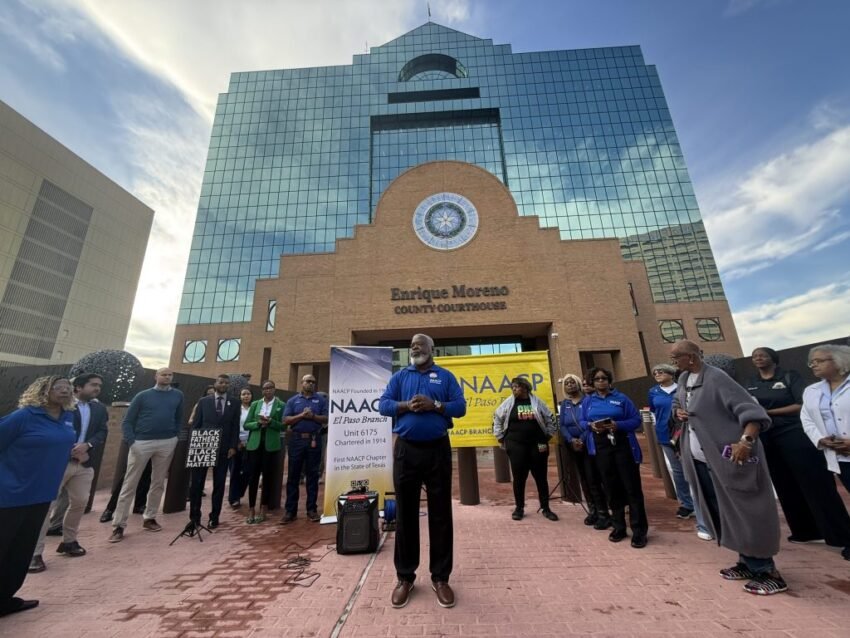
Local leaders including the El Paso police chief denounced the derogatory display the following day, when Carl B. Dwyer Jr., president of the NAACP El Paso chapter, also addressed the incident outside the El Paso County Courthouse.
He and other community members said this incident is part of a broader problem of racism in El Paso, where youths use the N-word in their everyday language. Some said they hope this incident can turn into a teaching moment to address racism in El Paso, a topic they said can make people in a Hispanic-majority city defensive.
Black people make up less than 4% of El Paso’s population.
If parents allow their children to use racial slurs at home, they’re going to say it in public, said Tephanie Hopper, an NAACP El Paso member and owner of Colorful Chapters bookstore. But it’s going to take the whole community to advocate against racism, including principals and superintendents to support the teachers who address racial slurs, discrimination and bullying in school, she added.
“We have a shared history,” Hopper said. “The kids who were KKK, it was Halloween, but when they display that, it’s not only offensive, it’s also dangerous. They are invoking a legacy of violence against people of color, not just Black people, but Hispanic people as well.”
The Ku Klux Klan is a white supremacist terrorist organization whose violent mobs targeted Black Americans. In the Southwest, Mexican Americans were the second-most targeted group.
The KKK reached its height in El Paso in the 1920s, recruiting an estimated 3,500 people including former El Paso Mayor Tom Lea Sr. Members were part of the school board, El Paso Herald Post editorial staff and El Paso police, according to newspaper articles from that time. The hate group burned a cross on the Franklin Mountains and also attempted unsuccessfully to take over city government.
School districts, El Paso police respond
Texas public schools are limited in how they can discipline students for behavior off campus and outside school hours.
Tracy Garcia-Ramirez, spokesperson for Ysleta Independent School District, said in an email the district has not identified any YISD students as being part of the group of hooded individuals.
“Nonetheless, we are monitoring this matter closely and will swiftly address any resulting and substantial disruption to our educational environment to include retaliation, discrimination, harassment or bullying, which is not protected speech under the First Amendment,” she said.
Kevin Venegas, a spokesperson for Clint Independent School District, said the district is not aware of any currently enrolled students dressing up in KKK-style robes or hoods.
Socorro Independent School District did not respond to requests for comment.
The El Paso Police Department is investigating the incident to determine whether any laws were violated, including disorderly conduct.
“Free expression has limits when it crosses into conduct that threatens public order or the safety of others,” reads a statement from El Paso Police Chief Peter Pacillas on social media.
Addressing racism at school can feel like ‘political landmine’
Carolina Cardoza graduated high school three years ago in Northeast El Paso, where she saw “Mexican culture and Black culture coexist.” But she was not surprised when she saw the video clip of possible high school students dressed as Klansmen.
Her generation is known for being “woke,” but young people are so far removed from the history of the Ku Klux Klan and not being taught about it, she said.

“If you pay attention to social and cultural cues, it makes sense that something like this would happen in a space like El Paso,” Cardoza said.
Cardoza said she often heard non-Black students saying racial slurs and appropriating Black hairstyles. As someone who’s not Black, Cardoza said she did not think it was her place to confront them, especially if Black students gave their Mexican friends “a pass” on using the N-word. Mexicans have even told her they cannot be racist because they’re a minority as well, she added.
Now a senior at the University of Texas at El Paso, Cardoza is majoring in political science and multimedia journalism, and developing a project proposal on anti-Black discourse in Latino spaces. She said Mexicans in El Paso live in a bubble where they’re the majority-minority, so they can become blind to racism and even colorism within their own community until they step outside of El Paso and experience racism themselves.
“Both dynamics can coexist,” Cardoza said. “You can have someone experience racial discrimination, and still be able to participate in racism toward someone else or your own group.”
Cardoza noted that in the video clips posted on Instagram, people lingered around and followed the costumed group. She said if she saw people wearing Klan hoods, a symbol of violence, she would not feel safe and her first instinct would be to leave.
The KKK wore white robes and conical, hooded masks to hide their identity when they terrorized people, escaping consequences from law enforcement and the public.
June Straight, a digital media and journalism teacher at Jefferson High School, said many of her students learn for the first time what it’s like to be treated differently because of their accent or how they look when they go on field trips to other cities, such as University Interscholastic League competitions in Lubbock.
Without that experience, they tend to associate white supremacy as an issue between Black and white people and with lynching in the South, not with microaggressions and less fatal situations, Straight said. Rage baiting for a reaction is trendy among teenagers and there have been racial incidents throughout her teaching career, such as a student making the Nazi salute at the El Paso Holocaust Museum or another student yelling the N-word at Black athletes at a track meet.
Straight said she has given students at every school she’s taught at a reminder that intent doesn’t negate impact.
“If you have Black friends and you’re using the N-word around them, somewhere in their heart, they might not feel safe around you,” Straight said.
But it can be tricky to address empathy in schools at a time when state laws restrict how educators can teach race, she said. There are parents who argue that’s not what they send their children to school for, she said.
At Parkland High School, some of Straight’s students would open up to her because she was one of the few Black teachers, she said. Black students told her they felt uncomfortable hearing students saying the N-word and joking around about Black stereotypes. They felt like they couldn’t confront people, even their friends, because teachers seemed to allow it, she said.
But when Straight spoke to teachers, they said they too felt uncomfortable and in the current political climate, didn’t want to say something that might cause angry parents to threaten their jobs.
So in 2024, Straight gave a faculty-wide training on how to address slurs on campus “without feeling like they’re stepping on a political landmine.”
Straight said high school prepares students for the professional world. With this in mind, she tells students that using racial slurs is not appropriate in a professional space and could cost them their job or their employer to lose business, regardless of their moral ideas. It’s a neutral form of chastisement that takes away how the slurs make her feel or make other people feel, she said.
At the training, Straight shared data and anonymous comments from student surveys. Many teachers expressed shock because they thought of their classrooms as safe spaces, and felt hurt that their students didn’t bring issues up with them, she said.
“We can’t expect students to step up when we’re the adults,” Straight said. “They’re uncomfortable constantly about their identity and if they don’t feel comfortable talking to us, it’s on us to break down those barriers.”
Advocates demand accountability for hostile behavior
Retired police officer and author Ron Stallworth said dressing up as the Ku Klux Klan is an act of terrorism, regardless if people understand the history behind the robes and masks.
Stallworth grew up in El Paso and was a Colorado Springs police detective who infiltrated the KKK by phone, posing as a white supremacist. His book, “Black Klansman: Race, Hate and the Undercover Investigation of a Lifetime,” was the inspiration for Spike Lee’s 2018 Academy Award winning film, “BlacKkKlansman.”
“For them to think this is funny shows their lack of understanding and lack of knowledge of what this is all about,” Stallworth said.

People can connect the recent incident to the 2019 Walmart mass shooting, when a white supremacist killed 23 people in El Paso, he said.
“I would ask them how many of them remember the shooting, the mass shooting at Walmart … how they felt about it, how they feel about it now,” Stallworth said. “Remember the outrage that everybody expressed over that kid coming from Dallas and then killing predominantly Mexicans? This has the same potential, the same impact.”
The KKK espouses the “Great Replacement” conspiracy theory that non-white immigrants are intentionally replacing white populations. The Walmart shooter cited the same conspiracy theory in his online manifesto posted just minutes before he attacked.
READ MORE: Racism scarred El Paso long before Aug. 3, 2019 mass shooting
In El Paso, the hate group tried to remove Catholics from positions of power. Italso targeted Jewish people who did not fit the KKK’s ideology of white nationalism, the El Paso Holocaust Museum said in a statement.
Monica Tucker, founder of online publication Black El Paso Voice, said in a Facebook statement that people should be concerned about how the Halloween incident “can escalate in ways nobody can control, and it puts everyone at risk, including the young people who did it.”
Tucker said she and her own children have experienced racism in El Paso. She has received threats and hateful messages since starting Black El Paso Voice, especially around Juneteenth, the holiday that commemorates the end to slavery. That hostility spilled across social media during Juneteenth this year and the silence from local leaders “made moments like this weekend easier,” she said.
“I have read the comments,” Tucker posted about the weekend’s incident. “‘Kids will be kids.’ ‘It was a joke.’ ‘Black people are too sensitive.’ My answer is simple: there is nothing funny about dressing up as the people who lynched Black Americans, and there is nothing sensitive about refusing to accept it. When adults excuse this behavior, they teach young people that it is acceptable, and that is exactly how it keeps happening.”
Living Black on the Border
Black El Paso Voice is hosting a virtual discussion about racism in El Paso at 2:30 p.m. Sunday, Nov. 8 and planning an in-person event in December. Sign up to participate or listen at: blackelpasovoice.com/racism.
Where it Began: Civil Rights and the El Paso Branch of the NAACP
The El Paso Museum of History in Downtown is hosting a pop-up exhibition in partnership with the El Paso branch of the National Advancement of Colored People, where visitors can learn about the organization’s fight against racism in El Paso. For more information about how to visit the museum, go to: www.epmuseumofhistory.org.
El Paso Matters editor Cindy Ramirez, audience engagement reporter Brandy Ruiz and CEO Robert Moore contributed to this article.
The post ‘Legacy of violence:’ El Paso advocates say pattern of silence led to racist incident where youths dressed up as Ku Klux Klan, yelled racial slurs appeared first on El Paso Matters.
Read: Read More