



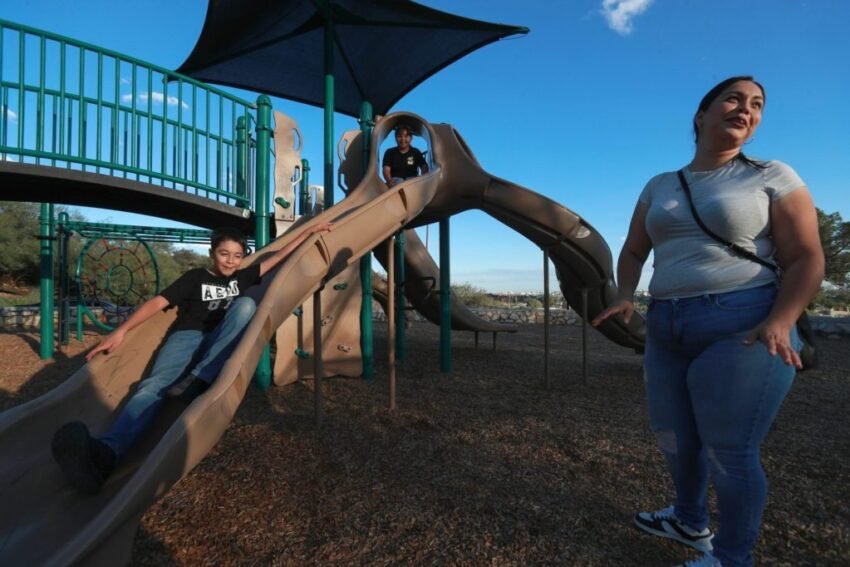

A sense of frustration and bewilderment overcame Brenda Torres as she sat at Clendenin Elementary School for a parent-teacher conference last year, struggling to understand what her son Jesus’ teacher was saying.
“Dijo todo en inglés y no le entendí nada. Le pregunté si habla español y me dijo que no y me fui sin saber cómo va el niño,” Torres said about the meeting with the El Paso Independent School District teacher. “She said everything in English and I didn’t understand anything. I asked her if she spoke Spanish, and she said, ‘No,’ so I left without knowing how my son was doing.”
Torres is not the only parent who’s felt left in the dark about what’s going on in their child’s school because of the language they speak.
About a quarter of El Paso County residents report speaking English “less than very well,” according to 2024 U.S. Census Data. Over 65% of households within the county speak Spanish at home — a response about whether a person speaks a language other than English at home and does not necessarily mean they cannot speak English.
Spanish-speaking parents of EPISD students who spoke to El Paso Matters said they have faced language barriers when seeking information from their child’s school or teacher, and at school activities and meetings such as open houses, award ceremonies, and parent meetings.
Over the spring, some of these parents, their children and local activists took to EPISD school board meetings to share the issues they have experienced and plead for improved access to translation services.
EPISD “has a history of pushing out families who don’t speak English,” parent and community activist Diana Ramirez told El Paso Matters in late September — pointing to a cheating scheme where the district held back ninth-grade students with limited English proficiency to artificially boost test scores and past lawsuits that alleged discrimination against non-English-speaking, Hispanic and Mexican-American families.
“Some of these campuses have a culture of intimidation, and they look down upon parents who don’t speak English,” Ramirez said. “People have been bullied and made fun of for speaking Spanish. I think it’s just something that we’ve had to deal with on the border that is still alive and well today.”
“It’s certainly not being encouraged by the new administration, but we do have the responsibility to change the culture,” she added.
Ramirez works with the Amanecer People’s Project, a grassroots organization that has advocated for new air conditioners and improved translation services at EPISD schools. She is also part of the district’s Communication Advisory Group, which was formed in July, in the translation and interpretation subcommittee — tasked with providing feedback on how to improve communication.
Trustee Alex Cuellar — who has worked with members of Amanecer — acknowledged that the district hasn’t always provided adequate support to, or gotten high levels of participation from parents who don’t speak English, but said he wants to focus on correcting the issue rather than dwelling on past mistakes.
“We would love to go into the past and and fix the wrongs. I think anybody would want to do that. But in terms of going forward from here, right now the issue is front and center,” Cuellar said. “Let’s fix it. It’s not going to be perfect from the get-go, but we’re giving it the attention that it deserves.”
An equity audit conducted by EPISD in 2025 found that language access was a significant barrier for some families, and that the district offered translation inconsistently, particularly in the classroom and at events.
Since then, EPISD has embarked on an initiative to improve communication and engagement with families who don’t speak English, which included launching a webpage where parents can request a translator for meetings with teachers, counselors, and other school employees.
Cuellar said the district is also developing a policy outlining how to communicate with and support families who don’t speak English when they have questions or concerns.
“The whole goal behind this is to make sure that we are getting as much parent involvement and student involvement,” Cuellar said. “If they feel comfortable, you’re going to have that much more involvement in extracurriculars, and you’re just going to have parents that feel good about taking their kids to EPISD schools.”
Parent engagement, the process of parents and school staff working together to support students, has been linked to higher academic achievement and a reduction in unhealthy behaviors, such as drug use, in adolescents, according to the Centers for Disease Control and Prevention. But research has found that language barriers can make it difficult for parents to participate in their child’s school.
In 2019, Spanish-speaking parents nationwide participated in 23% fewer school events, attended 14% fewer general school meetings and volunteered half as many times compared to their English-speaking counterparts, data collected by the U.S. Department of Education.
Under Title VI of the Civil Rights Act of 1964 public schools have to ensure all students have equal access to learning even if they or their families don’t speak English, although the statute does not explicitly mention language.
Last year, the U.S. Department of Education under the Trump administration rescinded a 2015 letter providing guidance on how schools can best serve English learner students and parents with limited proficiency in the language. The guidance said schools must communicate information about any programs, services, or activities to parents in a language they can understand and must respond to any requests from parents for interpretation services.
Although the letter guiding schools on how to comply with federal anti-discrimination laws has been axed, the law remains unchanged.
Schools must offer interpretation services during Admission, Review and Dismissal — or ARD meetings — where parents, teachers and campus staff can discuss accommodations for a student with disabilities. They must also provide a document, known as an Individualized Education Program, or IEP, which outlines those accommodations in a parent’s native language.
The El Paso, Socorro and Ysleta school districts — the three largest in the county — all provide the required translation services for ARD and school board meetings, district officials said. They have websites that can be translated into multiple languages and publish major announcements in English and Spanish. The El Paso and Ysleta school districts work with third-party vendors to provide interpretation and Socorro uses translation devices that can interpret speech. The districts also rely on bilingual employees — and in EPISD’s case, volunteers — to help with translation.
All three districts have an app where parents can get notifications about their child’s school in English and Spanish. EPISD’s app allows parents to directly message their child’s teacher, which can be translated into several languages, and SISD’s app has an interpretation tool that can translate conversations.
At EPISD, Chief Communications Officer Liza Rodriguez said the district has begun focusing on improving interpretation services at students’ individual schools.
“We can always do better, but at the district level, board meetings, large events, we’ve offered translation. Now, we’re really also trying to focus on the campus level,” Rodriguez said.
EPISD this year began using an AI program to translate its high school graduations and launched a bilingual help-desk hotline to answer questions or concerns.
Over the summer, the district also began offering an online form for families to request interpretation services at parent-teacher conferences and other meetings, Rodriguez said.
Prior to that, parents could request the services from their child’s teacher or principal.
Rodriguez noted that the form gives the district time to prepare for the meeting and find an interpreter that can address parents’ needs.
“If someone comes through our website asking for translation support, we need enough time to make sure we can provide that support, whether it’s through an outside vendor, or through one of our staff members,” Rdogriguez said.

Torres said she didn’t know the district offered interpretation services and has continued to face language barriers at school meetings now that Jesus attends Wiggs Middle School.
“‘English or Spanish?’” a teacher asked Torres as she entered her son’s classroom for a parent-teacher conference last month, though the teacher only spoke English.
Torres said they tried to communicate, but she eventually needed to call Ramirez to translate and get the information she needed about her son’s class.
In other cases, she’s had to turn to Jesus, or her daughter Maya, 9, who are both bilingual, to translate.
“Me gusta ayudar a mi mamá,” “I like helping my mom,” Jesus said as he sat on a swing at Memorial Park.
The shy student with an aptitude for math class nodded when asked if he would prefer to have an adult translate for his mom, but noted there aren’t many people who can at his school.
“No hay muchos que hablen español,” Jesus said while kicking his feet into a swing. “There aren’t many people who speak Spanish.”
Breaking barriers
Ramirez said EPISD still struggles to provide adequate translation services to Spanish-speaking families, making it difficult for some parents to engage with the district, but has been earnest about making improvements.
Ramirez said the online form parents can use to request an interpreter is a start, but noted many parents did not know about it in time for parent-teacher conferences in September and it may not be useful to those who need immediate help.
“The biggest feedback we had is that it takes time. If I get called now to go pick up my son because he’s sick and the nurse can’t communicate with me, a link on the website isn’t going to help me,” Ramirez said.
Bilingual education expert Joy Esquierdo said more work is needed on how schools can best engage with Spanish-speaking and multilingual families.
“There is definitely some solid research about the correlation between parental involvement and student success, where I think we sometimes miss the mark is: how do we do that?” said Esquierdo, who is the Vice Provost for Bilingual Integration at the University of Texas Rio Grande Valley.
Esquierdo said most existing research focuses on English-speaking families, which may miss insight from parents who want to participate in their child’s education but struggle to do so due to language barriers, or language differences, as she calls them.
She noted that schools need to build relationships with their communities to determine the best way to support families that speak languages other than English.
“There isn’t a one way fits all approach to this. Every community is unique, and it’s important for schools to know the families and have this conversation with the families,” Esquierdo said.
Esquierdo said AI translation tools and technology could help address language differences, but noted that school leaders should get input from the community on their use.
“We could be offering all kinds of apps, but if parents are not comfortable with clicking something, it may not be as helpful. So, as you communicate and develop this relationship, then you would have a better sense of what the community is actually going to use instead of the schools investing in something that may not be as successful as they may anticipate,” Esquierdo said.
Torres said she would be willing to try the district’s translation services, but wishes she knew about it sooner.
“Si se llenaron la forma, yo creo que ellos estarían preparados para podernos ayudar a las personas que no hablamos inglés,” Torres said. “If you fill out the form, I think they should be prepared to help people who don’t speak English.”
The post Lost in translation: EPISD aims to break language barriers, parents ask for improved interpretation appeared first on El Paso Matters.
Read: Read More