



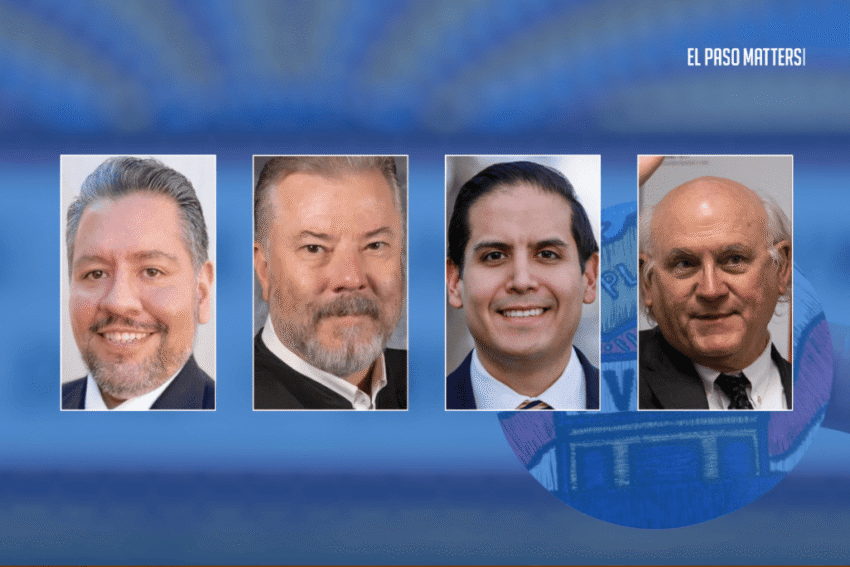

El Paso County voters will face a rarity when they look at their ballot for the Nov. 3 general election – two contested races for district court judge. The last time that happened was in 2008.
In the race for 120th District Court judge, appointed Republican incumbent Ben Ivey is being challenged by Democrat Chris Anchondo. For 168th District Court, Democrat Bernardo Cruz faces Republican R. Wayne Pritchard.
The judicial races feature candidates with varied legal experience – former prosecutors, an assistant county attorney, an intellectual property attorney and defense attorneys. The candidates say they prioritize fair and efficient processes to ensure that El Pasoans have access to justice.
- Election 2026 Voter Guide: Everything you need to know about the Nov. 3 general elections in El Paso
In seven other district court races – judgeships that wield immense power to affect people’s liberty and property – Democratic candidates are running unopposed.
In Texas, district judges are elected to four-year terms in partisan elections. Judges generally hear both civil and criminal cases, which is the case for the 120th and 168th district courts. The winner of the two contested races will each be paid $193,000 a year.
District judges hold some of the most consequential power over individual lives of any elected officials in Texas, but voters often focus on other elected offices as they prepare to cast ballots.
Early voting is Oct. 19-30, and Election Day is Tuesday, Nov. 3.
The candidates for the 120th and 168th district courts outlined their backgrounds, their experience and their philosophies in phone interviews with El Paso Matters.
120th District Court
The race features two experienced attorneys from prominent El Paso families.
Ivey, 52, was appointed to the bench in February 2025 by Gov. Greg Abbott. He succeeded Maria Salas-Mendoza, who was elected chief justice of the El Paso-based Eighth Court of Appeals in 2024. He was unopposed in the March Republican primary.
Anchondo, 45, defeated attorney Leonard “Lenny” Morales in the Democratic primary in March.
Ivey grew up in Tornillo, part of a family with deep roots in Lower Valley farming. He went to Cathedral High School and graduated from Texas A&M University with a degree in agricultural economics. He earned an MBA from Texas Tech before going on to law school at that university.
After graduation, he became a prosecutor in the El Paso District Attorney’s Office in 2001.
“I was there for about three years. They pretty much throw you to the fire. I was under Jaime Esparza. He just basically said, ‘You go try cases, figure it out, because there’s such a backlog.’ I didn’t really have much time for training, so that’s what I did,” Ivey said.
He was in private practice for 20 years before his judicial appointment, focusing on criminal cases while also handling family law and personal injury civil cases.
Ivey said he has always admired “judges that let the lawyers be lawyers.”
“You know, let them work the cases out. Some judges, without naming names, they kind of get involved in every little aspect, and I think it’s just unnecessary. And I think a lot of the lawyers feel that way,” he said.
Ivey said the “let lawyers by lawyers” approach has helped him run an efficient court, with past cases being cleared faster than new cases are filed.
He said his varied experience as a prosecutor, defense attorney and now judge make him the best choice for voters in the race.
“I pretty much have been practicing every part of the law, and I’ve been doing it for 25-plus years. So I think people should be rest assured that I know what I’m doing,” Ivey said.
Anchondo practices law with his father, Daniel Anchondo, a former El Paso County attorney and county court judge. His uncle, Robert Anchondo, is a county court judge.
He graduated from the University of Texas at El Paso and Penn State University law school, and has been licensed to practice law in Texas since 2008. Anchondo practices both criminal and civil law, and said he’s had more than 100 jury trials as a criminal defense lawyer.
Anchondo said a good judge needs to calmly preside over what is an inherently contentious process between attorneys advocating on behalf of their clients.
“I think temperament really plays a big role in that – to be level-headed, to be able to make those decisions without any type of partiality with regards to how their emotions are feeling,” he said.
His extensive trial experience has given him an understanding of how to run a courtroom, making him the best choice for voters in the 120th District Court race, Anchondo said.
“I have had more in-court trial experience, in both civil and criminal law, than than my opponent has. With regards to being able to put that experience into motion as far as being a judge,” he said.
Anchondo said he’s practiced in Ivey’s court, and believes he can run a more efficient docket to ensure that justice is timely. The appointed incumbent said he takes pride in the system he has put in place to handle his docket.
“I don’t believe that the way that the docket is being run is the most efficient way,” which adds costs for taxpayers and can frustrate people seeking justice, Anchondo said.
Ivey has received more than $75,000 in campaign contributions. His largest single donations were $2,500 each from El Paso businessmen Woody Hunt and Paul Malooly.
Anchondo has largely funded his campaign with more than $65,000 in personal loans and raised $19,000 in donations. He has received $2,500 contributions from attorneys David Leeper, Alejandro Acosta, James Tawney and James Scherr; as well as from real estate agent Elma Carreto and his mother, Martha Anchondo.
168th District Court
This race pits an assistant county attorney who played a significant role in several efforts challenging state and federal immigration policies against an attorney specializing in intellectual property law. Neither candidate has significant experience in criminal law, which makes up a large part of the court’s docket.
The incumbent judge, Marcos Lizarraga, chose to run instead for a county court seat, which he lost in the March Democratic primary.
Cruz, 39, won the Democratic nomination by defeating Enrique Holguin in the May Democratic runoff election.
He was born in El Paso and grew up in Ciudad Juárez, attending El Paso Catholic schools and graduating from UTEP. He worked as a banker before going to law school at the University of Seattle.
Cruz worked in public interest law on behalf of farmworkers in Washington state before returning to El Paso in 2018 as an attorney for the American Civil Liberties Union of Texas.
He has been an assistant county attorney since 2023, often leading the county’s efforts to challenge immigration and border enforcement policies laid out by Texas Gov. Greg Abbott and President Donald Trump.
Cruz said judges need to have strong values.
“Ultimately, the judge has to follow the law and apply its effects. But I think it’s also very incumbent on someone to make sure that they are there for the right reasons, to serve the public,” he said.
Cruz said voters should consider his experience in complex litigation as they pick a new judge for the 168th District Court.
“The bulk of my legal career has been looking at really complicated fact scenarios, really complicated legal issues, oftentimes very novel issues that really no one gives you a plan on how to deal with them and figuring out what the law says and how to apply the law. So, for me, I believe that has prepared me and made me the better candidate,” he said.
Pritchard, 69, was unopposed for the Republican nomination for the judgeship.
He grew up in an Air Force family that settled in San Antonio. He initially came to El Paso in 1975 to play football at UTEP, but transferred to Texas A&M because he wanted to study chemical engineering.
Pritchard worked as a chemical engineer for several years in Corpus Christi before attending St. Mary’s University School of Law in San Antonio. He served as a law clerk for patent attorneys in San Antonio before moving to El Paso. He worked for law firms in El Paso for several years, then for Wilsonart in Temple, Texas, before returning to El Paso as a solo practitioner.
He has specialized in intellectual property law, which deals with issues such as patents and copyrights. He also has handled product liability and employment law cases.
Pritchard said the best judges he’s practiced before work hard and give all parties a fair shot.
He cited his 40 years of legal experience as his primary advantage over Cruz, who graduated from law school 10 years ago.
“I think if I were a voter, what I would look at a lot is the fact that I have a lot more experience than he does, in a lot of different areas,” Pritchard said.
Cruz has received about $66,000 in donations to support his candidacy. His top donor is his mother, Maria Concepcion Cruz, at $9,500. Other major donors are engineer Jorge Saad, $7,000; hotel manager Karim Hagar, $5,000; engineer Diana Ramirez, $2,550; and equipment sales manager Luis Carlos Iglesias, $2,500.
The Democratic nominee also has loaned $26,000 to his campaign.
Pritchard has raised $7,300 for his campaign, including $2,500 each from property manager Aggie Choi and David Choi, whose occupation isn’t listed on campaign finance reports.
Why El Paso Republican judicial candidates are rare
Texas is one of 13 states that elect most or all judges in partisan elections, meaning candidates are listed on the ballot with a political party affiliation.
In six of the 11 election cycles since 2006, Republicans have not fielded any district judge candidates in El Paso County. The reason: the historic unlikelihood that a Republican can win such an election.
In the past 20 years, only seven of more than 100 district judge races have been contested by Republicans in the general election, and Democrats won each of the prior five contests by an average of 29 percentage points.
That history weighed on Ivey as people encouraged him to apply for the appointment for 120th District Court judge, and then run for a full term.
“I was like, ‘Man, this is going to be tough in a Democratic town, because odds are obviously stacked against me.’ There hasn’t been an elected Republican in 40-plus years, I think. And I kind of just did it out of a kind of civic duty,” he said.
Since 1900, only one Republican – Ward Koehler in 1982 – has been elected district judge in El Paso County. Republican Kathleen Cardone, now a federal judge in El Paso, came within 758 votes of Democrat Reed Leverton in 1996 for the 383rd District Court. No El Paso Republican has come close to winning a district judge race since.
Like Ivey, most of the Republican judicial candidates in El Paso over the past two decades were appointed by GOP governors to fill a vacancy created by the departure of an elected Democrat. Pritchard is only the second Republican district court candidate since 2006 to run without first being appointed to the bench.
Pritchard sees himself as fiscally conservative and liberal on social issues. He said Republican leaders approached him over the years about running for a judgeship, but he resisted.
“And so I would always tell them, ‘No, you convince me that a Republican in El Paso can win a citywide election, and maybe,” he said.
El Paso County Republican Chair Michael Aboud asked Pritchard again this year to run.
“And I thought about it. I said, ‘You know what? This will be a journey that I have not been on before, and it may not work out. But I think I’ll take this journey and see what happens.’ And it certainly has been an experience,” Pritchard said.
All four candidates in the two contested judicial races, Republican and Democrat alike, said their political affiliation wouldn’t shape their decisions on the bench. But all acknowledged the historic advantage of running as a Democrat in El Paso, as well as the advantage Republicans have in much of Texas.
“Our judicial races are kind of not fair like that because you have to run as a Republican or a Democrat, which for me running as a Republican most likely means I won’t win in El Paso,” Pritchard said.
Ivey acknowledged that the national political environment – an unpopular Republican president presiding over a sluggish economy – adds even more challenges for him.
“We’ve got the high gas prices going on. You know that the economy is not wonderful. There’s so many things that people could be taking out on any Republican candidate that can get a chance,” he said. “But I’m trying to just focus on the law.”
The post Meet the candidates for El Paso’s 120th and 168th district courts appeared first on El Paso Matters.
Read: Read More