



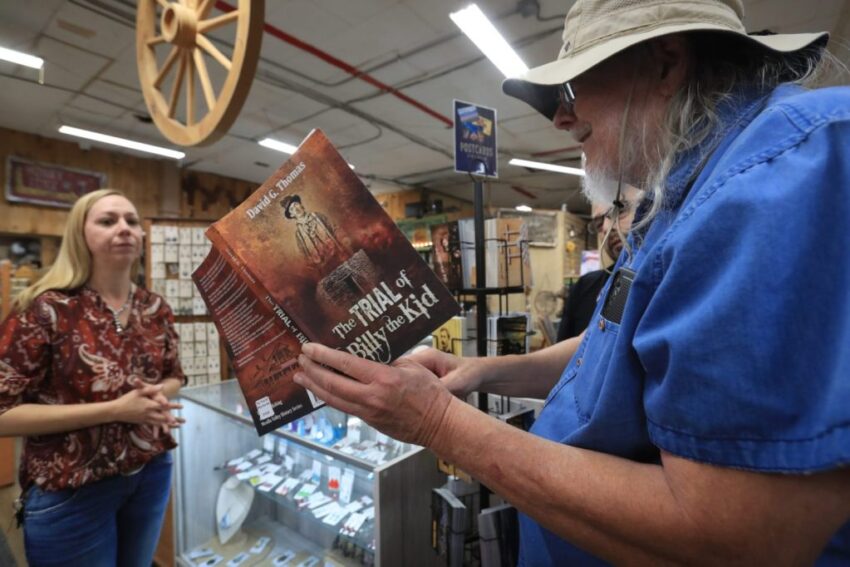

MESILLA — On the southeastern edge of Mesilla Plaza in southern New Mexico, where tourists drift between shops and restaurants in one of the Southwest’s most historic town squares, a quaint adobe storefront draws visitors with a familiar promise — Billy the Kid was here.
Inside, employees scoop ice cream and bag candied pecans just steps from where the notorious outlaw once stood trial. Historian and author David G. Thomas, who has spent years reconstructing the proceedings, says the spot where those treats are prepared today is likely where the judge sat on April 13, 1881 — presiding over the final day of the case that ended with Billy the Kid’s conviction for the April 1, 1878, murder of Lincoln County Sheriff William Brady.
“It happened here,” Thomas said, describing the space that has its original adobe walls, vigas and thatched ceiling. “We know where the judge was. We know where the jury sat. We can place it.”
For generations, that connection has drawn visitors from around the world to Mesilla, just four miles from Las Cruces, eager to step inside a place tied to one of the most enduring figures of the American West. But while the building, now known as the Billy the Kid Gift Shop, has long been part of Billy the Kid lore, the details of what happened there — and where, exactly, it happened — have often been less clearly understood.
Now, 145 years after the trial, which concluded with Billy the Kid being sentenced to death by hanging, Mesilla is making a more deliberate effort to define that history. A Frontier Fair is scheduled from 10 a.m. to 5 p.m. Saturday, April 11, in Mesilla Plaza along the 2300 block of Calle Principal. The event, coupled with the recent creation of a historic preservation position by the town of Mesilla, reflects a growing push to ground Billy the Kid’s story in documented research — even as films, television series and other portrayals continue to reshape his legend for new generations.
MORE EVENTS: Cellobration honors Zuill Bailey; Earth Day event brings music, food and family fun
The trial
Billy the Kid’s time in Mesilla was brief but consequential.
Born Henry McCarty and later known as William H. Bonney, Billy the Kid was brought south from Lincoln to stand trial beginning in March 1881, as territorial officials sought to bring closure to the violence of the Lincoln County War — a sprawling conflict that had left dozens dead and few held accountable.

On April 9, a jury found him guilty of murdering Sheriff Brady. Four days later, on April 13, Judge Warren Bristol sentenced him to hang.
Much of what is known about the trial today comes from research by Thomas, who has reconstructed the proceedings using surviving court records, census data and newspaper accounts. His book, “The Trial of Billy the Kid,” details the proceedings that took place in Mesilla. No official transcript of the trial exists because the case was never appealed, a common practice in the New Mexico Territory at the time.
That body of research may continue to grow. In 2025, New Mexico State University acquired the papers of Frederick Nolan, a historian whose decades of work on the Lincoln County War are considered among the most comprehensive on the subject. The collection includes notes, correspondence and source materials Nolan compiled over years of study.
Thomas said the case against Billy the Kid relied on limited direct evidence.
“So, no one could see anyone firing,” Thomas said of the ambush that killed Brady in Lincoln, New Mexico. “And no one ever testified they ever saw — I mean, even the previous accounts in newspapers, they never could say they saw anyone fire the guns.”
According to Thomas’ research, multiple gunmen were involved, and no witness could definitively identify who fired the fatal shot.
The jury was composed entirely of Hispanic men, many of whom, based on census records, could not read or write and did not speak English fluently. The proceedings were conducted in English with a translator, and, Thomas said, “the paper says the translation was poor.”

“Then, Judge Bristol provides about five pages of instructions to the jury,” he said. “These instructions have very complicated language and are only in English.”
Thomas argues those conditions significantly shaped the outcome of the case.
“(Bristol) convicted him with the instructions to the jury,” Thomas said.
Others frame the trial in the broader context of the territory’s effort to restore order after years of violence.
“Billy had become the most visible surviving figure associated with the (Lincoln County War),” said Josh Slatten, executive director of Billy the Kid’s Historical Coalition. “His conviction symbolized the government’s effort to finally close the chapter on the war and restore the rule of law in New Mexico Territory.”
The proceedings in Mesilla set in motion the final chapter of Billy the Kid’s life — his return to Lincoln, his escape from custody weeks later and, ultimately, his reported death at the hands of Sheriff Pat Garrett that summer in Fort Sumner, about 160 miles east of Albuquerque.
Myth, media and enduring legend
More than a century after his death, Billy the Kid remains as much a figure of interpretation as of history.
His life has been retold across generations, often with shifting emphasis — outlaw, antihero, victim, symbol of the frontier. The details of his story, including his origins and even aspects of his death, have been debated and reimagined for decades.

A television series, “Billy the Kid,” starring Tom Blyth as the outlaw and Eileen O’Higgins as his mother traced his early life and role in the Lincoln County War, portraying him as a young immigrant shaped by hardship and violence. The series concluded its run on MGM+ in 2025.
A new installment of the “Young Guns” franchise — which famously starred Emilio Estevez as Billy the Kid — is also in development, revisiting one of the most recognizable portrayals of the outlaw for modern audiences.
And the 2019 film “The Kid,” starring Ethan Hawke as Pat Garrett and Dane DeHaan as Billy, offered another interpretation, framing the story through the eyes of a young boy who encounters both men.
For historians, that constant reinvention can blur the line between documented fact and popular myth.
“It comes as little surprise that Hollywood continues to miss the mark when telling the story of Billy the Kid,” Slatten said. “While the main narrative … loosely follows elements of his life, the deviations from the historical record are frequent and, quite frankly, unnecessary.”
At the same time, Slatten said, those portrayals serve a purpose.
“Even when the history is flawed, anything that brings renewed attention to the story of Billy the Kid and the Lincoln County War can still serve a useful purpose,” he said. “It keeps the conversation alive, sparks curiosity, and ultimately benefits both historical awareness and tourism in the region.”
That tension — between storytelling and historical accuracy — is not new.
For Mesilla, that dynamic is especially relevant.
The town is not the central setting of Billy the Kid’s story, which is more closely tied to Lincoln and Fort Sumner. But it is the place where the legal system caught up with him — where the trial that helped define his legacy took place.
And today, it is one of the few places where that moment can still be experienced in a physical, tangible way.
Preservation and the Frontier Fair
For years, Mesilla’s connection to Billy the Kid has largely spoken for itself — a historic building on the plaza, a steady flow of visitors and a reputation tied to one of the most recognizable figures of the American West.

The building has been owned and operated by Charles Rogers since 2017, according to Doña Ana County records. Rogers took over the building from his father, who ran the gift shop since 1979. For nearly five decades, its association with Billy the Kid — and its place on Mesilla Plaza — has remained central to its identity.
Now, town officials are taking a more active role in shaping how that history is presented.
Liana Aguirre, who was hired in 2024 as Mesilla’s first historic preservation specialist, said part of her role has been to connect the town’s well-known past with a broader understanding of its history and identity.
“You would think there’s records, there’s information,” Aguirre said. “It’s slim pickings, I’ll be honest.”
That challenge is especially notable in a place like Mesilla Plaza, which has served as a focal point for major events in the region’s history.
The plaza was the site where the Gadsden Purchase was formally proclaimed, cementing the transfer of land that would shape the modern U.S.-Mexico border. Less than two decades later, it was also the setting of the Mesilla Riot of 1871, a deadly clash rooted in political tensions during the territorial period.
Aguirre said the goal is not to diminish Billy the Kid’s role in Mesilla’s story, but to place it within a larger historical narrative.
That approach is reflected in the town’s first Mesilla Frontier Fair, scheduled for April 11 in the plaza. The event will feature historical reenactments, demonstrations and exhibits from organizations across southern New Mexico, including Fort Stanton, Fort Selden and regional museums.
While Billy the Kid is part of the programming, Aguirre said the broader goal is to engage visitors with the full scope of the region’s history.
“We really wanted to incorporate a little bit of everything,” she said. “Just to get the town, the community, the region really thinking about our history and to have a sense of pride.”
The timing of the event is not incidental.

Aguirre said the anniversary of the trial offered an opportunity to build something new around a familiar narrative.
“Why not kind of make something of that and get people excited?” she said. “Embrace it.”
“We don’t want the stories to die. There’s other families here that are very much essential to the building of this town.”
Continuing to trace origins
Back inside the former courthouse on Mesilla Plaza, visitors continue to pass through the same space where Billy the Kid once faced judgment.
“I like explaining history to people,” said Crystal Blount, manager of the Billy the Kid Gift Shop. “It’s interesting for me to listen to people from all over the world. We step back in history. Billy was probably standing right here, you know what I mean? So, that’s kind of fun.”
That sense of place is something Mesilla can offer with a degree of certainty that is increasingly rare in the story of Billy the Kid.

Across the state line in San Elizario, Texas, for example, a long-told story holds that Billy the Kid once broke a friend out of jail — a tale that has endured despite limited historical backing.
The earliest known reference to Segura appears in the late-19th-century account by Pat Garrett in his book “The Authentic Life of Billy the Kid,” whose writings have shaped much of the historical narrative around the outlaw. But beyond that mention, historians have found little contemporaneous documentation to confirm that Billy was ever in San Elizario.
The story gained wider attention decades later, appearing in a 1950s nationally syndicated comic strip, “Laredo Crockett,” created by Bob Schoenke. In one storyline, Billy the Kid is depicted alongside Segura — a portrayal that helped introduce the tale to a broader audience.
From there, the account began to surface more prominently in El Paso-area newspapers and local lore, taking on a life of its own.
Maria del Pilar Muñoz, former director of the Los Portales Museum in San Elizario, said that while the story remains part of San Elizario’s oral history, efforts to verify it through primary sources have come up short.
“I was unable to find any type of documentation that showed that … as far as the fact that he was here,” Muñoz said.
In Mesilla, by contrast, the outline of what happened is clearer — even if the details are still being filled in.
Mesilla Frontier Fair
The Mesilla Frontier Fair will bring a day of historical reenactments, cultural programming and family-friendly activities to Mesilla Plaza. The event will include performances, interactive booths, costume and salsa contests, and a reenactment of “The Ballad of Billy the Kid,” along with a talk on the 1871 Mesilla Riot.
- When: 10 a.m.-5 p.m. Saturday, April 11
- Where: Mesilla Plaza, Calle Principal, Las Cruces, New Mexico
- Cost: Free`
- Information: mesillanm.gov
The post Mesilla revisits Billy the Kid trial 145 years later appeared first on El Paso Matters.
Read: Read More