



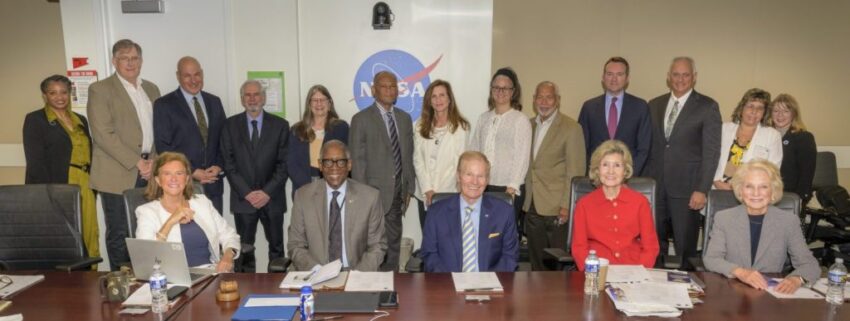

As the four-person crew of Artemis II arrived at Cape Canaveral on March 27 to prepare for the launch of its historic lunar mission, the administrator of NASA quietly removed the members of a key panel that had advised the agency for almost 50 years.
One of those removed from the NASA Advisory Council was Danny Olivas, a retired astronaut from El Paso who played a role in investigating the safety of the Artemis II heat shield that would allow the capsule to return through Earth’s atmosphere.

“At this time, the structure of Federal Advisory Committees at NASA is being adjusted, and your role will conclude at this time,” NASA Administrator Jared Isaacman’s letter to Olivas said.
Olivas said he wasn’t surprised, because Isaacman had indicated before becoming NASA administrator in December 2025 that he planned to eliminate many of the advisory groups of outside experts who have provided feedback to NASA for decades.
“But I also think that there’s a level of ignorance or arrogance that is part and parcel for those that are outside of NASA in trying to understand what the various organizations do,” said Olivas, who joined NASA in 1998 and is a veteran of two space shuttle missions that included more than 35 hours of space walks, known officially as extra vehicular activity.
His concern is shared by a number of former astronauts interviewed by El Paso Matters, including several who rose to the top leadership ranks of NASA. In addition to the apparent dismantling of much of the outside advisory system long used by NASA to shape policies and processes for space missions, the agency also has cut 20% of its work force since Donald Trump returned to the presidency in 2025.
Although NASA didn’t publicly acknowledge changes in the advisory council known as the NAC, it appears all 14 members were removed in March and no replacements have been named.
“My understanding is that all members of the NAC and the NAC subcommittees received ‘thank you’ letters from Administrator Isaacman, indicating that our role is ending. I was the chair of the NAC Science Committee and all members of my committee also received a letter,” said Amanda Hendrix, the senior scientist at the Planetary Science Institute in Tucson.
NASA officials provided a statement to El Paso Matters that appears to be the agency’s first public comment on its plans for the NASA Advisory Committee. Committee members are not paid for their service.
“The NASA Advisory Council is a discretionary committee that reports directly to the NASA administrator. The NAC has an active charter in place through September 2027. The composition of the NAC and the topics it addresses are within the authority and discretion of the administrator. Future membership is under discussion,” the statement said.
Two former NASA administrators, who also are veterans of spaceflights and served on the NAC, expressed deep concerns about Isaacman’s approach.
Isaacman, a billionaire entrepreneur with close ties to Elon Musk, whose company SpaceX is one of NASA’s largest contract recipients, was initially nominated to head NASA in late 2024. The nomination was withdrawn in May 2025 when Musk and Trump feuded. The nomination was resubmitted in late 2025 and Isaacman was confirmed by the Senate in December.

Charles Bolden Jr., a retired Marine Corps major general who was the pilot of two space shuttle missions and the commander of two others, was NASA’s administrator during the Obama administration, from 2009 to 2017. He said the changes at NASA are part of a broader pattern in the Trump administration.
“What he (Isaacman) risks is falling into the trap that the rest of the administration has, which is eschewing science and depending on ‘I alone can fix it’ or ‘I alone know what’s best,’ and you’re going to miss some of the best advice that you could get,” Bolden said in an interview with El Paso Matters.
If NASA is eliminating or diminishing the NASA Advisory Council, “this is a grave mistake, because outside consultation and advice is one of the best things that NASA can do, particularly among people who have the country’s and NASA’s best interests at heart,” said Bill Nelson, the NASA administrator in the Biden administration from 2021 to 2025. Nelson flew aboard the space shuttle Columbia while serving as a U.S. senator from Florida in 1986.

Nelson said the NASA Advisory Council has a long history of being nonpartisan. Nelson said the NASA administrator in the first Trump administration, Jim Bridenstine, appointed him to the council in 2019 after he lost his Florida Senate seat. Nelson said he offered to appoint Bridenstine to the council when Biden made him NASA administrator, though Bridenstine declined the offer.
He said closing off avenues of information sharing creates increased risks for human space exploration.
“We are in a highly risky business, and when you’re not paying attention, then what’s going to happen is how we’ve lost 17 astronauts in the past,” Nelson said.
He was referring to the 1967 Apollo 1 fire that killed three astronauts on the launch pad, the explosion of the space shuttle Challenger in 1986 that took the lives of all seven astronauts less than three weeks after Nelson had returned from space, and the destruction of the space shuttle Columbia when its heat shield failed on reentry in 2003, claiming the lives of all seven crew members on board.
The three fatal disasters occurred “because the management was not listening to the engineers on the line and all, and in the case of the Columbia loss, they weren’t listening to the astronauts,” Nelson told El Paso Matters.
NASA officials didn’t respond to an El Paso Matters request for comment on the concerns raised by its two former administrators, Bolden and Nelson.
Susan Helms, a retired Air Force lieutenant general who chairs NASA’s Aerospace Safety Advisory Panel, said Isaacman has shown a commitment to safety issues in his tenure so far.

Helms – who logged more than 200 days in space across five missions between 1993 and 2001 – pointed to Isaacman’s assessment earlier this year of mistakes by NASA and Boeing in a 2024 test flight of the company’s Starliner spacecraft. That mission, which faced numerous problems, forced astronauts Butch Willmore and Suni Williams to spend nine months at the International Space Station while awaiting a safe return to Earth.
Her panel – the only NASA advisory body mandated by federal law – had noted that it was a major safety misstep that NASA did not classify the Starliner mission as a “Type A mishap,” NASA’s highest classification for a mission failure.
Nelson had not taken that step when he was administrator, but an independent report of the mission released by NASA earlier this year recommended that designation, and Isaacman approved that classification.
“Everything he said, our safety panel absolutely agreed with, and he was very transparent in a way that made a lot of people very uncomfortable,” she said. “But we would agree with Jared that you’ve got to own these mistakes in order to be better.”
Pamela Melroy, who was the deputy administrator for NASA under Nelson, said the Trump administration is on a path that could silence dissent. She is a retired Air Force colonel who piloted two space shuttle missions and commanded a third while serving as an astronaut.
“It’s very clear that this administration, if they have an advisory group, they want it to be filled with people who are going to be supportive of whatever the administration wants to do,” Melroy said.
“It does have a chilling effect if you are sending a message that you’re not interested in other opinions, and then eventually … with that message in place long enough, it filters down to the bottom levels, and people become afraid to speak out,” she said.
The use of outside advice
Before Trump assumed the presidency for a second term, NASA had 12 advisory committees. Many of those were consolidated or eliminated in 2025, and the agency now lists four such panels, including the NASA Advisory Council.
The changes at NASA are part of a broader effort to eliminate science advisory panels in the second Trump administration.
NASA says eight advisory panels were eliminated to comply with Trump’s executive order in February 2025 to reduce the federal bureaucracy, including federal advisory committees.
Two of the remaining NASA panels, the Advisory Council and the Applied Sciences Advisory Committee, do not appear to have met since Trump took office.
The charter for the ASAC, which allows it to operate, appears to have expired in 2025. The charter for the NASA Advisory Council was renewed for two years in September 2025 by Transportation Secretary Sean Duffy, who also was acting as NASA administrator at the time.
The other two panels, the Aerospace Safety and Advisory Panel and the International Space Station Advisory Committee, have met in 2025 and 2026. Duffy also renewed the charter for the space station panel for two years in September 2025.
Ginger Kerrick, a longtime former NASA employee originally from El Paso, is a member of the space station committee.
The charter for the Aerospace Safety and Advisory Panel, which is mandated by federal law and also has an advisory function to Congress, was renewed for two years in July 2025 by Brian Hughes, then NASA’s chief of staff.
The NASA Advisory Council website still lists the members who had been serving as of the end of the Biden administration in January 2025.
U.S. Rep. Zoe Lofgren of California, the ranking Democrat on the House Science, Space and Technology Committee, said the failure of the Trump administration to convene the NASA Advisory Council since taking office last year, and now apparently removing the members, “is inexcusable and potentially dangerous.”

“Extricating outside experts and turning away from advisory input reeks of an insular process that suppresses openness, questioning, and input on major programs, policy issues, and directions that the agency is taking. It harms our scientific integrity. I hope that Administrator Isaacman reconsiders this action and begins to employ the expert knowledge of this experienced council,” she said in a statement to El Paso Matters.
Advisory panels have played a valuable role in improving federal agencies, said Waleed Abdalati, until March a member of the NASA Advisory Council who is director of the Cooperative Institute for Research in Environmental Sciences, a joint institute of the National Oceanic and Atmospheric Administration and the University of Colorado.
“I would think any agency leader (or organizational leader, for that matter) would want such perspectives, because it helps in making informed decisions on matters of such national importance,” Abdalati said in an email to El Paso Matters. “There is also value of having agency leaders explain to an advisory board – that shares their interests in mission success – the bases for their actions and decisions. Doing so forces more thoughtful internal deliberation and draws from the benefits of external perspectives.”
Melroy said the NASA Advisory Council is an important tool for such a complex organization, especially in ensuring that critical information is being communicated effectively at all levels.

“The fact that they were bringing it up and they had concerns or they wanted to know more about it told me that we needed to talk about this more, and we needed to communicate about it better,” she said.
Bolden and Nelson – who both also served on the NASA Advisory Council – said the panel provided them with useful feedback when they served as NASA administrator.
“They were invaluable to me, to give me inside information from subject-matter experts that I didn’t have,” Bolden said.
Records show that the NASA Advisory Council generally met three to four times a year during the Obama administration, when Bolden was the NASA administrator.
From 2017 to 2019 during the Trump administration, the NAC met as a full committee two to three times a year. The panel did not meet in 2020 or 2021 during the height of the COVID-19 pandemic.
During the Biden administration, when Nelson was NASA administrator, the panel met twice in 2022, once in 2023 and twice in 2024.
Helms, the chair of NASA’s Aerospace Safety Advisory Panel, said the advisory committee meetings require a significant commitment of time by NASA staff.
“I’m aware that for the ASAP and other advisory boards that there is a significant investment of time by the NASA staff and leadership to support the meetings. The NASA leadership spends a notable amount of time with our panel in candid and detailed fact finding discussions all year long,” she said. “As the chair of the ASAP, I’m keenly incentivized to ensure that our panel provides a really valuable return on their time investment, in the form of insightful observations and recommendations on matters of risk and safety.”
In the weeks just before Isaacman removed the NASA Advisory Committee members, lawmakers were looking to expand the panel’s role.
The near-term future of spaceflight
Even in the wake of the Artemis II mission – when astronauts orbited the moon for the first time since 1972 – ambitious U.S. plans for missions to the moon and Mars are clouded with questions.
NASA’s Aerospace Safety Advisory Panel, led by Helms, warned in its most recent annual report that the original Artemis III – the foundation of future U.S. spaceflight with human crews – was simply not ready.
“Our fact finding this year has driven the ASAP to the conclusion that the Artemis III mission, as baselined, cannot be accomplished with appropriate margins of safety,” the panel said in its December 2025 report.
Since the report was released, Isaacman has announced changes to the Artemis campaign that could improve the overall risk profile.
Bolden worries that the Trump administration will disregard such warnings.
“You know, everything sounds good, but anytime you’re marching along to a schedule set by the president, you know, ‘We’re going to do this by the end of my term,’ that’s a recipe for disaster. Because space flight doesn’t work that way,” he said.

Olivas, the astronaut who grew up in El Paso and now lives in southern California, is an expert on root-cause determination with an emphasis on materials science and mechanical engineering. He was part of the investigation into why Columbia was lost on reentry in 2003, and served on a NASA independent review board that examined unexpected damage to the heat shield of Artemis I, an uncrewed orbital test flight in 2022.
He said the Trump administration’s decision to eliminate 20% of NASA’s personnel exacerbates the risks inherent in spaceflight.
“We’ve laid off a significant amount of our workforce. And with that workforce went institutional knowledge,” he said. “I’m very uneasy about the future safety at NASA.”
Bolden said the Trump administration “took the chainsaw” to NASA with the Musk-led Department of Governmental Efficiency, or DOGE, in early 2025.
“NASA is very, very thin now in experienced senior leadership,” he said, adding that Isaacman is now trying to rebuild that leadership. Bolden said sidelining the NASA Advisory Council cuts off an important channel of advice for the new administrator.
“I think the NAC would probably tell him that your intentions are great, and I know you’re a billionaire, but this is not a billionaire problem. This is a personnel problem, and billionaires generally don’t worry about people,” he said.
Bolden pointed to cuts at the Goddard Space Flight Center in Maryland as something that will challenge U.S. space efforts for decades.
“That’s the world’s pride and joy when it comes to Earth science. We have decimated Goddard and who knows how long it’s going to take us – we’re talking about generational recovery,” he said.
The post NASA quietly removes former El Paso astronaut and other advisers, alarming former agency leaders appeared first on El Paso Matters.
Read: Read More