



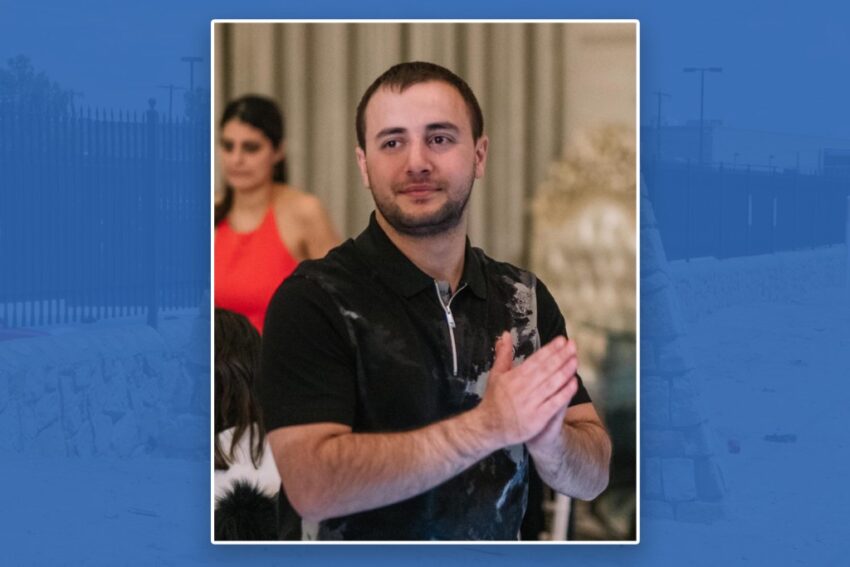

Argam Nazarian first came to the United States with his family as a child in 2008 – Iranian refugees escaping religious persecution. As Christians of Armenian descent, they faced mistreatment, imprisonment and even death in majority-Muslim Iran.
The family was forced back to Iran by his father, who converted to Islam, he said. Nazrian later unsuccessfully sought asylum in Russia, where he met and married his wife as a young adult. In 2021, he found himself back in the United States – crossing unlawfully from Mexico. Federal authorities allowed him to remain and work in the United States pending an immigration hearing.
He lived in Los Angeles for four years, working and supporting his family, before Immigrations and Customs Enforcement arrested him on his way to work last June – just after the United States conducted military strikes on three Iranian nuclear facilities.
He’s been in ICE detention since, held for months in El Paso before he was moved to the Cibola County Detention Center in New Mexico near Albuquerque on March 10. It’s unclear why he was transferred to the other facility.
In that time, Iran experienced growing economic distress and widespread anti-government protests before the United States, alongside Israel, began carrying out airstrikes against Iran on Feb. 28. The war disrupted ICE’s plans to deport dozens of Iranian nationals on specially arranged charter flights coordinated with the Iranian government, with a flight scheduled for late March called off because removal flights there have been “temporarily ceased” amid the war, Politico reported.
“I don’t have any place to go,” Nazarian, 27, told El Paso Matters by phone from the El Paso ICE Processing Center last month as the war in Iran intensified. “I just want to be where I can be free.”
The Texas Civil Rights Project is challenging Nazarian’s detention, claiming he’s being unlawfully detained without bond. The government has twice ordered Nazarian released because he presents neither a flight risk nor a danger to the community, court records show, including when he was released on his own recognizance after the entered the country without inspection. He has no criminal convictions on record.
His first habeas corpus petition – a lawsuit challenging the legality of his detention – was dismissed by U.S. District Judge Leon Schydlower of the Western District of Texas on March 23 after his transfer.
His attorneys filed an emergency petition for writ of habeas corpus in New Mexico on March 24. The case is assigned to U.S. District Judge Sara M. Davenport, who on March 26 gave the government until April 9 to respond as to why he should not be released. Davenport also ordered that Nazarian cannot be transferred out of the district while the case is pending.
He’s under an order of removal, but remains in active asylum proceedings.
Neither DHS nor ICE responded to requests for comment.
EL PASO ICE DETENTION CENTERS: Read El Paso Matters’ coverage of ICE detention centers in El Paso
Immigration detainees in Texas face harsher release restrictions than in New Mexico, largely because the Fifth Circuit Court of Appeals that covers Texas upheld mandatory detention without bond in February. New Mexico is under the 10th Circuit, which has previously ruled mandatory detention is illegal.
In a second victory for the federal government, the Eighth Circuit Court of Appeals last week overturned a lower court ruling that argued the practice of detention without bond is illegal, the Associated Press reported. That court covers Midwestern states, including Minnesota.
“Argam came to the U.S. to seek safety and seek freedom and he doesn’t understand why he’s behind bars,” said Charlotte Weiss, a staff attorney with the Beyond Border program under the Texas Civil Rights Project. She said Nazarian’s injured knee is in dire need of medical attention.
Coming to the United States
Nazarian first came to the United States as a refugee in 2008 when he was a child, brought over from Iran by his father and mother along with his younger brother – all escaping persecution, he said. His father, who had converted to Islam, forcefully took the family back to Iran in 2009, said Nazarian, who retained his Christian faith.

“The U.S. was colorful, beautiful,” he said. “I was crying not to go back to Iran. After we go over there, everything is black and white. There’s no color, no life.”
Looking to again escape Iran and seek asylum elsewhere, Nazarian left for Armenia, then Russia, where he met his wife, a native of that country.
He was denied asylum in Russia, so he and his wife went to Ukraine then to Mexico.
In August 2021, they entered the United States unlawfully through Arizona, where they were detained by immigration agents. They were released with a notice to appear in immigration court.
They settled in Los Angeles, living with his Nazarian’s brother and mother, and joined a close-knit community of Armenian Christians. Nazarian served as a caretaker for his mother, who has several chronic health conditions and an autoimmune disorder.
He filed an application for asylum in April 2025, which was denied. He filed an appeal, which remains pending.
Nazarian says he fears for his life if he were to be deported to Iran. Just as scary, he said, is losing his family, including his wife, who is living in Los Angeles and has a pending asylum claim.
“I’m going to lose my family if I get deported. I’ve lost everything else, working four years, legally, I paid taxes,” he said.
He worked as a delivery driver then in air conditioning, he said, helping support not just his wife but his mother in California. He hasn’t seen his father in 10 years, and isn’t sure about his whereabouts.
“I don’t want to lose my family, too.”
Time in detention
On the morning of June 23, 2025, Nazarian was walking to his car readying to go to work when he saw several individuals wearing hats and face coverings approach him. The individuals, Nazarian said, did not identify themselves as law enforcement or show any badges. He was placed in handcuffs and put into one of their vehicles.
He was transported to a federal building in Los Angeles, where he spent a handful of days before being put on a bus and sent to Arizona. From there, he was flown to El Paso.
In Los Angeles, he said, detainees were not provided clean clothes, blankets or showers. More than 80 people crowded into small holding spaces with very little water and food. Without any windows, he was unclear on time, not recalling exactly how many days he spent there, he said.

In El Paso, he spent about 14 days in the tent camp in Northeast, where he said he wasn’t allowed to shower for several days and wasn’t provided clean clothes.
Worst of all, he said, he wasn’t allowed to make phone calls.
He was sent to the processing center near El Paso International Airport.
More than a month after being detained, on Aug. 6, 2025, El Paso immigration Judge Michael S. Pleters ordered him released on bond, writing in his orders that Nazarian had proven “by a preponderance of the evidence that he does not pose either a danger to the community or a flight risk if released on bond.”
The federal government refused to release him, arguing in court that federal immigration law requires his detention without the possibility of release because he entered the U.S. without inspection. Therefore, the government argued, he is classified as an “applicant for admission” – a category it says must be held in custody during removal proceedings, even if an immigration judge finds he is not a flight risk or a danger and orders him released on bond.
Habeas corpus challenge detention
Nazarian’s habeas corpus petition in the Western District of Texas, which stretches from El Paso to Austin, was among the more than 1,000 filed in that district by immigrants detained by ICE since last summer.
LEARN MORE: El Paso, West Texas federal courts deluged with challenges to immigration detention
The majority of the petitions argue that the detainee has been unlawfully denied their right to seek a bond to get released from immigration detention.
Four federal judges in El Paso are handling the petitions, with an El Paso Matters analysis showing that three of them generally give the government a short window to respond to a show cause order – demonstrating why the petitioner should continue to be detained.
The fourth judge – Schydlower, appointed in 2024 by President Joe Biden – gives the government more time to respond and takes a much slower approach to his case load, the analysis shows. He has granted few if any habeas corpus petitions to detained immigrants, while his El Paso colleagues have granted petitions in the majority of cases they’ve handled.

Much of the backlog of petitions in Texas comes from a Board of Immigration Appeals ruling in September deciding that any person who crossed the border unlawfully and is later taken into immigration detention is no longer eligible for release on bond – reversing a longstanding precedent.
Nazarian’s attorneys argue that the government is misapplying the law, and that because he has been living in the United States for years while pursuing his asylum case, he should be held under a different statute that allows release on bond. His continued detention, despite a judge finding he’s not a flight risk or danger, is unlawful and unconstitutional, they argued.
Nazarian’s knee has worsened, with doctors who examined him at the El Paso Processing Center noting the injury has resulted in ACL “destruction with recurrent knee dislocation and bleeding at the joint,” according to court documents.
Finding a new home
For Nazarian, the United States represented more than opportunity.
“I didn’t come for a job, but for safety,” he said.
The persecution of Christians in Iran has surged in intensity and brutality in recent years, according to a 2025 report by the Center for Human Rights in Iran.
Prior to 2025, the United States didn’t regularly deport migrants to Iran, primarily due to a lack of diplomatic relations. But a significant shift in policy began in late 2025 under the Trump administration, with the United States executing at least three deportation flights to Tehran, the capital city of Iran, since then, according to the Human Rights First ICE flight tracker. More than 400 Iranians are in ICE custody.
The United States has carried out strikes against more than 11,000 targets since the war in Iran started earlier this year, with some 2,000 deaths reported and millions of Iranians displaced. At least 13 U.S. military service members have been killed in the war.
Nazarian said he’s not the same man he saw in the mirror nine months ago.
And it’s not just that he’s lost weight or that the lines on his young face are more defined or that he walks with a bit of a limp because of an injured knee that has gone without treatment, he said.
“Absolutely I’m a different person,” Nazarian said, adding that the ordeal is taking a toll on his physical and mental health. “I can’t trust anybody anymore.”
Nazarian said his advocates and attorneys give him hope – however distant it may seem.
“If I didn’t have people like Charlotte (Weiss) and my lawyers, I would do suicide,” he said.
Weiss, the attorney, said she notes the desperation in Nazarian’s face and voice deepening every time she talks with him.
“Especially with what’s happening in Iran now, he clearly cannot go back given the violence in that region,” Weiss said. “He can’t live in Armenia, either. This is the end of the road. This is his last chance to pursue safety and freedom.”
The post ‘No place to go’: Iranian asylum seeker detained in El Paso, New Mexico for months despite release orders appeared first on El Paso Matters.
Read: Read More