




By John Martin
In 2022, El Paso faced a convergence of challenges unlike anything our community had experienced in recent memory. Homelessness was increasing. The impacts of COVID-19 continued to strain public systems. Shelters, hospitals, outreach teams, law enforcement agencies and service providers were all experiencing growing pressure while trying to meet the needs of some of our community’s most vulnerable residents.

What emerged from those challenges was a recognition that homelessness could no longer be addressed through fragmented efforts and isolated services. If we were going to make meaningful progress, we needed a coordinated system built around the needs of the people we serve.
Through the city of El Paso’s El Paso Helps Initiative, community providers, healthcare systems, local government agencies, philanthropy, behavioral health organizations, housing providers, outreach teams, and other stakeholders came together around a shared belief that homelessness could not be solved by any one organization acting alone.
The initiative grew from the collective work that occurred during the COVID-19 response, when providers and public agencies recognized the value of greater coordination and stronger partnerships. Rather than operating independently, partners worked together to build a system capable of connecting people in crisis more effectively to shelter, housing, healthcare, behavioral health services and other community resources.
The result was the creation of the Welcome Center.
In many ways, the Welcome Center became the operational expression of the El Paso Helps Initiative — a place where the community’s commitment to collaboration could be translated into action every day.
The Welcome Center was designed as a stabilization and triage center — a coordinated entry point where individuals experiencing homelessness could enter through one door and gain access to a network of services. Whether someone needed emergency shelter, housing assistance, medical care, behavioral health services, transportation, family reunification, substance use treatment or simply help navigating a complicated system, the Welcome Center was built to provide a single point of entry.
Before the Welcome Center, individuals often moved from provider to provider, repeating their story while attempting to navigate a fragmented service network. Many became discouraged and disengaged. Others cycled repeatedly through emergency rooms, shelters, outreach contacts and public safety encounters without finding a clear path toward stability.
The Welcome Center model is founded on one simple principle: coordination.
Amistad Outreach focuses on engagement and trust-building with individuals living unsheltered. United Way of El Paso County provides coordinated referrals and system connections to prevent homelessness. Housing providers focus on placements. Medical and behavioral health partners address healthcare and treatment needs. The Welcome Center serves as the hub that brings those efforts together through assessment, triage, diversion, navigation and placement services.
Perhaps the greatest measure of the Welcome Center’s success is that it has become the coordinating hub for a communitywide response to homelessness. Through the Welcome Center, individuals have been connected to more than 40 partner organizations and programs, including emergency shelters, transitional housing facilities, Veteran-specific housing programs, permanent housing providers, hospitals, behavioral health organizations, substance-use treatment providers and other community resources.
Rather than requiring individuals in crisis to navigate a fragmented network of services on their own, the Welcome Center serves as the front door to a coordinated system of care that improves access, reduces duplication and helps people move more quickly toward stability.
One area where that coordination has been especially important is serving homeless veterans.
Since its inception, the Welcome Center has assisted 306 homeless veterans. Many face unique challenges, including service-related disabilities, behavioral health concerns, housing instability, employment barriers, and the complexities of navigating veteran benefit systems.
To ensure veterans remain connected to the services and support they have earned, the Opportunity Center established a dedicated pathway to veteran-specific programs, including the Veterans Transitional Living Center and the Magoffin Veterans Shelter, which together provide approximately 40 beds for homeless veterans.
Because demand frequently exceeds available capacity within veteran-specific housing programs, the Welcome Center serves as a bridge to placement. Rather than allowing veterans to disengage while opportunities become available, the Welcome Center provides ongoing case management, benefits navigation, healthcare access, behavioral health support, meals, shelter and coordination with veteran service providers.
Since opening, the Welcome Center has recorded more than 3,800 service registrations, representing local individuals seeking assistance through the program. These figures reflect services provided to our local homeless population and do not include individuals served through separate humanitarian response efforts. Through those engagements, the Welcome Center facilitated 2,716 documented interventions, resulting in 1,825 successful outcomes, a success rate of more than 67%.
Those outcomes included emergency shelter placements, transitional housing placements, housing and family reunifications, referrals to community resources and travel assistance. Behind every one of those numbers is a story — a person who found shelter, a veteran who secured housing, an individual who connected to treatment or a family that found stability.

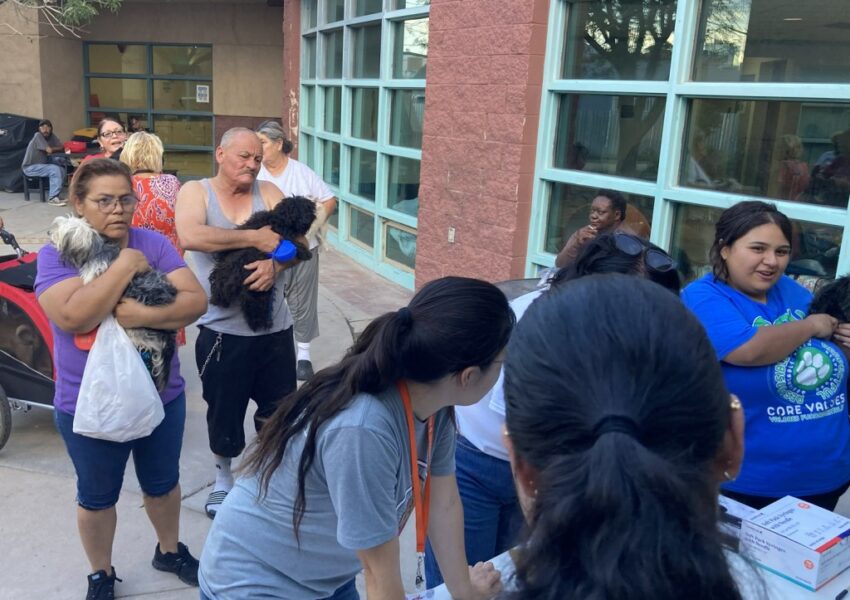
In July 2025, the Welcome Center served as one of the lead partners for a coordinated outreach surge with the U.S. Department of Veterans Affairs and numerous community organizations. Approximately 300 individuals experiencing homelessness were engaged, more than 40 individuals accepted services, and more than 30 companion animals received veterinary care.
In April 2026, the Welcome Center helped support the HEARTS Initiative, resulting in 147 engagements involving 110 unique individuals and directly leading to 34 shelter placements while also providing medical assistance and support through Animal Services.
These efforts demonstrate an important reality: some individuals will never walk through a service provider’s front door. Sometimes the system must go to them. The Welcome Center has become the operational hub that makes these coordinated responses possible.
The Welcome Center has also fundamentally changed how public safety responds to homelessness.
Historically, law enforcement officers often encountered the same individuals repeatedly with few options beyond another call for service. Today, that process looks very different.
Since 2025, more than 170 individuals have been transported by law enforcement to Opportunity Center facilities, with the vast majority arriving directly at the Welcome Center.
The Welcome Center established a dedicated 24-hour drop-off location for first responders, creating a direct pathway from street encounter to service engagement. Instead of a call ending with limited options, officers now have access to a coordinated system that can provide meals, showers, medical support, case management, shelter navigation, transportation assistance and follow-up services.
Today, the Welcome Center serves as a true 24/7 community resource, offering immediate access to services, navigation, medical support, transportation assistance, shelter connections, animal services and coordinated referrals. It is one of the few places in our community where public safety personnel, outreach teams, healthcare providers and individuals experiencing homelessness can all connect through a single coordinated system.
As discussions continue regarding the future of the Welcome Center, it is important to recognize what is truly at stake.
Sustainable long-term funding should absolutely be pursued. But preserving a successful system while developing permanent funding solutions is not an either-or proposition. Communities do both every day.
The greater risk is allowing a proven system to disappear while searching for a long-term solution.
Closing the Welcome Center would carry real costs. We would lose experienced staff who have developed expertise in coordinated entry, diversion, housing navigation, crisis stabilization and community outreach. We would risk losing partnerships that took years to establish. We would lose institutional knowledge and collaborative relationships built through the El Paso Helps Initiative.
Most importantly, we would lose an established community asset that would be far more difficult — and far more expensive — to rebuild later.
The reality is that homelessness and housing instability continue to exist in El Paso. Veterans continue to need specialized support. Families continue to face housing crises. Individuals continue to struggle with mental illness, substance use disorders, medical conditions and economic hardship.
The real question facing El Paso is whether we will preserve and sustain a coordinated-entry system that has demonstrated measurable results, strengthened community partnerships, improved public safety responses and connected thousands of people to shelter, housing, healthcare and hope.
The Welcome Center is the front door to El Paso’s homelessness response system. The question before us is whether we have the vision and commitment to keep that door open.
John Martin is deputy director of the Opportunity Center for the Homeless.
The post Opinion: Closing El Paso’s Welcome Center would weaken the city’s coordinated response to homelessness appeared first on El Paso Matters.
Read: Read More