




By Nicole Alderete-Ferrini
This week, Max Grossman – a man who’s been a stain on local government and politics for more than a decade – was charged with family violence.
For some, it was a shock. For many women in this city, it was confirmation.

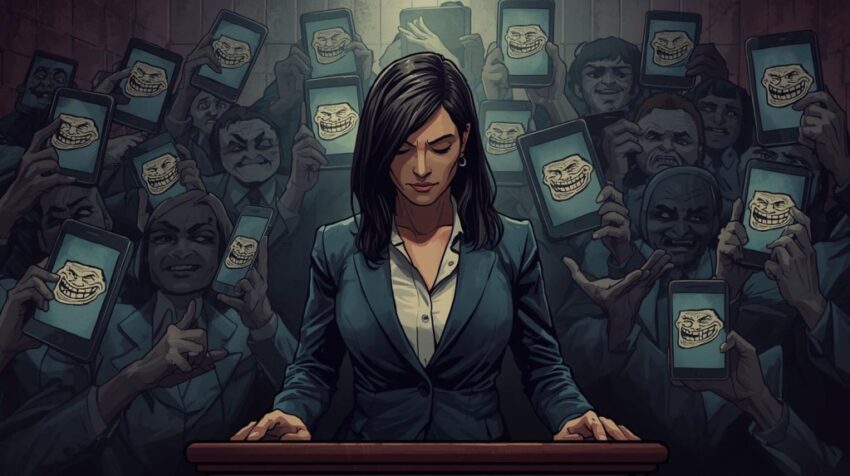
I know, because I am one of them. For years, this man built influence by attacking women who dared to lead, to speak, to take up public space. I’ve lived through his assaults. Not physical ones, but the kind that grind you down in the public square: smear campaigns, harassment, the calculated effort to discredit and humiliate. It is violence all the same.
I refuse to center him in this story, nor will I mention his name again. For years, he has thrived on recognition, even when it came in the form of outrage. This is not his story. It’s ours, the women he has tried to break, and the community that excused it.
I have never feared accountability. Public service demands it. But his attacks were never about accountability, they were about obliteration. Not critique, but character assassination. Not debate, but destruction.
And every time, the community shrugged.
“Welcome to the club.”
“Don’t take it sooo personally.”
“Let it roll off your shoulders, this is what it means to be in public service.”
But violence doesn’t roll off. It leaves a mark. And when we excuse it in public life, we create the very conditions for private violence to thrive.
This arrest is not an isolated event. It is the inevitable outcome of a culture that protects bullies while dismissing the people they target. It is what happens when we treat cruelty as personality instead of pathology. It is what happens when Latina leaders, specifically, are expected to endure character assassination as if it’s part of the job description.
It isn’t.
Already, I see the familiar script unfolding. His defenders rush to call the arrest “hysterical,” “ridiculous,” “false.” They “pray” for him as though he were the victim, not the man accused. They wring their hands that he was arrested before every piece of evidence was weighed, as if he himself has not spent years acting as judge, jury and executioner against women based on far less.
This is what abuse looks like when it metastasizes into culture: a man who harms, and a chorus ready to protect him while blaming the people he’s broken.
Let’s be clear: violence doesn’t start with a raised fist. It starts with the steady erosion of credibility, the constant chorus that her voice is too loud, her decisions too bold, her presence too threatening. That erosion is a form of violence. And when left unchecked, it escalates.
So, yes, this arrest matters. Not because it reveals something new about one man’s character, but because it exposes something old and corrosive about our own. About a community that laughed, looked away, or chose not to intervene. About a culture where women are told to toughen up instead of men being told to stop.
I’d be lying if I said I wasn’t afraid to write this. I know the price of speaking out against him. I’ve paid it before. The backlash, the harassment, the cult-like rage – none of it is hypothetical. But silence is its own violence. If I don’t use my voice, then who stands with the women he has already harmed? Who speaks for the ones he has yet to target? Fear may be real, but so is our responsibility to each other.
This is where we draw the line.
We can no longer dismiss toxic behavior in civic life as “just politics.” We can no longer tolerate leaders, commentators or self-appointed watchdogs who build influence by tearing people apart, though, let’s be honest, it’s most often women they target. Because when we normalize that violence, we condone it. And condoning is complicity.
This man’s arrest has finally shown the world what too many of us already knew. The question is not whether he will face consequences – he should, and the law will decide that. The question is whether El Paso will finally believe the women who sounded the alarm years ago.
What happened to me matters only because it has happened to so many. This is not a single story; it is a shared one. And if we don’t confront it together, it will happen again.
Will we shift the culture, so the next woman doesn’t have to endure it alone? Will we name this behavior for what it is: unacceptable, corrosive, dangerous?
This isn’t about vengeance. It’s about prevention. It’s about civic health. It’s about the safety of women, those in the public eye and those in their own homes and by extension, a safe civic space for us all. Violence and toxicity in civic life degrade the whole community.
El Paso deserves better than “that’s just the way it is.” We deserve leaders who build, not destroy. We deserve a culture that protects women, not predators.
The mask has slipped. The time is now. The question is whether we’ll finally refuse to look away, summoning the courage to build something better in its place.
Nicole Alderete-Ferrini is a lifelong El Pasoan, public strategist and former city executive working at the intersection of policy, design and equity.
The post Opinion: El Paso cannot keep excusing abuse of women in public life appeared first on El Paso Matters.
Read: Read More