



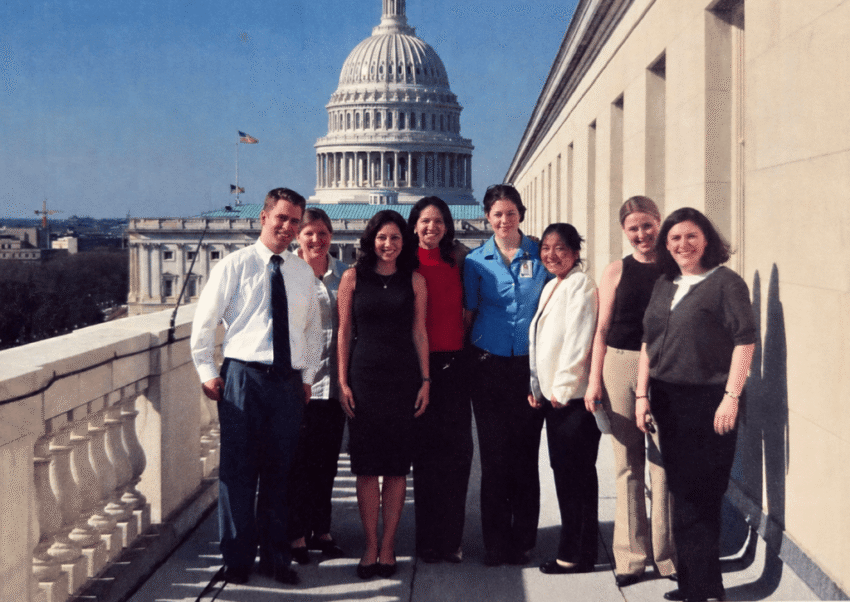

By Laura Rodriguez
Twenty-five years ago, on Sept. 11, 2001, I walked into my office on Capitol Hill a little after 9 a.m. I was 29 years old and the chief of staff to a member of Congress.

Our press secretary, Edith, pointed at the television. It normally showed C-SPAN. Instead, we were watching the World Trade Center towers burn.
I didn’t know another plane was headed toward Washington. I didn’t know the Pentagon would be struck minutes later. I didn’t know whether the Capitol was a target or what the next hour would bring.
I looked at my staff and said, “Call your mom. Tell her you’re safe. Then, go home.”
Minutes later, Capitol Police were running through the halls, banging on doors and telling us to evacuate. I don’t remember an emergency plan. It was simply: Get out.
There were no smartphones. No Uber. We had our BlackBerrys, CNN and the fear of not knowing what was coming next.
Hours later, I witnessed something extraordinary. Republicans and Democrats stood together on the steps of the Capitol and began singing “God Bless America”. Members of Congress held hands. There were tears in their eyes and fear on their faces.
Five weeks later, my friend Jen, our legislative director, called to tell me that anthrax had been found in the congressional mail system. It would eventually appear in offices of our building. Suddenly, opening the mail – one of the most ordinary acts in a congressional office – carried a new kind of fear. For a time, we worked out of a General Services Administration building because we were afraid to return to our office.
In those weeks, none of us quite knew what to do with ourselves. So we tried to be useful.
We gave blood. Across Washington, people waited for hours to donate, passing water and oranges to strangers in line. Restaurants brought food. People checked on their neighbors. The world rallied around the United States.
I saw what fear could produce: solidarity, generosity, public service. People looked for ways to help people they had never met.
But that isn’t my only memory of those weeks.
I was a newlywed on Sept. 11. Months earlier, I had been in Shiraz, Iran, celebrating my wedding and meeting my new family. After the attacks, Iranian American family members, and my Turkish, Syrian and Afghan friends, suddenly found themselves viewed differently.
Businesses were vandalized. There were slurs and suspicious looks on the Metro. Friends and family began asking questions they’d never needed to ask before: Is it safe to go there?
I learned something during those weeks that have stayed with me ever since: A frightened country can embrace its neighbors. It can also decide that some of its neighbors are the enemy.
Twenty-five years later, I recognize this fear.
I am writing this from a coffee shop in El Paso, eight miles from Camp East Montana, the country’s largest immigration detention center. Three people have died there since it opened last year. The ACLU of Texas and other civil rights organizations have documented cases of beatings, medical neglect, hunger and other inhumane conditions.
I hear fear in conversations much closer to home.
My trainer tells me attendance at his church is down because some families are afraid to leave their homes. His congregation has prayed for Lorenzo Salgado Araujo, a 52-year-old Mexican national shot by immigration officers in Houston this summer, and Johan Sebastián Durán Guerrero, a 25-year-old Colombian national who was shot and killed by an ICE agent in Maine a week later. Recent reporting has revealed that Durán Guerrero had a pending asylum claim and valid work authorization and was not the person agents initially sought. Parents worry about taking their children to school. Families weigh the need to live their lives – to go to work, church or the grocery store – against the fear of encountering immigration agents.
The circumstances of Sept. 11 and today are profoundly different.
But the fear is familiar.
And history has taught me to pay attention to what the government does when people are afraid.
I’ve spent most of my adult life working in and around government. I still believe in what good government and public policy can accomplish. I’ve seen it happen, step by unglamourous step.
Believing in government does not mean defending everything it does. It means demanding more from it.
Because government possesses enormous responsibility and power, we have an obligation to pay attention to how that power is used – and against whom.
Sept. 11 taught me that a crisis is also a question.
It asks government what it will do with its power. It asks leaders whom they will protect. And it asks the rest of whether fear will make our world smaller or bring us closer to our neighbors.
Twenty-five years later, I keep coming back to the simplest thing I said on a morning when none of us knew what was going to happen next:
Call your mom. Tell her you’re safe.
Then, look around and ask who else needs you.
We don’t always get to choose what makes us afraid. We do get to choose what we do with that fear.
Laura Rodriguez is founding principal and Texas market lead for Raben, a public affairs and organizational consulting firm, and a member of the ACLU of Texas Board of Directors.
The post Opinion: Sept. 11 taught me that fear can divide us — or bring us together appeared first on El Paso Matters.
Read: Read More